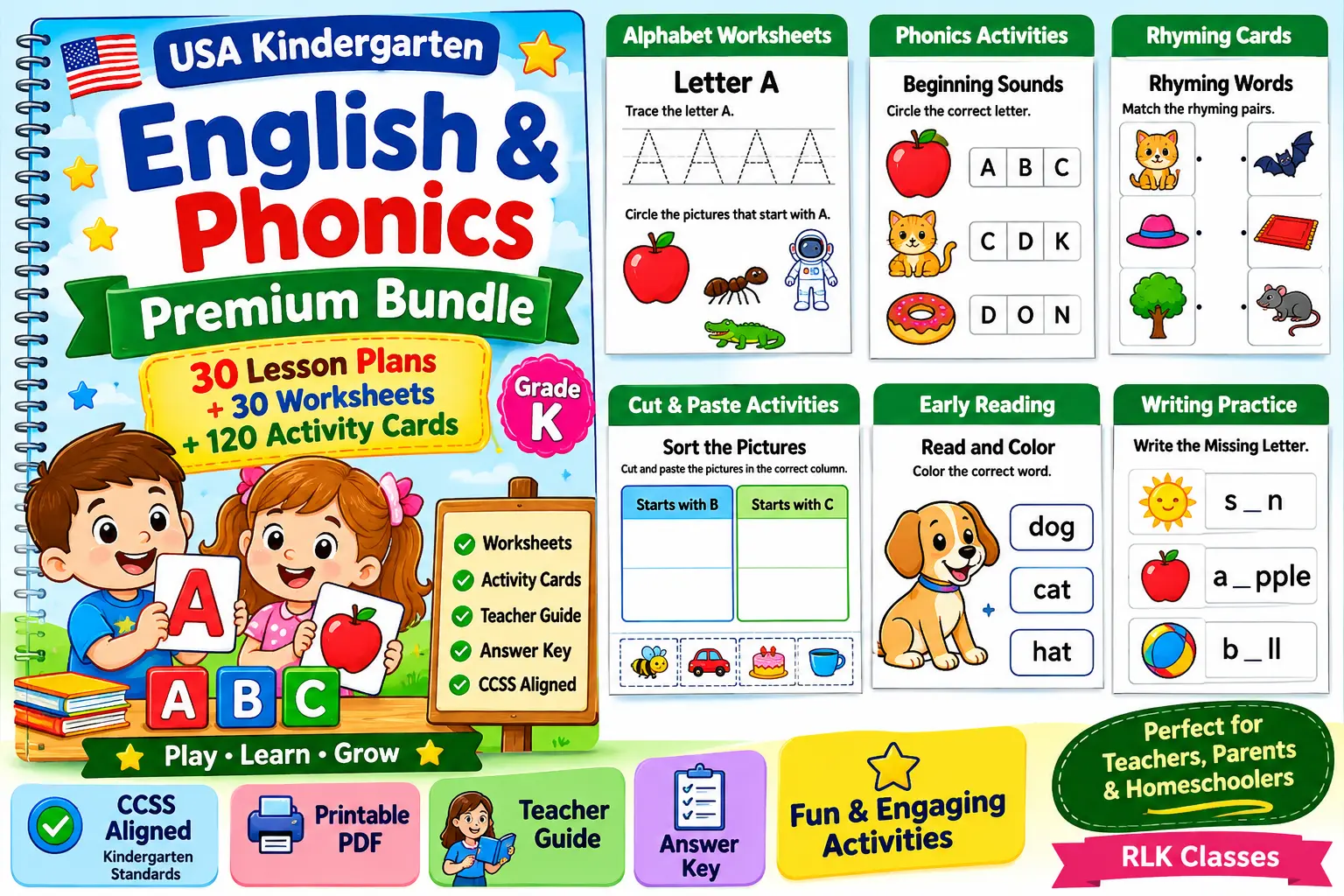
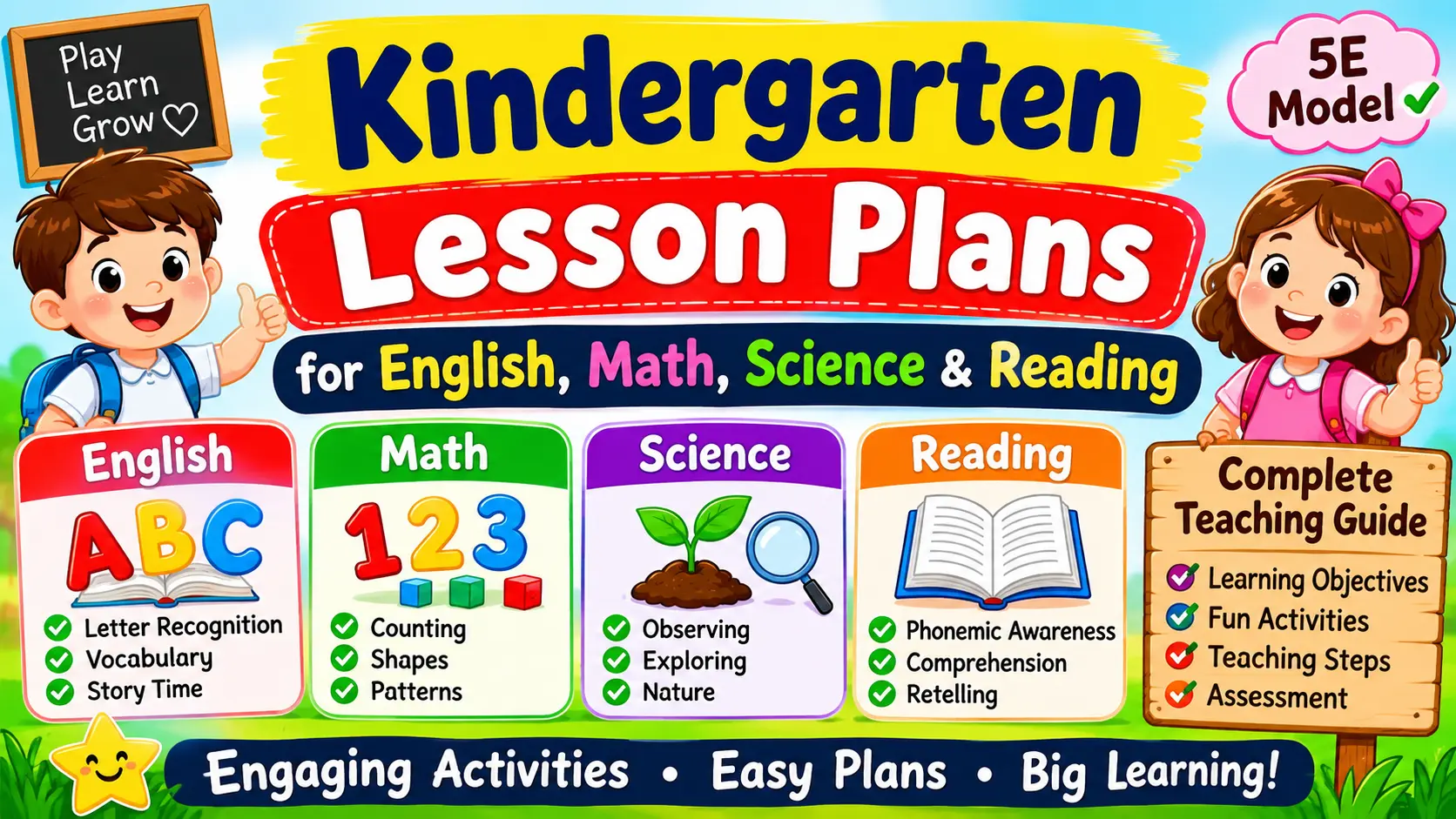
FREE Kindergarten Lesson Plans for English, Math, Science & Reading
Looking for engaging kindergarten lesson plans that make learning fun, meaningful, and easy to organize? Explore practical lesson ideas for English, phonics, math, science, reading, art, and social-emotional learning.
This collection includes learning objectives, materials, step-by-step teaching activities, hands-on practice, and simple assessments to help teachers and homeschool families plan engaging learning experiences.
Explore All Subjects ↓ View Sample LessonsWhat Are Kindergarten Lesson Plans?
kindergarten lesson plans are organized guides that help teachers introduce early academic concepts through stories, demonstrations, play, discussion, movement, and hands-on activities. They make it easier to set learning goals, prepare classroom materials, and check what children understand.
A well-designed kindergarten lesson plans typically includes a learning objective, required materials, an engaging introduction, teacher modeling, guided practice, independent or collaborative activity, and a short assessment. The activities should be appropriate for children’s developmental stages and allow different ways to participate.
Whether you are a classroom teacher, early childhood educator, substitute teacher, or homeschool parent, this guide brings together kindergarten lesson plan ideas for a variety of learning areas.
Kindergarten lesson plans by Subject
Explore lesson ideas by learning area. Each subject can include a collection of focused lessons, classroom activities, practice tasks, and printable resources. Choose the area that best matches your teaching goals.
English and Phonics
Introduce alphabet recognition, letter sounds, beginning sounds, rhyming words, vocabulary, and early writing through games and stories.
- Alphabet recognition A–Z
- Uppercase and lowercase letters
- Beginning sounds and phonics
- Letter tracing and vocabulary
Kindergarten Lesson Plans MATH
Build number sense with counting objects, comparing quantities, identifying shapes, sorting, patterns, and simple addition activities.
- Counting and number recognition
- Shapes and colors
- Sorting and patterns
- Comparing groups of objects
Kindergarten Lesson Plans Science
Encourage children to observe, ask questions, describe what they notice, and investigate the natural world using safe, simple activities.
- Living and nonliving things
- Plants and animals
- Weather and seasons
- Five senses and observation
Kindergarten Lesson Plans Reading
Develop listening comprehension, book awareness, vocabulary, story sequencing, print awareness, and early reading habits.
- Picture-book read-alouds
- Story sequencing
- Sight-word introduction
- Retelling and comprehension
Social Studies and SEL
Help children understand their classroom, family, community, feelings, friendships, routines, and responsibilities.
- Family and community helpers
- Classroom rules and routines
- Recognizing emotions
- Sharing and cooperation
Art, Music and Movement
Support creativity, coordination, listening, self-expression, and physical development with age-appropriate creative activities.
- Color mixing and drawing
- Clapping and rhythm patterns
- Movement games
- Cutting, pasting and crafts
Looking for a specific format? A lesson plan can be a short daily activity, a full classroom lesson, a multi-day unit, or a printable teaching template. Choose the format that fits your learning objective and available teaching time.
English, Alphabet and Phonics kindergarten lesson plans
Early English instruction can help children recognize letters, hear sounds, build vocabulary, and experiment with writing. Use songs, picture cards, manipulatives, read-alouds, and short practice sessions instead of relying entirely on worksheets.
Popular English kindergarten lesson plans Ideas
| Lesson Topic | Learning Goal | Activity Idea |
|---|---|---|
| Alphabet A–Z | Recognize selected letters | Letter hunt with cards |
| Beginning Sounds | Connect a sound to a word | Sort picture cards by initial sound |
| Rhyming Words | Notice words with similar ending sounds | Match simple rhyming pictures |
| Vocabulary | Name familiar objects | Describe classroom objects |
| Early Writing | Practice purposeful marks and letter formation | Trace, draw, and label |
Teaching Tips for Early Literacy
- Introduce a small number of letters or sounds at a time.
- Model the sound clearly and invite children to repeat it.
- Use pictures and familiar words to make new sounds meaningful.
- Allow children to respond orally, by pointing, drawing, or writing.
- Revisit previously taught skills through short daily routines.
Kindergarten Lesson Plans Math
Kindergarten mathematics should build number sense through counting, comparing, sorting, shapes, measurement language, and patterns. Children benefit from touching, moving, grouping, and discussing objects before moving to pictures and written number representations.
Important Math Topics
Numbers and Counting
Count classroom objects, match quantities to numerals, and practice one-to-one correspondence.
Shapes and Spatial Language
Identify circles, squares, triangles, and rectangles. Describe position using words such as above, below, and beside.
Patterns and Sorting
Sort objects by color, shape, or size and extend simple repeating patterns such as red-blue-red-blue.
Comparing Quantities
Compare two small groups using more, fewer, and the same number, with concrete objects.
Math Lesson Planning Tips
- Begin with a real-world question or a collection of objects.
- Demonstrate the skill using counters, blocks, shapes, or drawings.
- Invite children to solve a similar task with a partner.
- Offer a short independent activity at an appropriate level.
- Ask children to explain or demonstrate how they solved the problem.
Keep activities flexible. Some children may count a small set accurately, while others may need additional practice matching each spoken number to one object. Use observations to choose the next learning step.
See Math Lesson CollectionScience Kindergarten Lesson Plans
Science lessons encourage curiosity. Children can make observations, ask questions, compare objects, describe patterns, and share what they discover. The goal is to build early scientific thinking through simple, safe, guided investigations.
Popular Science Lesson Topics
| Topic | Learning Objective | Suggested Activity |
|---|---|---|
| Living and Nonliving Things | Describe observable differences | Sort pictures and explain choices |
| Plants | Identify basic plant parts | Observe a plant and draw what is seen |
| Animals | Compare animal features and needs | Group animal pictures by observable traits |
| Weather | Observe and describe daily weather | Complete a class weather chart |
| Five Senses | Explore how senses gather information | Describe safe, familiar objects |
| Pushes and Pulls | Notice how objects move | Move a toy gently across different surfaces |
How to Teach Science Through Exploration
- Ask: Begin with a question children can investigate.
- Observe: Give children time to look closely at an object or event.
- Explore: Let them compare, sort, draw, or test a simple idea.
- Discuss: Invite them to describe what they noticed.
- Reflect: Ask what they learned and what they would like to investigate next.
Kindergarten Reading and Writing Lesson Plans
Early reading instruction includes listening to stories, discussing illustrations, learning how books work, hearing sounds in words, recognizing familiar words, and developing the foundations of decoding. Writing can begin with drawings, marks, invented spelling, labels, and attempts at letter formation.
Reading Lesson Activities
- Picture Walk: Preview illustrations and predict what a story might be about.
- Read-Aloud: Pause at selected points to ask simple questions about characters and events.
- Story Sequencing: Put three picture cards in the order in which events occur.
- Retelling: Invite children to explain what happened using pictures or their own words.
- Print Awareness: Model the title, author, direction of print, and the relationship between spoken and written language.
Writing Lesson Activities
- Draw a picture and tell a sentence about it.
- Label a picture with a letter or a word the child knows.
- Practice writing a name with developmentally appropriate support.
- Dictate a sentence for the teacher to write and discuss.
- Share a drawing or piece of writing with a partner.
Kindergarten Art, Music and Movement Activities
Creative activities support expression, coordination, imagination, and opportunities to communicate ideas in different ways. They can also reinforce learning in math, science, language, and social-emotional development.
🎨 Color and Shape Art
Create a picture using basic shapes. Invite children to name shapes and describe the colors they selected.
🎵 Rhythm and Listening
Clap a short rhythm and invite children to repeat it or create a new pattern.
🤸 Movement Break
Practice safe movements such as stretching, balancing, marching, and stopping when a signal is given.
✂️ Fine-Motor Art
Use age-appropriate drawing, tearing, sticking, or supervised cutting activities to make a simple collage.
Provide alternatives when needed, such as larger materials, adapted tools, seated movement, or verbal descriptions. Focus on participation and creative process rather than producing identical finished work.
How to Create a kindergarten lesson plans
A clear planning template helps teachers prepare purposeful lessons without making the process unnecessarily complicated. Start with one achievable objective, select a suitable activity, and decide how you will recognize learning.
| Lesson Plan Component | What to Include |
|---|---|
| Lesson Title | The topic or skill being taught. |
| Learning Objective | What children should be able to demonstrate. |
| Materials | Books, cards, counters, art supplies, or other resources. |
| Introduction | A question, story, object, song, or demonstration to gain attention. |
| Modeling | A clear demonstration of the skill or task. |
| Guided Practice | A supported opportunity for children to try the skill. |
| Independent or Group Activity | A suitable task for children to apply their learning. |
| Assessment | Questions, observations, student work, or demonstrations of learning. |
| Adaptations | Additional support, accessible materials, and extension tasks. |
USA Kindergarten Lesson Plans
Four Complete Classroom Teaching Plans
English • Mathematics • Science • Reading
Early Childhood Education | Kindergarten Level
These lesson plans are designed for kindergarten learners using age-appropriate, hands-on, interactive, and developmentally suitable classroom activities. Teachers may adjust the vocabulary, materials, timing, and level of support according to student needs.
Kindergarten lesson plans 1: ENGLISH
Letter Recognition and Beginning Sounds
Specific Learning Objectives: By the end of the lesson, students will be able to:
- Identify the target letter from a small group of letters.
- Recognize the sound represented by the target letter.
- Connect familiar pictures and words to their beginning sounds.
- Practice forming the target letter.
Previous Knowledge
Students may already recognize some letters of the alphabet and may know familiar words such as apple, ball, cat, and dog.Teaching Materials
Letter cards, picture cards, alphabet chart, whiteboard, markers, paper, crayons, and a practice worksheet.Teaching Procedure
| Teaching Point / Time | Teacher’s Activity | Students’ Activity | Blackboard Work / Teaching Materials |
|---|---|---|---|
| 1. Warm-Up 3 Minutes |
The teacher greets the students and displays the target letter. The teacher asks: “Have you seen this letter before?” The teacher encourages students to say the letter’s name. | Students observe the letter, listen carefully, and try to identify or name it. | Display the target letter in large print. Materials: Letter card. |
| 2. Teacher Modeling 4 Minutes |
The teacher demonstrates the letter name and its beginning sound. The teacher slowly pronounces the sound and shows familiar picture examples, such as apple and ant for the letter A. The teacher models how to form the letter. | Students repeat the letter name and sound. They observe the pictures and imitate the teacher’s movements. | A a — /ă/ Apple, Ant Materials: Picture cards and whiteboard. |
| 3. Guided Practice 5 Minutes |
The teacher displays a mixture of picture cards. The teacher asks: “Which picture begins with the /ă/ sound?” The teacher provides hints and repeats the sound when needed. | Students select the matching pictures and explain their choices using simple words. | A — Apple A — Ant Materials: Picture cards. |
| 4. Independent Practice 5 Minutes |
The teacher distributes a practice sheet. The teacher asks students to circle pictures beginning with the target sound and practice writing the letter. The teacher observes individual progress. | Students circle matching pictures, trace the letter, and attempt to write it independently. | Trace and write: A a Materials: Worksheet and crayons. |
| 5. Review 3 Minutes |
The teacher reviews the letter and asks students to identify it from a few choices. The teacher invites volunteers to name another familiar word beginning with the same sound. | Students identify the letter and share a word or picture associated with its beginning sound. | A a — Apple Oral revision. |
Blackboard Summary
Beginning Sound: /ă/
Words: Apple, Ant
Activity: Identify, Say, Match, and Write.
Assessment Questions
- Can you point to the letter A?
- What sound does the letter A make in apple?
- Which picture begins with the /ă/ sound?
- Can you name a word that begins with A?
- Can you trace and write the letter A?
Differentiation
- Additional Support: Use fewer picture choices, repeat the sound, and provide visual cues.
- Extension: Invite confident learners to suggest additional words beginning with the target sound.
Home Connection
Ask students to find one object at home that begins with the target letter and share its name in class.Teacher’s Reflection
Did students identify the letter and connect it with its beginning sound? Which students need additional practice?Kindergarten lesson plans 2: MATHEMATICS
Counting Objects and Matching Numbers
Specific Learning Objectives: By the end of the lesson, students will be able to:
- Count a small group of objects in sequence.
- Use one number word for each object counted.
- Recognize numerals within their learning range.
- Match a group of objects to the correct numeral.
Previous Knowledge
Students may have experience counting everyday objects, such as toys, fingers, blocks, and classroom materials.Teaching Materials
Counters, colored blocks, number cards, small containers, counting mats, and paper.Teaching Procedure
| Teaching Point / Time | Teacher’s Activity | Students’ Activity | Blackboard Work / Teaching Materials |
|---|---|---|---|
| 1. Warm-Up 3 Minutes |
The teacher places a few objects on the table and counts them aloud while touching each object once. The teacher asks: “How many blocks can you see?” | Students watch, listen, and count the objects together. They may use their fingers to show the number. | 1, 2, 3, 4, 5 Materials: Blocks. |
| 2. Modeling 4 Minutes |
The teacher arranges five counters in a row and demonstrates how to count each object only once. The teacher explains that the last number tells how many objects are in the group. | Students observe the counting process and repeat the number sequence aloud. | ● ● ● ● ● = 5 Materials: Counters and number cards. |
| 3. Guided Practice 5 Minutes |
The teacher gives small groups of counters to pairs of students. The teacher asks them to move each counter as they count. The teacher checks whether students count each item once. | Students work in pairs, move the counters, and count aloud. They compare their answers with their partners. | Count each object once. Materials: Counters and counting mats. |
| 4. Number Matching 5 Minutes |
The teacher displays number cards and asks students to select the numeral matching their counted group. The teacher asks: “How did you know this was the correct number?” | Students select a number card, match it to their objects, and explain their counting. | ● ● ● = 3 ● ● ● ● = 4 Materials: Number cards. |
| 5. Review 3 Minutes |
The teacher displays a new small group of objects and invites students to demonstrate counting and identify the total. | Students count the objects independently or with support and identify the matching numeral. | Number and quantity matching. |
Blackboard Summary
Count each object one time.
1 object = 1
2 objects = 2
3 objects = 3
4 objects = 4
5 objects = 5
Assessment Questions
- How many objects are in this group?
- Can you count five objects aloud?
- Why should we touch each object only once while counting?
- Which number card matches this group of counters?
- Can you make a group of four objects?
Differentiation
- Additional Support: Begin with smaller groups, spread objects apart, and provide number cards with visual dots.
- Extension: Ask students to create their own groups, count larger sets within their current learning range, and explain their strategies.
Home Connection
Ask students to count five safe household objects with a family member, such as spoons, pencils, or toys.Teacher’s Reflection
Can students count one object at a time and match the total to a numeral? Which counting skills need further practice?Kindergarten lesson plans 3: SCIENCE
Observing and Describing Plants
Specific Learning Objectives: By the end of the lesson, students will be able to:
- Observe a plant carefully using their senses of sight.
- Identify visible parts such as leaves and stems.
- Describe at least one feature of a plant.
- Communicate an observation through speech or drawing.
Previous Knowledge
Students may have seen plants, trees, flowers, and grass in their homes, gardens, parks, or school surroundings.Teaching Materials
A safe, non-toxic plant, observation sheet, crayons, magnifying glass if available, and picture cards.Teaching Procedure
| Teaching Point / Time | Teacher’s Activity | Students’ Activity | Blackboard Work / Teaching Materials |
|---|---|---|---|
| 1. Engage 3 Minutes |
The teacher displays a safe plant and asks: “What do you notice about this plant?” The teacher encourages students to share their ideas without correcting every initial observation. | Students look at the plant and share what they notice about its color, shape, and size. | Topic: Plants Materials: Safe classroom plant. |
| 2. Observe 5 Minutes |
The teacher models careful observation of the leaves, stem, and other visible features. The teacher explains that plants should be observed gently without pulling or damaging them. | Students observe the plant closely. They point to visible parts and compare their shapes. | Visible Plant Parts: Leaves — Stem Materials: Plant and magnifying glass. |
| 3. Discussion 5 Minutes |
The teacher asks questions about the plant’s color, shape, texture, and visible parts. The teacher introduces simple vocabulary such as green, leaf, stem, and flower. | Students describe what they see using simple words and answer the teacher’s questions. | Words: Green, Leaf, Stem, Flower. Materials: Picture cards. |
| 4. Record Observations 7 Minutes |
The teacher distributes drawing sheets and asks students to draw the observed plant. The teacher supports students in labeling one visible feature. | Students draw the plant and label or describe at least one feature with appropriate support. | Draw a plant. Label: Leaf / Stem. Materials: Paper and crayons. |
| 5. Reflect 5 Minutes |
The teacher invites students to share one observation and one question they still have about plants. The teacher reviews the importance of caring for plants. | Students show their drawings, describe one plant feature, and ask or answer a simple question. | I notice… The leaf is… |
Blackboard Summary
A plant has visible parts.
Leaves — Stem — Flower (when present)
We observe plants carefully and take care of them.
Assessment Questions
- What is the color of the leaves you observed?
- Can you point to a leaf on the plant?
- Can you identify the stem?
- What is one feature you noticed about the plant?
- How can we take care of plants?
Differentiation
- Additional Support: Provide picture vocabulary, gestures, and sentence starters such as “I notice…” and “The leaf is…”.
- Extension: Invite students to compare two plants and describe one similarity and one difference.
Home Connection
Ask students to observe a plant at home or in a nearby garden with an adult and share one feature they noticed.Teacher’s Reflection
Were students able to observe and describe visible plant features? Did they communicate their ideas through speech or drawing?Kindergarten lesson plans 4: READING
Picture-Book Read-Aloud and Story Retelling
Specific Learning Objectives: By the end of the lesson, students will be able to:
- Listen attentively to an age-appropriate story.
- Identify a character or important event.
- Respond to simple questions about the story.
- Retell at least one event using pictures, words, or drawings.
Previous Knowledge
Students may have experience listening to stories at home, in school, or through picture books and classroom conversations.Teaching Materials
An age-appropriate picture book, three simple picture cards, drawing paper, crayons, and a story sequence chart.Teaching Procedure
| Teaching Point / Time | Teacher’s Activity | Students’ Activity | Blackboard Work / Teaching Materials |
|---|---|---|---|
| 1. Before Reading 3 Minutes |
The teacher shows the book cover and reads the title. The teacher asks students to look at the illustration and predict what the story might be about. | Students observe the cover, listen to the title, and share their predictions. | Book Title: As shown on the selected book. Materials: Picture book. |
| 2. Read Aloud 7 Minutes |
The teacher reads the story with expression and appropriate pacing. The teacher pauses to discuss illustrations, characters, and important events. | Students listen carefully, observe the pictures, and respond to simple questions during reading. | Key Words: Character — Story — Event Materials: Picture book. |
| 3. Discussion 4 Minutes |
The teacher asks: “Who is the story about?” “What happened in the story?” The teacher encourages students to use words and picture clues to support their answers. | Students identify a character or event and share their ideas with the class. | Who? What happened? Materials: Story illustrations. |
| 4. Retelling 5 Minutes |
The teacher provides three picture cards or drawing paper. The teacher models how to describe one important event from the story using simple sentences. | Students arrange picture cards or use drawings to retell one event from the story. | First — Next — Last Materials: Picture cards and drawing paper. |
| 5. Review 1 Minute |
The teacher invites a volunteer to share a favorite part of the story and briefly explains the importance of listening and sharing ideas. | Students share a favorite part or listen to a classmate. | My Favorite Part. |
Blackboard Summary
Character — Who is in the story?
Event — What happened?
Sequence — First, Next, Last.
Retell — Share an important part of the story.
Assessment Questions
- Who was the main character in the story?
- What happened in the story?
- Can you describe one important event?
- What was your favorite part of the story?
- Can you retell one part using a picture or sentence?
Differentiation
- Additional Support: Use picture prompts, gestures, oral responses, repetition, and home-language support where appropriate.
- Extension: Ask students to compare two characters, explain a prediction, or describe what might happen next.
Home Connection
Invite students to share the story with a family member and describe their favorite character or event.Teacher’s Reflection
Could students identify a character or event? Were they able to communicate an idea from the story through speech, pictures, or drawings?OVERALL LEARNING REVIEW
| Lesson | Subject | Key Learning Skill | Assessment Evidence |
|---|---|---|---|
| 1 | English | Letter and Beginning Sound Recognition | Letter identification and picture matching |
| 2 | Mathematics | Counting and Number Matching | One-to-one counting and numeral selection |
| 3 | Science | Observation and Description | Plant drawing and oral description |
| 4 | Reading | Listening and Story Retelling | Character identification and event retelling |
General Teacher Reflection
- Were the learning objectives achieved?
- Did students participate actively in the activities?
- Which students need additional support?
- Were the teaching materials appropriate for the age group?
- What changes would improve the next lesson?
Date: ______________________
Class / Section: ______________________
Simple Lesson Planning Checklist
- Choose one clear learning objective.
- Prepare and check all materials before the lesson.
- Plan a short, engaging introduction.
- Demonstrate the activity before children begin.
- Provide opportunities for movement, discussion, and hands-on learning.
- Plan how students with different needs can participate.
- Use a brief assessment to decide what to teach next.
Example Kindergarten Daily Learning Schedule
A daily schedule can provide predictability while allowing enough flexibility for children’s needs, transitions, outdoor play, and classroom routines. The example below is illustrative; actual schedules vary by school, program, and local requirements.
| Time Block | Learning Experience | Possible Focus |
|---|---|---|
| Arrival | Welcome and classroom routines | Social-emotional skills |
| Morning Meeting | Greeting, calendar or weather discussion | Speaking and listening |
| Literacy Block | Phonics, read-aloud, or writing | Early literacy |
| Math Block | Counting, shapes, or sorting | Number sense |
| Movement Break | Stretching, movement, or outdoor play | Physical development |
| Exploration | Science, art, or learning centers | Inquiry and creativity |
| Closing | Reflection and review | Communication and recall |
Use the schedule as a planning framework rather than a fixed timetable. Follow your school’s required instructional time, transitions, breaks, and student support arrangements.
Planning Kindergarten Lessons for US Classrooms
When creating kindergarten lesson plans for the United States, consider the learning expectations used by the school, district, or state. Many schools refer to state learning standards, and English language arts and mathematics instruction may use standards informed by the Common Core State Standards.
Science instruction may use state science standards or frameworks informed by the Next Generation Science Standards. The specific requirements and implementation vary by state and district, so teachers should verify the expectations that apply to their setting.
Practical Planning Considerations
- Use familiar US classroom vocabulary and age-appropriate examples.
- Include learning objectives that can be observed during a lesson.
- Provide opportunities to explain thinking, not just select answers.
- Use inclusive examples that reflect varied family and community experiences.
- Include accessible options for students with different language and learning needs.
- Check local standards before labeling a resource as standards-aligned.
Assessment and Differentiation in Kindergarten
Assessment in kindergarten can be informal and practical. Teachers can observe students during activities, listen to their explanations, review drawings, ask questions, and note which skills need more practice. Assessment should help guide instruction rather than interrupt learning.
Simple Ways to Check Learning
- Observation: Watch how students use materials or follow a process.
- Oral response: Ask students to explain or name something they learned.
- Student work: Review a drawing, sorting task, or short practice activity.
- Demonstration: Invite a student to show how a task is completed.
- Exit question: End with one brief question or reflection.
Supporting Different Learners
Students may differ in language development, attention, fine-motor skills, prior knowledge, and confidence. Effective lesson plans offer multiple ways to engage with content and demonstrate understanding.
- Break directions into small, manageable steps.
- Use pictures, gestures, objects, and teacher modeling.
- Allow oral, visual, physical, or written responses when appropriate.
- Offer additional guided practice for skills that are still developing.
- Provide meaningful extensions for students ready for more challenge.
Frequently Asked Questions About Kindergarten Lesson Plans
What are kindergarten lesson plans?
Kindergarten lesson plans organize learning objectives, teaching materials, activities, and assessment for young learners. They help teachers structure instruction in areas such as literacy, math, science, creative arts, and social-emotional learning.
Where can I find free kindergarten lesson plans?
You can explore educational websites, school and district resources, teacher resource platforms, and the subject-based lesson ideas on this page. Check the terms of use for any resource you download or adapt.
How do I write a kindergarten lesson plan?
Begin with one learning objective. Choose materials, prepare a short introduction, model the skill, provide guided and independent practice, and finish with a brief assessment. Adapt the plan to the needs of your students and the time available.
What subjects should kindergarten lesson plans include?
Common learning areas include English language arts, phonics, reading, writing, mathematics, science, social studies, art, music, physical development, and social-emotional learning. The exact curriculum varies by school and educational program.
How long should a kindergarten lesson be?
Lesson length depends on the objective, activity, and students. A focused teacher-led activity may take 10–20 minutes, while a learning center, project, or exploration block may take longer. Adjust the duration to maintain engagement and allow sufficient practice.
What is the difference between a lesson plan and a unit plan?
A lesson plan outlines one learning session or activity. A unit plan organizes multiple connected lessons around a broader topic, skill, or learning goal.
Can kindergarten lesson plans include worksheets?
Yes. Worksheets can reinforce skills such as letter recognition, counting, matching, and drawing. They work best alongside discussion, play, hands-on activities, and opportunities to explain thinking.
How can I adapt kindergarten lesson plans for different learners?
Adjust the amount of practice, provide visual supports, demonstrate tasks, use manipulatives, and offer different ways to respond. Students who need more support can practice smaller steps, while students who are ready can explore a more challenging version of the activity.
Plan Engaging Kindergarten Lessons with Confidence
Great kindergarten lesson plans give children opportunities to explore, talk, create, count, read, ask questions, and practice new skills. Begin with a clear objective, choose a meaningful activity, and use student responses to guide the next lesson.
Use this collection as a starting point for planning English, math, science, reading, and other early learning experiences. Adapt each lesson to your students, classroom routines, and curriculum expectations.
Explore All Lesson Plan Subjects ↑ Review the Lesson Plan TemplateEducational note: Lesson ideas are general examples for planning purposes. Teachers should adapt activities to children’s needs, local curriculum expectations, accessibility requirements, and school safety procedures.