Nutrition Lesson Plans for Elementary Students (K–5)
Teach children about healthy eating with engaging, activity-based nutrition lessons!
Are you looking for detailed Nutrition Lesson Plans for Kindergarten and elementary school students? This comprehensive teaching resource is designed to help teachers introduce food groups, balanced meals, essential nutrients, healthy eating habits, food safety, and nutrition awareness.
Inside this guide, Food Groups Lesson Plans. you will find complete Grade K–5 lesson plans, the 5E instructional model, step-by-step teacher activities, student participation tasks, classroom discussion questions, assessment strategies, and colorful printable worksheet activities.
Whether you are an elementary school teacher, homeschool educator, or health education instructor, these lessons will help make nutrition education practical, interactive, and enjoyable.
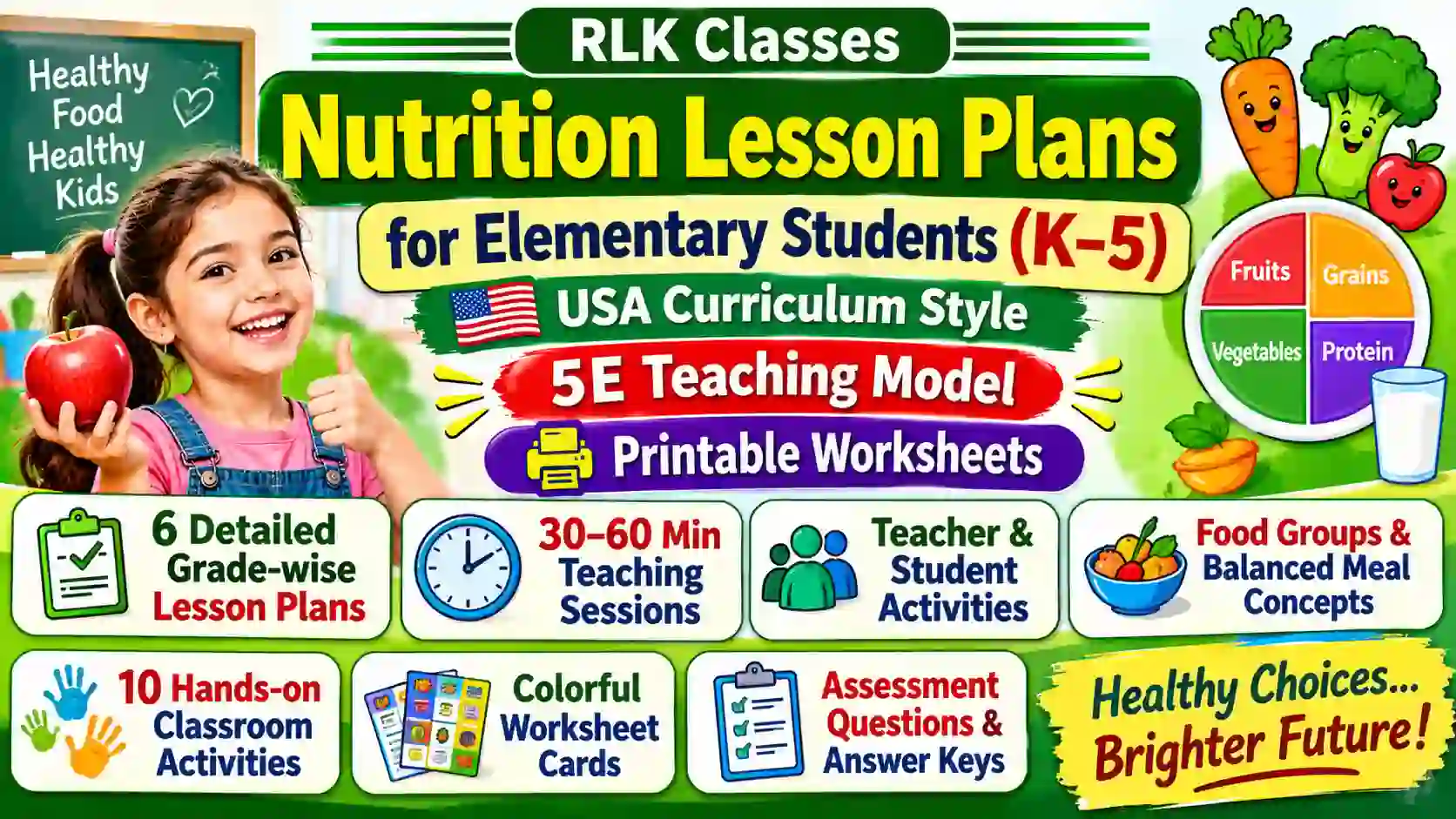
Kindergarten–Grade 5USA Curriculum Style5E Teaching ModelPrintable Worksheets
- 6 detailed grade-wise lesson plans
- 30–60 minute teaching sessions
- Teacher and student activities
- Food groups and balanced meal concepts
- 10 hands-on classroom activities
- Colorful worksheet cards
- Assessment questions and answer keys
- Why Teach Nutrition in Elementary School?
- Learning Objectives
- The Five Food Groups
- Detailed Grade-Wise Lesson Plans
- 5E Nutrition Lesson Plans
- Hands-On Nutrition Activities
- Printable Nutrition Worksheets
- Assessment and Answer Keys
- Weekly Teaching Schedule
- Free Teacher Resources
- Frequently Asked Questions
Why Teach Nutrition in Elementary School?
Elementary school is an important time for children to develop food awareness and learn basic concepts about nutrition. Nutrition lesson plans can help students understand how different foods contribute to growth, energy, and overall well-being.
Instead of simply memorizing food names, children should have opportunities to explore, compare, classify, discuss, and apply what they learn through practical classroom experiences.
Benefits of Nutrition Education
- Food Awareness: Students learn about different food groups and where food comes from.
- Healthy Habits: Children explore everyday habits such as drinking water and eating a variety of foods.
- Scientific Thinking: Students investigate food sources, plant parts, and nutrients.
- Critical Thinking: Older students practice reading food labels and comparing information.
- Social Learning: Group discussions and activities encourage teamwork and communication.
Nutrition Lesson Plans Learning Objectives
By the end of the elementary nutrition unit, students will be able to:
- Identify common fruits, vegetables, grains, protein foods, and dairy products.
- Describe the five food groups represented in the USDA MyPlate model.
- Explain why the body needs different types of nutrients.
- Recognize examples of carbohydrates, proteins, fats, vitamins, and minerals.
- Describe the importance of drinking water.
- Plan a meal containing a variety of foods.
- Identify basic information on a Nutrition Facts label.
- Recognize the importance of handwashing and food safety.
- Participate in group discussions and food-related learning activities.
- Apply nutrition concepts to everyday classroom examples.
Understanding the Five Food Groups
The USDA MyPlate model provides an easy visual way to introduce the five food groups to elementary students. Teachers can use food pictures, posters, sorting cards, and meal-planning activities to explain these groups.
| Food Group | Examples | Teaching Concept |
|---|---|---|
| Fruits | Apples, bananas, oranges, strawberries | Identify fruits and explore their colors and plant sources. |
| Vegetables | Carrots, broccoli, spinach, peas | Explore different vegetables and the parts of plants we eat. |
| Grains | Oatmeal, rice, bread, whole-wheat pasta | Discover foods made from grains. |
| Protein Foods | Beans, eggs, fish, chicken, nuts | Identify different animal and plant-based protein sources. |
| Dairy | Milk, yogurt, cheese, fortified soy milk | Explore dairy foods and appropriate fortified alternatives. |
Detailed Nutrition Lesson Plans by Grade (K–5)
The following lessons are organized by grade level. Each lesson includes instructional objectives, materials, preparation, teaching procedures, 5E learning phases, differentiation, and assessment.
Grade K35 MinutesBeginning LevelHealth Education
Topic: Exploring Different Kinds of Food
Essential Question: What kinds of food do we eat, and why does our body need food?
Learning Objectives
Students will be able to:
- Name at least three familiar foods.
- Identify common fruits and vegetables.
- Recognize that different foods belong to different groups.
- Explain in simple words why people need food.
Materials Required
- Colorful food picture cards
- Fruit and vegetable flashcards
- Food group poster
- Paper plates and crayons
- Chart paper and glue sticks
Detailed Teaching Procedure
Teacher Activity:
Display pictures of an apple, banana, carrot, bread, milk, and beans. Invite students to observe the pictures carefully.
Ask simple questions:
- What food can you recognize?
- Which of these foods have you seen at home?
- What is your favorite fruit?
- Where have you seen vegetables growing?
Student Activity: Students name familiar foods and share their experiences. The teacher encourages all responses without judging food preferences.
Teacher Activity:
Distribute a set of food picture cards to small groups. Ask students to observe the pictures and create their own categories. Do not introduce all the correct food group names immediately.
Encourage students to identify foods that look similar or grow in similar ways.
Student Activity:
- Sort the picture cards into groups.
- Discuss why they placed similar foods together.
- Share their groupings with classmates.
Teacher Activity:
Introduce the five food groups using a colorful poster. Explain each group using simple examples.
- Fruits: Apples, bananas, and oranges.
- Vegetables: Carrots, spinach, and broccoli.
- Grains: Bread, rice, and oatmeal.
- Protein foods: Eggs, beans, and chicken.
- Dairy: Milk, yogurt, and cheese.
Student Activity: Students repeat the food group names and identify examples from the poster.
Teacher Activity:
Give each student a blank paper plate. Ask students to draw or paste pictures of different foods on their plates.
Encourage them to include more than one food group. Ask students to describe the foods they selected.
Student Activity:
- Draw different foods on a paper plate.
- Identify the foods by name.
- Share their food plate with a partner.
Teacher Activity: Hold up food cards one at a time and ask students to identify each food.
Student Activity: Name the food, identify its group when possible, and explain one thing they learned.
Assessment Questions:
- Name two fruits.
- Which food group includes milk?
- Why do people need food?
Differentiation and Support
- Use large, clear pictures for visual learners.
- Allow students to point to pictures instead of writing answers.
- Provide food names and picture labels for emerging readers.
- Challenge advanced learners to identify foods from different food groups.
Students will identify familiar foods, recognize basic food groups, and create a simple food plate using pictures and drawings.
Grade 140 MinutesHealthy Habits
Topic: Healthy Eating Habits and Everyday Food Choices
Essential Question: How can we include different kinds of foods in our everyday meals?
Learning Objectives
- Identify different foods eaten at breakfast, lunch, and dinner.
- Recognize the importance of food variety.
- Describe why water is important for the body.
- Identify simple everyday food and hygiene habits.
Materials Required
- Breakfast, lunch, and dinner picture cards
- Food group poster
- Healthy meal chart
- Drawing sheets and colored pencils
- Water bottle picture cards
Detailed Teaching Procedure
Teacher Activity: Start a classroom conversation about the different meals students may eat throughout the day.
Ask:
- What foods might someone eat for breakfast?
- What foods can be part of lunch?
- Why do people eat at different times of the day?
- What do you like to drink when you are thirsty?
Student Activity: Students describe familiar meals and listen to their classmates’ examples.
Teacher Activity: Provide pictures of common breakfast, lunch, and dinner foods. Ask students to sort them into different meal categories.
Invite students to notice that the same food may be eaten at different times of the day.
Student Activity: Students organize pictures, compare choices, and explain their sorting decisions.
Teacher Activity: Explain that different foods provide different nutrients. Introduce food variety using simple examples.
- Fruits and vegetables provide vitamins, minerals, and fiber.
- Grains provide carbohydrates and other nutrients.
- Protein foods provide protein and other nutrients.
- Dairy foods and fortified alternatives can provide calcium and protein.
- Water helps the body function properly.
Explain that breakfast is one opportunity to include a variety of foods, but individual meal patterns differ among families.
Student Activity: Students identify foods from each group and explain how they might combine different foods in a meal.
Teacher Activity: Give students a breakfast planning worksheet. Ask them to draw a meal with a variety of foods.
Demonstrate one example without requiring everyone to create the same meal.
Student Activity:
- Draw at least three different foods.
- Label the foods.
- Identify the food groups represented.
- Explain their breakfast choices to a partner.
Ask students to complete these sentences:
- One fruit I can name is ______.
- Water is important because ______.
- I can include different foods in my ______.
Review responses to identify students who need additional support.
Differentiation
- Provide illustrated meal cards for students who need reading support.
- Allow oral explanations instead of written sentences.
- Ask advanced learners to create a full-day meal picture schedule.
Students will recognize everyday meal patterns, identify a variety of foods, and explain basic habits related to food and water.
Grade 245 MinutesFood Diversity
Topic: Fruits and Vegetables – Exploring the Rainbow
Essential Question: How many different fruits and vegetables can we identify, and where do they come from?
Learning Objectives
- Identify fruits and vegetables by their names and colors.
- Classify foods into fruit and vegetable categories.
- Describe where selected fruits and vegetables grow.
- Recognize that eating a variety of produce can contribute to a nutritious eating pattern.
Materials Required
- Fruit and vegetable flashcards
- Rainbow color chart
- Pictures of farms and gardens
- Chart paper and crayons
- Food sorting worksheet
Detailed Teaching Procedure
Teacher Activity: Show a covered basket or bag containing pictures of different fruits and vegetables. Reveal one picture at a time.
Ask:
- Can you identify this food?
- What color is it?
- Have you seen this food growing?
- Is it a fruit or a vegetable?
Student Activity: Observe the pictures, guess the food names, and explain their ideas.
Teacher Activity: Distribute food picture cards in different colors. Ask students to organize them into color groups.
Next, ask them to create a second classification using fruits and vegetables.
Student Activity:
- Sort foods into color categories.
- Sort the same foods into fruit and vegetable categories.
- Compare the two classification systems.
Teacher Activity: Introduce basic plant parts using diagrams.
- Roots: Carrots and radishes.
- Leaves: Spinach and lettuce.
- Stems: Celery.
- Flowers: Broccoli and cauliflower.
- Fruits: Apples, tomatoes, and peppers.
Explain that tomatoes and peppers are botanical fruits but are commonly used as vegetables in cooking.
Student Activity: Identify foods using the plant-part diagram and discuss where they grow.
Teacher Activity: Divide the class into small groups. Assign each group a color or a combination of colors.
Ask students to draw or paste pictures of fruits and vegetables on a poster.
Student Activity:
- Create a colorful food poster.
- Write the names of selected foods.
- Identify whether each is a fruit or vegetable.
- Present the poster to classmates.
Ask students to classify five food pictures and answer:
- Name one red fruit.
- Name one green vegetable.
- Which plant part do we eat when we eat a carrot?
- Where do apples grow?
Differentiation
- Use color-coded cards for visual learners.
- Provide word banks for students who need spelling support.
- Challenge advanced learners to identify roots, stems, leaves, flowers, and fruits.
Students will classify common fruits and vegetables, identify their colors, and explain how different edible plant parts are used as food.
Grade 350 MinutesBalanced Meals
Topic: Understanding Balanced Meals and MyPlate
Essential Question: How can different food groups come together to make a varied and balanced meal?
Learning Objectives
- Name the five MyPlate food groups.
- Recognize the different food groups in familiar meals.
- Explain the idea of food variety.
- Create a meal using different food groups.
- Describe the importance of including fruits and vegetables.
Materials Required
- MyPlate poster or diagram
- Food picture cards
- Paper plates
- Colored pencils
- Meal planning worksheet
- Food group labels
Detailed Teaching Procedure
Teacher Activity: Display two illustrated meal examples. One contains only a single type of food, while the other contains foods from several food groups.
Ask:
- What foods do you see in each picture?
- Which meal contains more variety?
- Can you identify the food groups?
- Why might food variety be important?
Student Activity: Observe, compare, and explain their opinions using evidence from the pictures.
Teacher Activity: Distribute food cards and a MyPlate diagram. Ask students to match each card with its corresponding food group.
Give students time to discuss their choices before reviewing the answers.
Student Activity:
- Match foods to the five food groups.
- Identify foods that may be used in different cultural meals.
- Discuss which food groups are represented in a sample lunch.
Teacher Activity: Explain the MyPlate visual as a guide to food group variety and proportions.
Introduce these concepts:
- Fruits and vegetables are important parts of a varied eating pattern.
- Grains include whole grains and refined grains.
- Protein foods include both plant and animal sources.
- Dairy and fortified alternatives can provide important nutrients.
- Different foods contribute different nutrients.
Use familiar meal examples to explain how different groups can be combined.
Student Activity: Identify the food groups represented in sample meals and explain what might be added to increase variety.
Teacher Activity: Give each student a blank plate template. Ask them to design a varied meal using the MyPlate food groups.
Encourage students to use different foods and explain their selections.
Student Activity:
- Draw a meal on the plate template.
- Label each food.
- Identify its food group.
- Write two sentences explaining their meal.
Ask students to present their meal to a partner.
Assessment questions:
- What are the five food groups?
- What does food variety mean?
- Which food groups are represented in your plate?
- Why is it useful to eat different kinds of foods?
Differentiation
- Provide a labeled MyPlate diagram for students needing additional support.
- Allow students to use food pictures instead of drawing.
- Challenge advanced learners to create two different meals from different cultural traditions.
Students will identify food groups, compare meal variety, and design a meal containing foods from multiple groups.
Grade 455 MinutesNutrients and Science
Topic: Nutrients and Their Functions
Essential Question: What nutrients are found in food, and how does the body use them?
Learning Objectives
- Define the term nutrient.
- Identify carbohydrates, proteins, fats, vitamins, and minerals.
- Explain basic functions of different nutrients.
- Identify examples of foods that contain different nutrients.
- Understand the importance of water.
Materials Required
- Nutrient information cards
- Food package pictures
- Food group chart
- Science notebook
- Matching worksheets
- Markers and chart paper
Detailed Teaching Procedure
Teacher Activity: Display pictures of bread, eggs, nuts, oranges, milk, and beans.
Ask:
- Do all foods contain the same nutrients?
- Why might our bodies need different kinds of nutrients?
- What do you think is found inside the foods we eat?
Student Activity: Students share their prior knowledge and make predictions.
Teacher Activity: Distribute food cards and nutrient information cards. Ask students to match foods with nutrients they commonly provide.
Use these examples:
- Bread and rice: Carbohydrates.
- Eggs and beans: Protein.
- Nuts and oils: Fats.
- Oranges and peppers: Vitamin C.
- Milk and fortified alternatives: Calcium.
Student Activity: Work in groups, compare food examples, and explain their matching decisions.
Teacher Activity: Explain the five major nutrient categories in age-appropriate language.
| Nutrient | Basic Function | Food Examples |
|---|---|---|
| Carbohydrates | Provide an important source of energy. | Rice, bread, oats |
| Proteins | Support growth and tissue repair. | Beans, eggs, fish |
| Fats | Provide energy and help absorb certain vitamins. | Nuts, seeds, oils |
| Vitamins | Help regulate many body processes. | Fruits and vegetables |
| Minerals | Support functions such as bone health and fluid balance. | Milk, beans, leafy greens |
Explain that many foods contain more than one nutrient. Water is also essential for normal body functions.
Student Activity: Record the nutrient groups and one food example for each.
Teacher Activity: Divide students into five teams. Assign one nutrient category to each group.
Ask students to prepare a chart showing the nutrient name, its basic function, and three food examples.
Student Activity:
- Research or review their assigned nutrient.
- Select suitable food examples.
- Prepare a visual chart.
- Present their findings to classmates.
Ask students to complete a short matching exercise.
- Which nutrient is an important energy source?
- Which nutrient supports growth and tissue repair?
- What is one function of fats?
- Name one mineral.
- Why is water important?
Differentiation
- Use illustrated nutrient cards for students needing additional support.
- Provide a partially completed chart as a scaffold.
- Challenge advanced learners to explain why a single food can contain multiple nutrients.
Students will identify major nutrient categories, describe basic functions, and connect common foods with the nutrients they provide.
Grade 560 MinutesFood Literacy
Topic: Reading Nutrition Facts Labels and Making Informed Food Choices
Essential Question: How can food labels help us understand the foods we buy and eat?
Learning Objectives
- Identify the main sections of a Nutrition Facts label.
- Explain serving size and servings per container.
- Locate calories, sodium, and added sugars.
- Understand the basic meaning of % Daily Value.
- Compare information from two sample food labels.
Materials Required
- Sample Nutrition Facts labels
- Empty food packages with labels
- Food comparison worksheet
- Highlighters and pencils
- Projector or classroom display
Detailed Teaching Procedure
Teacher Activity: Display two fictional food packages with different Nutrition Facts labels.
Ask:
- Have you seen these labels before?
- Where can we find nutrition information on a package?
- Why might someone read a food label?
- What information would you like to know about a food?
Student Activity: Observe the labels and share what they already know.
Teacher Activity: Give students sample labels and ask them to locate specific information without explaining every section first.
Students should identify:
- Serving size
- Servings per container
- Calories
- Total fat
- Sodium
- Total carbohydrates
- Added sugars
- Protein
Student Activity: Highlight each section and record their observations.
Teacher Activity: Explain the purpose of each important section.
- Serving Size: The amount of food used as the basis for the label information.
- Calories: A measure of the energy provided by a serving.
- Total Fat: The amount of fat in a serving.
- Sodium: The amount of sodium in a serving.
- Added Sugars: Sugars added during food processing or preparation.
- % Daily Value: Shows how much a nutrient in one serving contributes to a general daily reference amount.
Explain that serving size is not necessarily a recommendation for how much a person should eat.
Student Activity: Follow along with the sample label and answer teacher questions.
Teacher Activity: Provide two fictional food labels. Ask students to compare the serving sizes and nutrient information.
Use guiding questions:
- Do both packages have the same serving size?
- Which label lists more sodium per serving?
- Which label lists more added sugars per serving?
- Why is it important to compare serving sizes before comparing nutrients?
Student Activity: Complete a comparison chart and present their observations.
- What does serving size mean?
- Where can you find added sugars?
- What does % Daily Value tell us?
- Why should we compare serving sizes?
- Name two nutrients shown on a Nutrition Facts label.
Differentiation
- Provide enlarged labels with highlighted sections.
- Give students a word bank for unfamiliar vocabulary.
- Challenge advanced learners to calculate the total nutrients in two servings of a sample food.
Students will locate important information on a Nutrition Facts label, understand serving size, and compare basic nutrient information accurately.
Complete 5E Nutrition Lesson Plans
The 5E instructional model provides a structured approach to inquiry-based teaching. This sample lesson can be adapted for Grades 3–5.
Lesson Overview
Subject: Health / Science
Topic: Exploring the Five Food Groups
Grade Level: Grades 3–5
Duration: 50 Minutes
Teaching Method: Inquiry-Based and Activity-Based Learning
Materials: MyPlate diagram, food cards, chart paper, colored pencils, and worksheet.
Essential Question: How do different food groups contribute to a varied eating pattern?
Teacher Instructions: Display a picture of a meal containing different foods. Ask students to identify the foods and share what they already know about them.
Introduce the essential question and record students’ initial ideas on the board.
Student Participation: Students observe, discuss, and make predictions about the different food groups.
Check for Understanding: Can students identify at least two different food groups?
Teacher Instructions: Divide students into groups. Give each group a collection of food picture cards and ask them to create categories based on similarities.
Allow students to explain their own classification methods before introducing the official food group names.
Student Participation: Students sort cards, compare ideas, and discuss their observations.
Check for Understanding: Can students explain why they placed particular foods together?
Teacher Instructions: Introduce the five food groups using the USDA MyPlate visual. Explain the basic features and examples of each group.
Discuss how different foods contribute different nutrients and why variety matters.
Student Participation: Students record food group names, identify examples, and ask questions.
Check for Understanding: Ask students to identify the food group of a randomly selected food picture.
Teacher Instructions: Give students a blank plate template. Ask them to plan a meal that includes foods from several food groups.
Encourage students to explain their choices and consider different cultural food examples.
Student Participation: Students draw, label, and present their meals.
Application: Students use what they learned to create a new meal rather than simply repeat examples from the lesson.
Teacher Instructions: Conduct a short quiz and collect student meal-planning sheets.
Student Participation: Students answer questions and complete an exit ticket.
Assessment: Evaluate food group identification, explanation, and application.
10 Hands-On Nutrition Activities for Elementary Students
1. Food Group Sorting Challenge
Grades: K–2
Procedure: Provide food picture cards. Students sort them into the five food groups and explain their choices.
Learning Skill: Classification and observation.
2. Build Your Own MyPlate
Grades: K–5
Procedure: Students use paper plates and food illustrations to design a meal containing a variety of food groups.
Learning Skill: Application and creative thinking.
3. Rainbow Fruit and Vegetable Chart
Grades: K–3
Procedure: Students identify colorful fruits and vegetables and organize them into a rainbow poster.
Learning Skill: Color recognition and classification.
4. Food Source Investigation
Grades: 1–4
Procedure: Students investigate whether foods come from plants, animals, or both through pictures and examples.
Learning Skill: Scientific observation.
5. Nutrient Matching Game
Grades: 3–5
Procedure: Match common foods with nutrient categories and explain their basic functions.
Learning Skill: Matching and scientific reasoning.
6. Design a Healthy Breakfast
Grades: K–3
Procedure: Students draw or assemble a breakfast using a variety of food groups.
Learning Skill: Meal planning.
7. Food Label Detective
Grades: 4–5
Procedure: Students investigate sample Nutrition Facts labels and locate serving size, calories, and added sugars.
Learning Skill: Reading and interpreting information.
8. Water Awareness Poster
Grades: K–5
Procedure: Students create a poster explaining why water is important for the human body.
Learning Skill: Communication and health awareness.
9. Create a Food Journey Story
Grades: 2–5
Procedure: Students describe how a food item travels from its source to the table.
Learning Skill: Sequencing and storytelling.
10. Food Safety and Handwashing Demonstration
Grades: K–5
Procedure: Demonstrate proper handwashing steps and discuss clean food preparation surfaces.
Learning Skill: Hygiene and everyday safety.
Printable Nutrition Worksheets for Kids
The following printable nutrition worksheets are designed for elementary students. Each worksheet uses a simple, student-friendly format with clear instructions and enough space for writing and drawing.
Grade Level: K–2
Directions: Read each food name and write the correct food group.
| Food | Food Group |
|---|---|
| 1. Apple | ________________________ |
| 2. Milk | ________________________ |
| 3. Rice | ________________________ |
| 4. Egg | ________________________ |
| 5. Carrot | ________________________ |
| 6. Yogurt | ________________________ |
| 7. Beans | ________________________ |
| 8. Oatmeal | ________________________ |
Challenge: Can you name one more food for each group?
Grade Level: K–3
Directions: Write or draw fruits and vegetables in the color groups below.
| Color | Food Examples |
|---|---|
| Red | ____________________________ |
| Orange | ____________________________ |
| Yellow | ____________________________ |
| Green | ____________________________ |
| Purple | ____________________________ |
Draw your favorite colorful fruit or vegetable:
Grade Level: 2–5
Directions: Design a meal using a variety of food groups. Draw and label your choices.
My Meal Includes:
- Fruit:
- Vegetable:
- Grain:
- Protein Food:
- Dairy or Fortified Alternative:
Reflection: Why did you choose these foods?
Grade Level: 1–4
Directions: Write T for True and F for False.
- Fruits belong to one of the five food groups. ______
- Water is important for our body. ______
- All foods contain exactly the same nutrients. ______
- Beans are a source of protein. ______
- Rice belongs to the grain group. ______
- Reading food labels can provide useful information. ______
- Vegetables can come from different parts of plants. ______
- Food variety is an important part of a balanced eating pattern. ______
Write one fact you learned today:
Grade Level: 4–5
Directions: Match each nutrient with its basic function.
| Nutrient | Function |
|---|---|
| 1. Carbohydrates | A. Support growth and tissue repair |
| 2. Proteins | B. Help regulate body processes |
| 3. Fats | C. Provide an important source of energy |
| 4. Vitamins | D. Support functions such as bone health |
| 5. Minerals | E. Provide energy and help absorb certain vitamins |
Answers:
Short Answer: Why does the body need different nutrients?
Grade Level: 1–3
Directions: Write P for plant source, A for animal source, or B for both, where appropriate.
- Apple ______
- Egg ______
- Spinach ______
- Milk ______
- Rice ______
- Beans ______
- Honey ______
- Peanut butter ______
Think About It: Name two foods that come from plants.
Grade Level: K–3
Directions: Complete the sentences using your own ideas.
- One fruit I enjoy is __________.
- One vegetable I can name is __________.
- I drink __________ when I am thirsty.
- I wash my hands before __________.
- One food group I learned about is __________.
- I can add more variety to my meal by __________.
Draw a healthy habit you want to practice:
Grade Level: 4–5
Directions: Study the fictional Nutrition Facts label below and answer the questions.
Nutrition Facts
4 servings per container
Serving size 1 cup (30g)
Amount per serving
Calories 120
| Nutrient | Amount |
|---|---|
| Total Fat | 3g |
| Sodium | 150mg |
| Total Carbohydrate | 22g |
| Added Sugars | 5g |
| Protein | 4g |
Fictional classroom example. Not an actual product label.
- How many servings are in the container? ______
- What is the serving size? ______
- How many calories are in one serving? ______
- How much sodium is listed per serving? ______
- How many grams of added sugars are listed? ______
- How many grams of protein are listed? ______
Thinking Question: Why is serving size important when comparing two products?
Grade Level: K–5
Directions: Put the handwashing steps in the correct order by numbering them from 1 to 5.
- Dry your hands with a clean towel. ______
- Wet your hands with clean running water. ______
- Scrub your hands with soap for at least 20 seconds. ______
- Rinse your hands under clean running water. ______
- Apply soap to your hands. ______
Short Answer: Why should we wash our hands before preparing or eating food?
Grade Level: 3–5
Directions: Create a sample meal plan that includes a variety of foods. Use familiar foods from your family or community.
| Meal | Food Ideas | Food Groups |
|---|---|---|
| Breakfast | ||
| Lunch | ||
| Snack | ||
| Dinner |
Reflection Questions:
- Which food groups did you include?
- Did you include different fruits and vegetables?
- How could you add more variety to your plan?
Nutrition Lesson Assessment and Answer Keys
Use the following assessment to check students’ understanding of nutrition concepts after completing the lessons.
Multiple Choice Assessment
1. Which of the following belongs to the fruit group?
A. Carrot B. Apple C. Bread D. Egg
2. Which food belongs to the grain group?
A. Rice B. Milk C. Orange D. Egg
3. Which of these is a protein food?
A. Beans B. Apple C. Bread D. Orange
4. Which nutrient is an important source of energy?
A. Carbohydrates B. Water C. Minerals D. Fiber only
5. What does a Nutrition Facts label provide?
A. Nutrient information B. Food’s smell C. Food’s color only D. Food’s taste
6. Which food is made from a plant source?
A. Apple B. Egg C. Milk D. Fish
7. What does serving size refer to?
A. The amount used as the basis for label information B. The price C. The package color D. The food’s shape
8. Which of these is a mineral?
A. Calcium B. Glucose C. Starch D. Water
9. What is one important reason to drink water?
A. It supports normal body functions B. It replaces all foods C. It is a food group D. It contains all nutrients
10. Which practice supports food safety?
A. Washing hands before handling food B. Using dirty utensils C. Leaving food uncovered D. Ignoring cleanliness
Multiple Choice Answer Key
| Question | Correct Answer |
|---|---|
| 1 | B – Apple |
| 2 | A – Rice |
| 3 | A – Beans |
| 4 | A – Carbohydrates |
| 5 | A – Nutrient information |
| 6 | A – Apple |
| 7 | A – Amount used as the basis for label information |
| 8 | A – Calcium |
| 9 | A – Supports normal body functions |
| 10 | A – Washing hands before handling food |
Short Answer Assessment
- What is nutrition?
- Name the five food groups.
- What are nutrients?
- Explain one function of protein.
- Why is water important?
- What is a balanced eating pattern?
- What information can we find on a Nutrition Facts label?
- Why is handwashing important before handling food?
Teacher Guidance: Accept age-appropriate responses. Evaluate students on conceptual understanding rather than memorization of exact wording.
Five-Day Nutrition Teaching Schedule
This sample weekly schedule can be used to organize a nutrition unit for elementary classrooms.
| Day | Lesson Topic | Teaching Activity | Assessment |
|---|---|---|---|
| Monday | Introduction to Nutrition | Food picture discussion | Oral questions |
| Tuesday | Five Food Groups | Food sorting game | Matching worksheet |
| Wednesday | Fruits and Vegetables | Rainbow food chart | Picture classification |
| Thursday | Balanced Meals and Nutrients | Build MyPlate activity | Meal planning sheet |
| Friday | Food Labels and Food Safety | Label detective activity | Short quiz |
Cross-Curricular Connections
Nutrition education can be integrated into different elementary school subjects to support a broader learning experience.
Science
Explore plant parts, food sources, nutrients, and the role of water in the human body.
Mathematics
Count food groups, organize food data, create charts, and compare serving sizes using sample labels.
English Language Arts
Write food descriptions, read nutrition-related passages, create posters, and present meal plans.
Art
Draw colorful food plates, create food group collages, and design nutrition awareness posters.
Social Studies
Explore foods from different cultures and investigate how climate, geography, and traditions influence food choices.
Tips for Effective Nutrition Teaching
- Use age-appropriate language and colorful learning materials.
- Connect classroom concepts with familiar foods and cultural traditions.
- Encourage students to explain their ideas instead of memorizing definitions.
- Use group activities and visual demonstrations.
- Include examples of plant-based and animal-based foods.
- Provide alternatives for students with food allergies.
- Avoid judging or labeling individual foods and students.
- Focus on food variety, positive habits, and practical learning.
- Use inclusive examples that reflect different family backgrounds.
Free Nutrition Education Resources for Teachers
Teachers can supplement these nutrition lesson plans with the following official U.S. educational resources.
1. USDA Discover MyPlate
Explore kindergarten nutrition education materials, classroom activities, food cards, student workbooks, and teacher resources.
Explore Discover MyPlate ↗2. USDA MyPlate
Learn about the five food groups and explore educational materials that support food group awareness.
Visit MyPlate ↗3. USDA Team Nutrition
Find nutrition education materials, classroom resources, and teaching ideas for school communities.
Explore Team Nutrition ↗4. USDA Nutrition Facts Label Resources
Explore educational information about Nutrition Facts labels and how to understand food package information.
Learn About Food Labels ↗Frequently Asked Questions About Nutrition Lesson Plans
Nutrition lesson plans are structured teaching guides that help students learn about food groups, nutrients, food sources, balanced meals, hydration, and everyday food habits.
Teachers can use food picture cards, sorting games, MyPlate activities, classroom posters, food label investigations, and printable worksheets to make nutrition education interactive.
The five food groups shown in the USDA MyPlate model are fruits, vegetables, grains, protein foods, and dairy.
A 5E nutrition lesson plans follows five stages: Engage, Explore, Explain, Elaborate, and Evaluate. It encourages students to investigate and apply nutrition concepts through classroom activities.
Kindergarten students can begin with food identification, fruits and vegetables, basic food groups, food colors, and simple everyday food habits.
Grade 5 students can study major nutrients, food group variety, Nutrition Facts labels, serving sizes, added sugars, sodium, and food safety.
Yes. Worksheets provide opportunities for students to practice food classification, understand nutrients, create meal plans, interpret food labels, and demonstrate their learning.
The USDA Food and Nutrition Service offers Discover MyPlate, Team Nutrition, student workbooks, classroom activities, and other nutrition education materials.
A typical lesson may take 30–60 minutes, depending on grade level, learning objectives, and the activities included.
Yes. Teachers can connect nutrition with science by exploring plant parts, food sources, nutrients, digestion at an age-appropriate level, and the importance of water.
Conclusion: Make Nutrition Education Fun and Meaningful
Teaching children about nutrition is more effective when lessons combine clear explanations with hands-on activities, classroom discussions, and opportunities to apply new knowledge.
These Nutrition Lesson Plans for Elementary Students (K–5) provide a complete teaching framework, including grade-wise lesson procedures, the 5E instructional model, food group activities, nutrient investigations, food label exercises, and colorful printable worksheets.
Teachers can adapt these resources to their students’ grade levels, classroom needs, and local food traditions. Start with simple food identification in Kindergarten and gradually introduce more advanced nutrition concepts in Grades 4 and 5.
Explore More Teaching Resources at RlkClasses
Looking for more classroom lesson plans, printable worksheets, teaching activities, and educational resources?
Explore RlkClasses ↗Educational Disclaimer: This resource is intended for classroom education and does not provide individualized dietary or medical advice. Adapt activities to student age, allergies, dietary needs, and family preferences.