Maths Lesson Plan Class 1 to 5 English medium
All Chapters · Class-Wise Lesson Plans · Printable PDF
Looking for a Maths Lesson Plan Class 1 to 5 English medium pdf (Joyful Mathematics Lesson Plan)? Explore structured mathematics lesson-planning resources for primary teachers, b ed lesson plan for maths, D.El.Ed trainees and BSTC students.
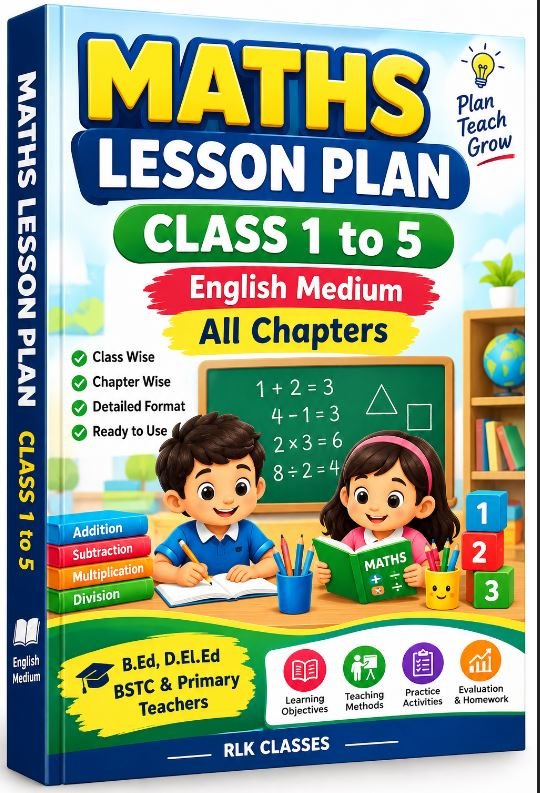
Useful for B.Ed, D.El.Ed, BSTC and primary teacher preparation.
Maths Lesson Plan Class 1 to 5 English medium PDF
Mathematics is an important subject at the primary level. A well-organised lesson plan helps teachers introduce mathematical concepts step by step, connect learning with everyday life and provide suitable practice activities for children.
The Maths lesson plan class 1 to 5 english medium resource is intended to support teachers in planning classroom instruction. It can help student-teachers organise learning objectives, teaching aids, introductory questions, presentation, practice work, assessment and homework.
Whether you are preparing for teaching practice, a school internship or regular classroom teaching, a class-wise lesson-plan format can make your preparation more systematic.
Maths Lesson Plan Class 1 to 5 English medium
Class 1 Maths
Early number sense, counting, shapes, comparison and simple operations.
Class 2 Maths
Number understanding, addition, subtraction, patterns and measurement activities.
Class 3 Maths
Problem-solving, basic multiplication, division, shapes and practical mathematics.
Class 4 Maths
Multi-step problems, numbers, fractions, measurement and geometry concepts.
Class 5 Maths
Advanced primary concepts, mathematical reasoning and real-life applications.
What Does a Maths Lesson Plan Include?
A structured mathematics lesson plan generally contains the following sections. The exact content depends on the class, topic and textbook edition included in the resource.Maths lesson plan class 1 to 5 english medium.
| Lesson Plan Section | Purpose |
|---|---|
| General Information | Class, subject, topic, duration and teaching method. |
| Learning Objectives | Defines what learners are expected to understand or do. |
| Teaching-Learning Materials | Lists number cards, objects, charts, shapes or other teaching aids. |
| Previous Knowledge | Connects the new concept with learners’ existing understanding. |
| Introduction Questions | Uses short questions to introduce the topic. |
| Presentation | Explains the concept through teacher activity, pupil activity and examples. |
| Practice Work | Provides guided and independent mathematical exercises. |
| Evaluation | Checks whether learners have achieved the learning objectives. |
| Homework | Provides suitable follow-up practice. |
Class-Wise Maths Lesson Plan PDF
Choose the class you need. Add the relevant PDF link to each button after uploading your files or creating your payment page.
📘 Class 1 Maths Lesson Plan
Suitable for planning lessons on foundational mathematics, counting, number recognition, shapes and simple activities.
Class 1 PDF📗 Class 2 Maths Lesson Plan
Use for lesson planning on number operations, patterns, measurement and mathematical thinking.
Class 2 PDF📙 Class 3 Maths Lesson Plan
Plan classroom explanations, guided exercises and activities for primary mathematics topics.
Class 3 PDF📕 Class 4 Maths Lesson Plan
Organise lesson objectives, examples, practice tasks and evaluation for Class 4 mathematics.
Class 4 PDF📒 Class 5 Maths Lesson Plan
Prepare structured lessons with examples, problem-solving and classroom assessment activities.
Class 5 PDFAll Chapters Maths Lesson Plan PDF
If you are looking for a complete class-wise collection, use the combo section below. Chapter names and lesson-plan coverage should match the actual PDF and the prescribed textbook for the relevant academic session.
📚 Maths Lesson Plans — Class 1 to 5 Combo
Use this section for a combined collection of primary mathematics lesson plans in English Medium.
- Class-wise lesson-planning resources.
- Topic-wise or chapter-wise material, as included in the PDF.
- Learning objectives and classroom teaching activities.
- Practice questions and evaluation ideas.
- Useful for teaching practice and lesson preparation.
Mega Lesson Plan for Mathematics Sample Format for B.Ed and D.El.Ed
For teaching practice, a mathematics lesson plan may be arranged in the following sequence.
Class, subject, topic, date, duration and teaching method.
State the mathematical knowledge, skills and understanding learners should develop.
Ask short questions related to familiar numbers, objects or everyday situations.
Explain the concept using examples, teaching aids, guided practice and pupil participation.
Check learning through oral questions, written exercises, problem-solving and follow-up practice.
Maths lesson plan class 1 to 5 english medium
English Medium | Chapter 1 | Complete Lesson Plans
RLK CLASSESAbout These Lesson Plans
This complete Mathematics lesson plan collection covers Chapter 1 of the current NCERT Maths lesson plan class 1 to 5 english medium. The plans are designed for B.Ed, D.El.Ed, BSTC and Primary Teacher teaching practice.
Each lesson plan follows a practical classroom format including learning objectives, previous knowledge, introduction, teacher-pupil interaction, activities, assessment, blackboard work, homework and teacher reflection.
CLASS 1 (Maths lesson plan class 1 to 5 english medium)
1. General Objectives
- To develop children’s interest in Mathematics through play and observation.
- To develop spatial awareness and mathematical communication.
- To connect mathematical ideas with objects in the child’s surroundings.
- To encourage children to describe the position of objects using simple words.
- To develop observation, listening and speaking skills.
2. Specific Learning Outcomes
- Students will identify objects as above, below, on, under, inside and outside.
- Students will understand simple positional relationships.
- Students will describe the position of familiar classroom objects.
- Students will follow simple positional instructions.
- Students will use mathematical position words in oral communication.
3. Previous Knowledge
Students are already familiar with common classroom objects such as a bag, chair, table, book, box and ball. They can observe where objects are kept and can follow simple instructions.
4. Teaching-Learning Material
5. Introduction – Previous Knowledge Questions
| No. | Teacher’s Question | Expected Student Response |
|---|---|---|
| 1 | Where is your school bag? | It is near/under/behind my chair. |
| 2 | Where do you keep your pencil? | Inside my pencil box. |
| 3 | Where is the fan? | Above us. |
| 4 | Where are your shoes? | Outside/under the desk. |
| 5 | Can you show me something inside your bag? | Yes, teacher. |
6. Statement of the Topic
The teacher introduces the lesson: “Today we will learn how to tell where things are. We will use words such as above, below, on, under, inside and outside.”
7. Detailed Presentation
| Teaching Point | Pupil-Teacher Activity | Pupil Activity | Blackboard Summary |
|---|---|---|---|
| Above and Below | The teacher holds a book above the table and then places it below the table. Questions are asked about both positions. | Students observe and say “above” and “below”. | Above Below |
| On and Under | The teacher places a pencil on a book and then under the book. | Students identify the position. | On Under |
| Inside and Outside | A ball is placed inside a box and then outside it. | Students say “inside” and “outside”. | Inside Outside |
| Position in Classroom | The teacher asks students to identify objects above, below, inside and outside the classroom. | Students point to objects and describe their positions. | Where is the object? |
| Oral Practice | The teacher gives positional instructions such as “Put the pencil inside the box.” | Students perform the instructions. | Position Words |
8. Blackboard Work
Below → lower position
On → touching the top surface
Under → lower than something
Inside → within something
Outside → not within something
9. Evaluation
1. MCQ: The book is ___ the table.
(a) on (b) outside (c) below (d) behind
Answer: (a) on
2. Fill in the blank: The fan is ______ us.
Answer: above3. One Word: What word means “within a box”?
Answer: Inside4. One Word: What is the opposite of inside?
Answer: Outside5. Short Answer: Write any two position words.
Answer: Above and below.10. Homework
Draw three objects and write one sentence for each describing its position using above, below, on, under, inside or outside.
11. Teacher Reflection
The teacher observes whether children can understand and use positional words independently. Children needing support are given additional object-based activities.
CLASS 2 (Maths lesson plan class 1 to 5 english medium)
1. General Objectives
- To develop number sense through real-life situations.
- To strengthen counting and grouping skills.
- To develop understanding of tens and ones.
- To encourage children to compare quantities.
- To develop mathematical reasoning through concrete activities.
2. Specific Learning Outcomes
- Students will group objects into tens and ones.
- Students will count collections efficiently.
- Students will represent two-digit numbers using tens and ones.
- Students will compare simple two-digit numbers.
- Students will identify ordinal positions in familiar situations.
3. Previous Knowledge
Students can count objects and recognise numbers up to at least 20. They have some experience with grouping objects and counting in sequence.
4. Teaching-Learning Material
5. Introduction – Previous Knowledge Questions
| No. | Question | Expected Response |
|---|---|---|
| 1 | How many fingers are there on both hands? | Ten. |
| 2 | Can we make a group of ten objects? | Yes. |
| 3 | Which is easier: counting 20 objects one by one or making groups? | Making groups. |
| 4 | How many ones make one ten? | Ten. |
| 5 | Can you make 15 using tens and ones? | 1 ten and 5 ones. |
6. Statement of the Topic
The teacher announces: “Today we will learn how grouping objects into tens and ones makes counting easier.”
7. Detailed Presentation
| Teaching Point | Pupil-Teacher Activity | Pupil Activity | Blackboard Summary |
|---|---|---|---|
| Grouping | The teacher gives students sticks and asks them to make groups of ten. | Students make bundles of ten. | 10 ones = 1 ten |
| Tens and Ones | The teacher demonstrates 14 as one group of ten and four single objects. | Students make 14 using concrete objects. | 14 = 1 Ten + 4 Ones |
| Two-digit Numbers | The teacher gives number cards and asks students to represent them with tens and ones. | Students form the numbers. | 23 = 2 Tens + 3 Ones |
| Comparing | The teacher compares two collections and asks which has more. | Students use more/less language. | Greater than Less than |
| Ordinal Position | Students stand in a line and identify first, second, third etc. | Students identify positions. | 1st, 2nd, 3rd… |
8. Blackboard Work
23 = 2 Tens + 3 Ones
35 = 3 Tens + 5 Ones
More → Greater quantity
Less → Smaller quantity
9. Evaluation
1. MCQ: 24 has: (a) 2 tens and 4 ones (b) 4 tens and 2 ones (c) 24 tens (d) 2 ones
Answer: (a)
2. Fill in the blank: 10 ones make one ______.
Answer: ten3. One Word: What is the place of 5 in 35?
Answer: Ones4. One Word: What comes after 39?
405. Short Answer: Write 27 in tens and ones.
Answer: 2 tens and 7 ones.10. Homework
Write any five two-digit numbers and show each number as tens and ones.
11. Teacher Reflection
Observe whether students can form groups of ten and identify the remaining ones. Use sticks, counters or classroom objects for students who need additional practice.
CLASS 3 (Maths lesson plan class 1 to 5 english medium)
1. General Objectives
- To develop number sense through meaningful activities.
- To encourage children to observe patterns in number names.
- To connect language with Mathematics.
- To develop counting and comparison skills.
- To promote mathematical discussion and reasoning.
2. Specific Learning Outcomes
- Students will count and compare the length of names.
- Students will identify the number of letters in words and names.
- Students will read and write number names.
- Students will observe patterns in number names.
- Students will classify information according to simple properties.
3. Previous Knowledge
Students know numbers up to 100 and can read simple number names. They can count letters in familiar words and names.
4. Teaching-Learning Material
5. Introduction – Previous Knowledge Questions
| No. | Question | Expected Response |
|---|---|---|
| 1 | How many letters are there in your name? | Students count their letters. |
| 2 | Whose name is longer in your group? | Students compare names. |
| 3 | Can two names have the same number of letters? | Yes. |
| 4 | What is the number name of 25? | Twenty-five. |
| 5 | Can number names have different numbers of letters? | Yes. |
6. Statement of the Topic
The teacher introduces the topic by saying: “Today we will explore names, number names, counting and patterns. We will see how Mathematics can be found in words too.”
7. Detailed Presentation
| Teaching Point | Pupil-Teacher Activity | Pupil Activity | Blackboard Summary |
|---|---|---|---|
| Counting Letters | The teacher writes two or three names and asks children to count the letters. | Students count and record the letters. | NAME → Number of Letters |
| Longest and Shortest Name | The teacher compares names using the number of letters. | Students identify longest and shortest names. | More letters → Longer name |
| Number Names | The teacher displays numbers and asks students to write their names. | Students write number names. | 43 → Forty-three |
| Number-name Pattern | The teacher gives different numbers and asks children to compare the number of letters in their names. | Students find similarities and differences. | Number → Number Name |
| Grouping | Students group names according to first letter or number of letters. | Students classify name slips. | Grouping by a common property |
8. Blackboard Work
Longer name → More letters
Shorter name → Fewer letters
25 → Twenty-five
43 → Forty-three
56 → Fifty-six
9. Evaluation
1. MCQ: Which has more letters?
(a) CAT (b) ELEPHANT (c) DOG (d) COW
Answer: (b) ELEPHANT
2. Fill in the blank: The number name of 20 is ______.
Answer: Twenty3. One Word: What do we call a name with fewer letters?
Answer: Shorter4. One Word: Write the number name of 30.
Answer: Thirty5. Short Answer: How can you find which of two names is longer?
Answer: Count the letters in both names and compare them.10. Homework
Write the names of five family members. Count the letters in each name and arrange the names from shortest to longest.
11. Teacher Reflection
The teacher checks whether students can connect counting with language and compare names using measurable information.
CLASS 4 (Maths lesson plan class 1 to 5 english medium)
1. General Objectives
- To develop spatial and geometrical thinking.
- To connect geometry with real-life objects.
- To develop observation and classification skills.
- To encourage students to construct and examine shapes.
- To develop mathematical vocabulary related to geometry.
2. Specific Learning Outcomes
- Students will identify common 2D and 3D shapes.
- Students will identify faces, edges and vertices of solids.
- Students will recognise simple angles.
- Students will distinguish between acute, right and obtuse angles at an introductory level.
- Students will relate geometrical shapes to objects in their surroundings.
3. Previous Knowledge
Students have seen common shapes such as circle, square, rectangle and triangle. They can identify common objects such as boxes, balls and cans.
4. Teaching-Learning Material
5. Introduction – Previous Knowledge Questions
| No. | Question | Expected Response |
|---|---|---|
| 1 | What shape is a coin? | Circle. |
| 2 | What shape is a book? | Rectangle/Cuboid. |
| 3 | How many sides does a triangle have? | Three. |
| 4 | Can you find a box in the classroom? | Yes. |
| 5 | What happens when two lines meet? | They form an angle. |
6. Statement of the Topic
The teacher says: “Today we will explore shapes around us. We will look at solid shapes, their faces, edges and corners, and also learn about angles.”
7. Detailed Presentation
| Teaching Point | Pupil-Teacher Activity | Pupil Activity | Blackboard Summary |
|---|---|---|---|
| 2D Shapes | The teacher displays circle, square, rectangle and triangle cards. | Students identify and name the shapes. | Circle Triangle Square Rectangle |
| 3D Shapes | The teacher shows a cube, cuboid, cylinder and cone. | Students observe and identify familiar objects with similar shapes. | 3D Shapes |
| Faces | The teacher asks students to touch and count visible surfaces of a solid. | Students count faces. | Face = flat surface |
| Edges and Vertices | The teacher demonstrates the meeting lines and corners of a cube. | Students locate edges and vertices. | Edge = meeting line Vertex = corner |
| Angles | The teacher folds paper to make a right angle and compares smaller and larger openings. | Students observe and make angles using two pencils. | Acute Right Obtuse |
8. Blackboard Work
3D → Solid shapes
Face → Surface
Edge → Line where faces meet
Vertex → Corner
Angle smaller than right angle → Acute
Angle equal to right angle → Right
Angle larger than right angle → Obtuse
9. Evaluation
1. MCQ: Which solid has six square faces?
(a) Cone (b) Cube (c) Cylinder (d) Sphere
Answer: (b) Cube
2. Fill in the blank: A point where two or more edges meet is called a ______.
Answer: Vertex3. One Word: Name the shape of a ball.
Answer: Sphere4. One Word: An angle equal to a square corner is called a ______ angle.
Answer: Right5. Short Answer: Write the difference between a face and a vertex.
Answer: A face is a surface of a solid, while a vertex is a corner where edges meet.10. Homework
Find five objects at home and write their shapes. Identify whether each object is related to a 2D shape or a 3D solid.
11. Teacher Reflection
The teacher checks whether students can distinguish flat shapes from solids and use basic geometric vocabulary correctly.
CLASS 5 (Maths lesson plan class 1 to 5 english medium)
1. General Objectives
- To develop understanding of large numbers in real-life situations.
- To strengthen place-value concepts.
- To develop estimation and rounding skills.
- To encourage mathematical reasoning through travel-related situations.
- To develop accurate reading and writing of large numbers.
2. Specific Learning Outcomes
- Students will read and write five-digit numbers.
- Students will identify the place and place value of digits.
- Students will write numbers in expanded form.
- Students will compare and arrange large numbers.
- Students will round numbers to the nearest tens, hundreds and thousands.
- Students will apply number concepts to travel-related situations.
3. Previous Knowledge
Students know numbers up to thousands and can identify ones, tens, hundreds and thousands places. They have previous experience reading and writing four-digit numbers.
4. Teaching-Learning Material
5. Introduction – Previous Knowledge Questions
| No. | Question | Expected Response |
|---|---|---|
| 1 | How many ones make one ten? | Ten. |
| 2 | How many tens make one hundred? | Ten. |
| 3 | What is the place of 5 in 5,432? | Thousands. |
| 4 | Can you read 12,345? | Twelve thousand three hundred forty-five. |
| 5 | Why do we use commas in large numbers? | To make numbers easier to read. |
6. Statement of the Topic
The teacher introduces the lesson: “Today we will travel through Mathematics and learn how large numbers are read, written, compared and rounded.”
7. Detailed Presentation
| Teaching Point | Pupil-Teacher Activity | Pupil Activity | Blackboard Summary |
|---|---|---|---|
| Five-digit Numbers | The teacher displays numbers such as 45,678 and discusses their place values. | Students read the numbers aloud. | 45,678 Forty-five thousand six hundred seventy-eight |
| Place Value | The teacher places digits in a place-value chart. | Students identify the place and value of selected digits. | O T H Th TTh |
| Expanded Form | The teacher expands a five-digit number using place values. | Students write expanded forms. | 45,678 = 40,000 + 5,000 + 600 + 70 + 8 |
| Comparison | The teacher gives two large numbers and compares them from the highest place. | Students use >, < and =. | 68,950 > 68,905 |
| Rounding | The teacher demonstrates rounding on a number line. | Students round numbers to tens, hundreds and thousands. | 47,620 ≈ 48,000 nearest thousand |
8. Blackboard Work
Ten Thousands | Thousands | Hundreds | Tens | Ones
45,678
= 40,000 + 5,000 + 600 + 70 + 8
Rounding Rule:
0–4 → Stay
5–9 → Increase by 1
9. Evaluation
1. MCQ: What is the place value of 6 in 45,678?
(a) 6 (b) 60 (c) 600 (d) 6,000
Answer: (c) 600
2. Fill in the blank: 10 thousands make ______.
Answer: 10,0003. One Word: Write the number name of 25,000.
Answer: Twenty-five thousand4. One Word: Round 4,560 to the nearest hundred.
Answer: 4,6005. Short Answer: Write 38,405 in expanded form.
Answer: 30,000 + 8,000 + 400 + 5.10. Homework
Write five five-digit numbers. For each number, write its number name, expanded form and rounded value to the nearest thousand.
11. Teacher Reflection
The teacher checks whether students understand place value rather than simply memorising number names. Additional number cards and place-value activities should be provided to students who require reinforcement.
Common Teaching Strategy for Classes 1–5
| Stage | Teacher Role | Student Role |
|---|---|---|
| Introduction | Connect the topic with children’s daily experiences. | Share prior experiences and answers. |
| Exploration | Provide objects, questions and situations. | Observe, explore and discuss. |
| Concept Formation | Guide students towards the mathematical idea. | Explain the idea in their own words. |
| Practice | Provide graded questions and activities. | Solve individually and in groups. |
| Assessment | Ask oral and written questions. | Demonstrate understanding. |
| Reflection | Identify learning gaps. | Think about what they learned. |
Learning Resources and Classroom Activities
- Number cards and flash cards
- Place value charts
- Sticks, counters and blocks
- Shape cards and solid objects
- Classroom object hunt
- Group and pair activities
- Number games
- Oral mathematical discussion
- Drawing and construction activities
- Real-life problem situations
Teacher’s Assessment Checklist
| Skill | Achieved | Needs Practice |
|---|---|---|
| Understands the main concept | ☐ | ☐ |
| Participates in classroom activity | ☐ | ☐ |
| Uses mathematical vocabulary | ☐ | ☐ |
| Solves basic problems | ☐ | ☐ |
| Explains the answer | ☐ | ☐ |
| Works cooperatively | ☐ | ☐ |
Benefits of Maths lesson plan class 1 to 5 english medium for Primary Teachers
⏱️ Better Preparation
Organise the lesson sequence and classroom activities before teaching.
🎯 Clear Objectives
Keep the lesson focused on specific mathematical learning outcomes.
🧩 Activity-Based Learning
Use objects, diagrams, examples and learner participation to explain concepts.
📝 Teaching Practice
Support lesson preparation for B.Ed, D.El.Ed and BSTC teaching practice.
Download Maths lesson plan class 1 to 5 english medium
📘 Maths lesson plan class 1 to 5 english medium
Explore the available class-wise or combined Maths Lesson Plan PDF resources for primary-level teaching and teacher training.
Digital product availability, contents, price and delivery details should be confirmed on the linked product page.
Related Lesson Plan Resources
| Resource | Useful For | Visit |
|---|---|---|
| EVS Lesson Plan PDF Class 1 to 5 | Primary environmental studies lesson plans. | View EVS Plans |
| English Lesson Plan PDF Class 1 to 5 | English-medium primary lesson plans. | View English Plans |
| D.El.Ed Lesson Plan PDF | Primary teaching practice and teacher training. | View D.El.Ed Plans |
| Lesson Plan PDF Store | Browse available digital lesson-plan resources. | Open PDF Store |
| RLK Classes Test | Online practice tests and educational quizzes. | Take a Test |
Frequently Asked Questions
Use the class-wise or combo buttons on this page. The actual PDF or payment link must be added by the website owner.
Yes, mathematics lesson-plan formats can support teaching practice, lesson preparation and classroom demonstrations.
Coverage depends on the PDF linked to the product. Check its contents and chapter list before purchasing.
Yes. Teachers can adapt the lesson objectives, examples and activities to their students’ needs and prescribed syllabus.
Teaching methods may be adaptable, but chapter names and syllabus coverage can differ between NCERT and state-board textbooks. Check your prescribed textbook edition.
Delivery depends on the linked product. If it is a digital PDF, clearly state on the payment page that no physical book will be shipped.
RLK CLASSES
Maths Lesson Plan PDF · Primary Classes 1–5 · English Medium
Supporting B.Ed, D.El.Ed, BSTC students and primary teachers with lesson-planning resources.
Visit RLK Classes