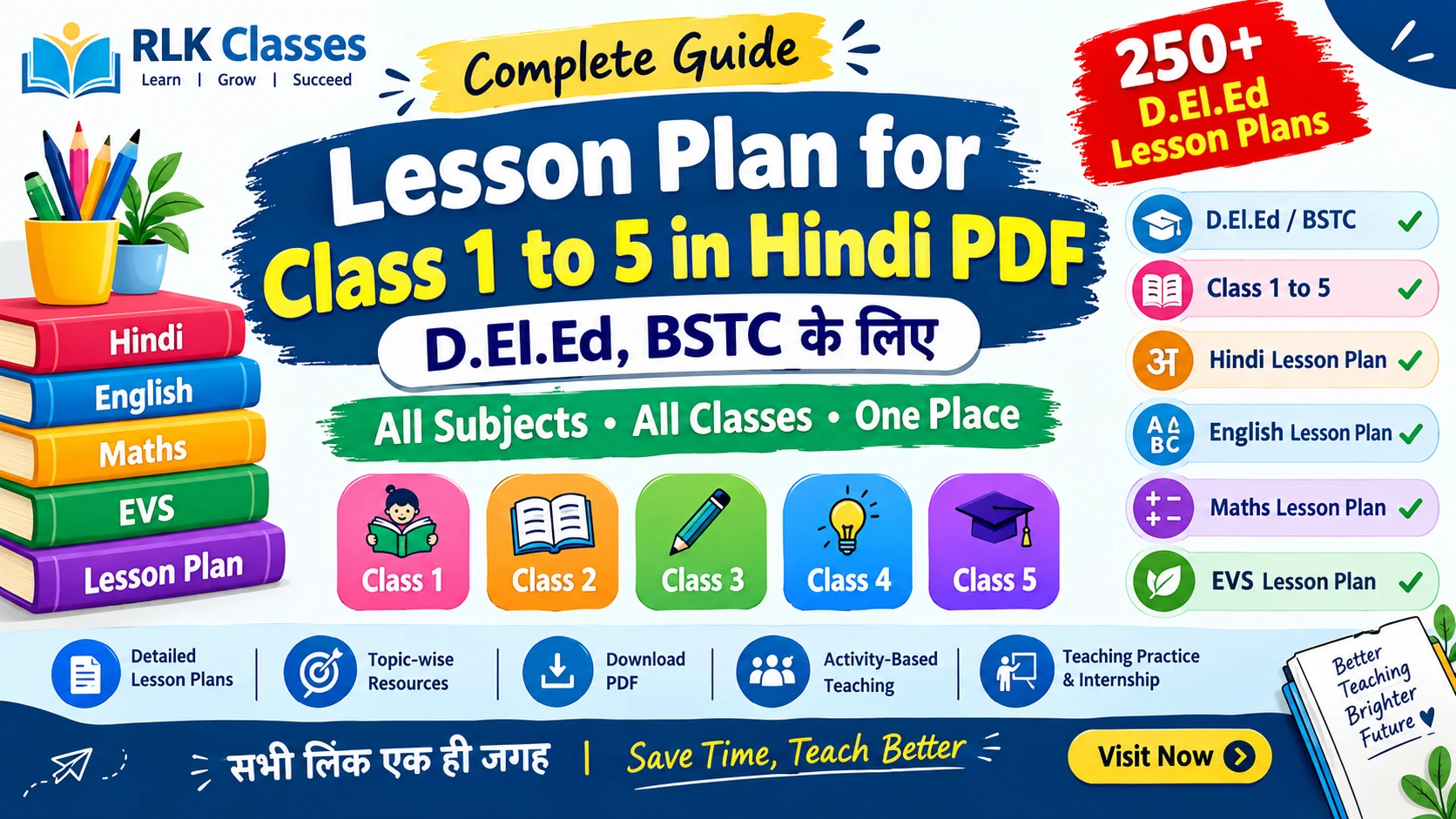
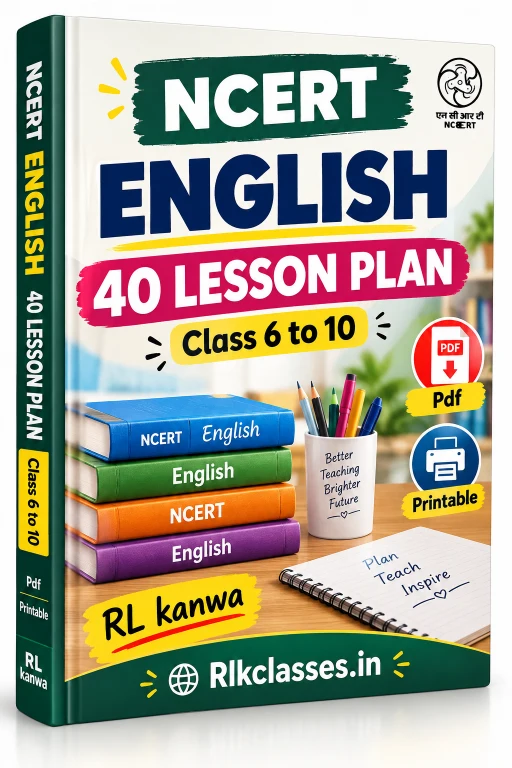
Mega Lesson Plan for English | simulated teaching lesson plan english
Class 6 to 10 | 40 English Lesson Plans PDF
NCERT आधारित B ed english lesson plan के नमूने और पूरी PDF की जानकारी एक ही जगह।
📘 View 40 Lesson Plans PDF📚 Mega Lesson Plan for English Class 6 to 10
यदि आप B.Ed की Teaching Practice, Internship या स्कूल में अंग्रेजी पढ़ाने के लिए English Lesson Plans खोज रहे हैं, तो यह पेज आपके लिए उपयोगी है। यहाँ कक्षा 6, 7, 8, 9 और 10 के English Lesson Plans के नमूने दिए गए हैं। साथ ही 40 English Lesson Plans की पूरी PDF प्राप्त करने के लिए खरीदने का विकल्प भी दिया गया है।📗 Class 6
English prose, poetry और grammar के लिए पाठ योजनाएँ।📘 Class 7
पाठ-आधारित एवं व्याकरण संबंधी lesson plans।📙 Class 8
Reading, writing और grammar पर आधारित योजनाएँ।📕 Class 9–10
उच्च कक्षाओं के लिए English teaching resources।✨ English Lesson Plan के मुख्य भाग
🎯 Teaching Objectives
General objectives, specific objectives तथा expected behavioural changes.🧰 Teaching Aids
Blackboard, textbook, charts और आवश्यक शिक्षण सामग्री।📖 Introduction
पूर्व ज्ञान पर आधारित प्रश्न और पाठ के उद्देश्य की घोषणा।📝 Presentation
Teaching points, teacher activities, pupil activities और blackboard summary.📝 B ED English Lesson Plan Sample class 6 to 10
नीचे English Lesson Plan का एक संक्षिप्त नमूना दिया गया है। पूरी PDF में उपलब्ध पाठ योजनाओं का वास्तविक प्रारूप PDF में देखें।
English Lesson Plans – Class 6 to 10
NCERT English & Grammar
B.Ed Internship Teaching Practice
RLK CLASSES
📚 Index – Class 6 to 10 English Lesson Plans
| S.N. | Class | Lesson Plan Topic | Book / Source | Type |
|---|---|---|---|---|
| 1 | Class 6 | A House, A Home | NCERT – Honeysuckle | Poetry |
| 2 | Class 7 | Three Questions | NCERT – Honeycomb | Prose |
| 3 | Class 8 | The Best Christmas Present in the World | NCERT – Honeydew | Prose |
| 4 | Class 9 | The Fun They Had | NCERT – Beehive | Prose |
| 5 | Class 10 | A Letter to God | NCERT – First Flight | Prose |
Lesson Plan – 1 | Class 6
1. General Objectives
- To develop students’ reading, comprehension and communication skills.
- To develop interest in English poetry and encourage students to express their ideas about home and family.
2. Expected Behavioural Changes
- Students will be able to explain the difference between a house and a home.
- Students will be able to express the importance of love, care and family.
3. Teaching Methods
- Question–Answer Method
- Explanation Method
- Discussion Method
- Recitation Method
4. Teaching Material / Teaching Aids
- NCERT English Textbook
- Blackboard / Whiteboard
- Chalk / Marker
- Picture of a house
- Word cards
5. Previous Knowledge
Students know about their house, family members and basic English words related to home and family.
6. Introduction
| S.N. | Teacher’s Question | Expected Answer |
|---|---|---|
| 1 | What is a house? | A building to live in. |
| 2 | Who lives in a house? | Family members. |
| 3 | What makes a house a home? | Love and care. |
| 4 | Do you love your home? | Yes. |
| 5 | What will we study today? | A House, A Home. |
7. Statement of Objective
Today we shall study the poem “A House, A Home” and understand the difference between a house and a home.
8. Presentation
| Teaching Point | Pupil-Teacher Activity | Pupil Activity | Blackboard Summary |
|---|---|---|---|
| Difference Between a House and a Home |
Developmental Questions
The pupil-teacher explains that a house is a physical structure made of walls, doors, windows and rooms. A home is more than a building because it contains love, affection and care. The teacher reads the relevant lines and explains the central idea in simple English.
Comprehension Questions
Q1. What is a house? Q2. What makes a house a home? |
Expected Answers
|
House → Building Home → Love & Care Family → Home |
| Love and Care in a Family |
Developmental Questions
The teacher explains that family members support and care for one another. Love, affection, cooperation and understanding make a home peaceful and happy.
Comprehension Questions
Q1. What is important in family life? Q2. How can we make our home happy? |
Expected Answers
|
Love Care Cooperation |
| Importance of a Happy Home |
Developmental Questions
The teacher explains that a loving home gives people comfort, security and emotional support. The poem teaches that a home is created by people who live together with love and care.
Comprehension Questions
Q1. What does a home provide? Q2. What is the main message of the poem? |
Expected Answers
|
Happy Home Comfort Security |
9. Homework
Write five sentences on “My Home” and explain why you love your home.
10. Assessment
- What is the main difference between a house and a home?
- A home is mainly associated with: (a) Love (b) Road (c) Market (d) Playground
- A home is a place of ______ and care.
- What makes a home happy?
- Write 2–3 sentences about the importance of family.
Lesson Plan – 2 | Class 7
1. General Objectives
- To develop reading comprehension and communication skills.
- To develop understanding of moral values through English prose.
2. Expected Behavioural Changes
- Students will be able to identify the three questions asked by the king.
- Students will understand the importance of the present moment, helping others and doing good work.
3. Teaching Methods
- Question–Answer Method
- Explanation Method
- Discussion Method
- Reading Method
4. Teaching Material / Teaching Aids
- NCERT Honeycomb Textbook
- Blackboard / Whiteboard
- Chalk / Marker
- Picture of a king
- Word cards
5. Previous Knowledge
Students know about kings, important decisions and the importance of helping other people.
6. Introduction
| S.N. | Teacher’s Question | Expected Answer |
|---|---|---|
| 1 | Who rules a kingdom? | A king. |
| 2 | Does a king have to make decisions? | Yes. |
| 3 | Why are good decisions important? | For people. |
| 4 | Should we help others? | Yes. |
| 5 | What are we going to study? | Three Questions. |
7. Statement of Objective
Today we shall study “Three Questions” and learn the important ideas about the right time, the right person and the right action.
8. Presentation
| Teaching Point | Pupil-Teacher Activity | Pupil Activity | Blackboard Summary |
|---|---|---|---|
| The King’s Three Questions |
Developmental Questions
The teacher explains that the king wanted answers to three important questions. He believed that correct answers would help him become a better ruler.
Comprehension Questions
Q1. Who asked the questions? Q2. Why did he ask them? |
Expected Answers
|
Three Questions Right Time Right Person Right Action |
| The Hermit’s Answer |
Developmental Questions
The teacher explains that the king visited a hermit to obtain answers. The hermit did not give direct answers but showed the king their meaning through actions.
Comprehension Questions
Q1. Where did the king meet the hermit? Q2. What did the hermit teach? |
Expected Answers
|
Hermit Wisdom Action |
| The Importance of the Present |
Developmental Questions
The teacher explains that the present moment is the only time available to us. The person with us at the moment deserves our attention, and the most important work is to do good.
Comprehension Questions
Q1. What is the most important time? Q2. What should we do? |
Expected Answers
|
Present = Important Person with us Do Good |
9. Homework
Write five sentences explaining the moral of “Three Questions.”
10. Assessment
- What were the three questions of the king?
- The most important time is: (a) Yesterday (b) Tomorrow (c) Present (d) Next year
- The king went to a ______ for answers.
- Who gave wisdom to the king?
- Write 2–3 sentences about the moral of the story.
Lesson Plan – 3 | Class 8
1. General Objectives
- To develop reading, comprehension and communication skills.
- To develop sensitivity towards peace, friendship and humanity.
2. Expected Behavioural Changes
- Students will be able to describe the main events of the story.
- Students will understand the importance of peace, kindness and human friendship.
3. Teaching Methods
- Question–Answer Method
- Explanation Method
- Discussion Method
- Reading Method
4. Teaching Material / Teaching Aids
- NCERT Honeydew Textbook
- Blackboard / Whiteboard
- Chalk / Marker
- Picture related to Christmas
- Word cards
5. Previous Knowledge
Students know about Christmas, gifts, letters and the idea of friendship and peace.
6. Introduction
| S.N. | Teacher’s Question | Expected Answer |
|---|---|---|
| 1 | When do people exchange gifts? | On special occasions. |
| 2 | What festival is associated with Santa Claus? | Christmas. |
| 3 | What does a gift express? | Love. |
| 4 | Is peace important? | Yes. |
| 5 | What will we study today? | The Best Christmas Present in the World. |
7. Statement of Objective
Today we shall study “The Best Christmas Present in the World” and understand the story’s message of peace, friendship and humanity.
8. Presentation
| Teaching Point | Pupil-Teacher Activity | Pupil Activity | Blackboard Summary |
|---|---|---|---|
| The Old Roll-Top Desk |
Developmental Questions
The teacher explains that the narrator purchased an old roll-top desk from a junk shop. While repairing it, he found a hidden compartment containing an old letter.
Comprehension Questions
Q1. Where did the narrator find the desk? Q2. What did he discover? |
Expected Answers
|
Old Desk Junk Shop Hidden Letter |
| Jim Macpherson and the Letter |
Developmental Questions
The teacher explains that the letter was written by Jim Macpherson to his wife Connie during wartime. Jim described an unusual moment of friendship between opposing soldiers.
Comprehension Questions
Q1. Who was Jim Macpherson? Q2. Who was Connie? |
Expected Answers
|
Jim Macpherson Connie War |
| Message of Peace and Friendship |
Developmental Questions
The teacher explains how the soldiers temporarily stopped fighting and shared food and friendship. The story presents human kindness and peace.
Comprehension Questions
Q1. What did the soldiers share? Q2. What is the main message? |
Expected Answers
|
Peace Friendship Humanity |
9. Homework
Write a paragraph on “Why is Peace Important?”
10. Assessment
- What did the narrator find inside the desk?
- The letter was written by: (a) Connie (b) Jim Macpherson (c) The narrator (d) A shopkeeper
- Jim wrote the letter to his ______.
- What festival did the soldiers celebrate?
- Write 2–3 sentences on the message of the story.
Lesson Plan – 4 | Class 9
1. General Objectives
- To develop reading, comprehension and analytical skills.
- To develop interest in English literature and encourage students to compare different forms of education.
2. Expected Behavioural Changes
- Students will be able to describe the major events and characters of the story.
- Students will be able to compare traditional schools with mechanical learning systems.
3. Teaching Methods
- Question–Answer Method
- Explanation Method
- Discussion Method
- Reading Method
4. Teaching Material / Teaching Aids
- NCERT Beehive Textbook
- Blackboard / Whiteboard
- Chalk / Marker
- Picture of a computer
- Word cards
5. Previous Knowledge
Students know about schools, teachers, classrooms, computers and online learning.
6. Introduction
| S.N. | Teacher’s Question | Expected Answer |
|---|---|---|
| 1 | Where do children usually study? | School. |
| 2 | Who teaches students? | Teacher. |
| 3 | Do students study together? | Yes. |
| 4 | Can computers teach students? | Yes. |
| 5 | What will we study today? | The Fun They Had. |
7. Statement of Objective
Today we shall study “The Fun They Had” and understand the differences between future mechanical education and traditional school education.
8. Presentation
| Teaching Point | Pupil-Teacher Activity | Pupil Activity | Blackboard Summary |
|---|---|---|---|
| Margie and Tommy Discover an Old Book |
Developmental Questions
The teacher explains that Margie and Tommy lived in the future. Tommy discovered an old printed book in his house. The children were surprised because they were used to reading words on screens.
Comprehension Questions
Q1. Who found the book? Q2. What kind of book was it? |
Expected Answers
|
Margie Tommy Old Printed Book |
| Mechanical School |
Developmental Questions
The teacher explains that Margie studied at home with a mechanical teacher. Her lessons were given through a machine. She disliked the machine because it gave her repeated tests and had problems with geography.
Comprehension Questions
Q1. Where did Margie study? Q2. What subject caused problems? |
Expected Answers
|
Mechanical Teacher Home School Geography Problem |
| Traditional School and Its Fun |
Developmental Questions
The teacher explains that children in old schools studied together in a classroom. They had human teachers and learned with other children. Margie imagined that such schools would be enjoyable.
Comprehension Questions
Q1. How did children study together? Q2. What did Margie think of old schools? |
Expected Answers
|
Old School Human Teacher Children Together Fun |
9. Homework
Write a paragraph comparing “Traditional School and Future School.”
10. Assessment
- Who found the old book?
- Margie was taught by: (a) A human teacher (b) A mechanical teacher (c) Her mother (d) Tommy
- Margie’s mechanical teacher had a problem with ______.
- Who was Margie’s friend?
- Write 2–3 sentences about why Margie thought old schools would be fun.
Lesson Plan – 5 | Class 10
1. General Objectives
- To develop reading, comprehension and communication skills in English.
- To develop interest in English prose and understand values such as faith, hope and kindness.
2. Expected Behavioural Changes
- Students will be able to explain the main events and characters of the story.
- Students will be able to express their views about faith, hope and human behaviour.
3. Teaching Methods
- Question–Answer Method
- Explanation Method
- Discussion Method
- Reading Method
4. Teaching Material / Teaching Aids
- NCERT First Flight Textbook
- Blackboard / Whiteboard
- Chalk / Marker
- Picture of a farmer and field
- Word cards
5. Previous Knowledge
Students know about farmers, crops, rainfall, natural disasters, letters and prayers.
6. Introduction
| S.N. | Teacher’s Question | Expected Answer |
|---|---|---|
| 1 | Who works in the fields? | Farmers. |
| 2 | What do farmers need for good crops? | Rain. |
| 3 | What may happen if crops are destroyed? | Loss. |
| 4 | To whom do people pray in difficult situations? | God. |
| 5 | What are we going to study today? | A Letter to God. |
7. Statement of Objective
Today we shall study the story “A Letter to God” and understand its main events, characters and message about faith and hope.
8. Presentation
| Teaching Point | Pupil-Teacher Activity | Pupil Activity | Blackboard Summary |
|---|---|---|---|
| Lencho and His Hope for Rain |
Developmental Questions
The teacher explains that Lencho was a poor farmer who lived with his family in a valley. His crops needed rain and he waited for rainfall with great hope.
Comprehension Questions
Q1. Who was Lencho? Q2. What did he need for his crops? |
Expected Answers
|
Lencho → Farmer Crops → Rain Hope → Harvest |
| The Hailstorm and Loss |
Developmental Questions
The teacher explains that heavy hailstones destroyed Lencho’s crops. He was deeply disappointed because the crop was his main source of income.
Comprehension Questions
Q1. What destroyed the crops? Q2. How did Lencho feel? |
Expected Answers
|
Hailstorm Crops Destroyed Heavy Loss |
| Lencho’s Letter to God |
Developmental Questions
The teacher explains that Lencho had complete faith in God. He wrote a letter asking God to send him money because his crop had been destroyed.
Comprehension Questions
Q1. To whom did Lencho write? Q2. What did he ask for? |
Expected Answers
|
Letter → God Request → Money Faith → Strong |
| The Postmaster’s Kindness |
Developmental Questions
The teacher explains that the postmaster was impressed by Lencho’s faith. He collected money from his employees and friends and sent it to Lencho in an envelope.
Comprehension Questions
Q1. Who helped Lencho? Q2. Why did he help him? |
Expected Answers
|
Postmaster Kindness Help |
9. Homework
Write a paragraph on “Faith and Kindness in A Letter to God.”
10. Assessment
- Who was Lencho?
- Lencho wrote a letter to: (a) The postmaster (b) God (c) His friend (d) His neighbour
- Lencho’s crops were destroyed by a ______.
- Who helped Lencho?
- Write 2–3 sentences about the role of the postmaster.
📚 40 English Lesson Plans PDF
Class 6 to 10 के लिए तैयार की गई 40 English Lesson Plans की पूरी PDF प्राप्त करने के लिए नीचे दिए गए बटन का उपयोग करें।
- Class 6 से 10 तक की English lesson plans
- B.Ed Teaching Practice के लिए उपयोगी सामग्री
- Lesson Plan के नमूने और विस्तृत पाठ योजनाएँ
- PDF के रूप में डिजिटल सामग्री
🔗 More Teaching Resources
RLK Classes पर उपलब्ध अन्य Lesson Plans और Teaching Resources भी देखें।
✏️ English Lesson Plan
English lesson plans के नमूने और अन्य जानकारी। View Sample →📖 B.Ed Lesson Plan File
B.Ed के लिए अलग-अलग विषयों के संसाधन। View Resources →❓ Frequently Asked Questions
1. Mega Lesson Plan for English क्या है?
यह English विषय की अनेक पाठ योजनाओं का संग्रह है, जो शिक्षकों और B.Ed प्रशिक्षुओं की Teaching Practice में उपयोगी हो सकता है।
2. क्या ये Lesson Plans Class 6 से 10 के लिए हैं?
यह PDF संग्रह कक्षा 6 से 10 के लिए निर्धारित है। खरीदने से पहले PDF के विषयों और कक्षाओं की सूची जाँच लें।
3. क्या English Lesson Plan का Sample उपलब्ध है?
इस पोस्ट में English Grammar का एक नमूना दिया गया है। पूरी PDF के लिए खरीदने का लिंक ऊपर उपलब्ध है।
4. English Lesson Plan PDF कैसे प्राप्त करें?
ऊपर दिए गए Buy 40 English Lesson Plans PDF बटन पर क्लिक करके उपलब्ध खरीद प्रक्रिया पूरी करें।
5. क्या ये B.Ed Teaching Practice में उपयोगी हैं?
इनका उद्देश्य B.Ed की Teaching Practice और पाठ योजना तैयार करने में सहायता करना है। अपने कॉलेज के निर्धारित प्रारूप के अनुसार आवश्यक बदलाव करें।
Start Your English Teaching Preparation
English Lesson Plans के नमूने देखें और पूरी PDF के लिए उपलब्ध खरीद विकल्प का उपयोग करें।
Get 40 English Lesson PlansAuthor: Roshan Kanwa | RLK CLASSES