Lesson Plan English Class 1 to 5 PDF Download
Class-Wise English Lesson Plans | Chapter-Wise Resources | Printable PDF | D.El.Ed Teaching Practice | Lesson Plan English Class 1 to 5
कक्षा 1 से 5 तक English के lesson plans खोज रहे हैं? यहाँ NCERT आधारित पाठ योजनाओं, Grammar Lesson Plans और अलग-अलग कक्षाओं के PDF संग्रह की जानकारी एक ही जगह प्राप्त करें।
Explore Class-Wise PDFs ↓ View Complete ComboLesson Plan English Class 1 to 5 क्या है?
An lesson plan english class 1 to 5 is a structured teaching plan that helps teachers explain English lessons, vocabulary, reading, writing and grammar through age-appropriate classroom activities.
प्राथमिक कक्षाओं में बच्चों के English language skills विकसित करने के लिए lesson plan english class 1 to 5 उपयोगी होती है। इसमें learning objectives, previous knowledge, introduction, presentation, teaching aids, evaluation और homework जैसी गतिविधियाँ शामिल की जा सकती हैं।
- D.El.Ed / BSTC विद्यार्थियों की teaching practice
- B.Ed trainees और internship students
- Primary school English teachers
- NCERT English और grammar के लिए lesson plan बनाने वाले शिक्षक
अपनी आवश्यकता के अनुसार नीचे Class 1, Class 2, Class 3, Class 4 और Class 5 के संसाधन देखें। खरीदने से पहले प्रत्येक PDF में शामिल topics और format की जानकारी जाँचें।
Class-Wise English Lesson Plan PDF
हर कक्षा के विद्यार्थियों का language level अलग होता है। इसलिए lesson plan english class 1 to 5 class-wise lesson plans चुनने से संबंधित पाठ और गतिविधियों को व्यवस्थित करना आसान हो सकता है।
📘 Class 1 English
Alphabet, basic vocabulary, simple words, picture reading और शुरुआती sentence activities के लिए English lesson plan resources.
View Class 1 Posts →📗 Class 2 English
Reading practice, simple sentences, vocabulary building और शुरुआती grammar activities के लिए उपयोगी resources.
View Class 2 Posts →📙 Class 3 English
Chapter-based reading, comprehension, sentence formation और grammar practice के लिए lesson plan resources.
View Class 3 Posts →📕 Class 4 English
NCERT chapter-wise planning, vocabulary, reading comprehension और writing activities के लिए संसाधन.
View Class 4 Lesson Plan →📒 Class 5 English
Reading, paragraph writing, comprehension और grammar-related lesson plan resources.
View Class 5 Posts →📚 All Classes 1–5
यदि आपको पाँचों कक्षाओं के लिए lesson plan english class 1 to 5 चाहिए, तो complete collection की जानकारी यहाँ देखें।
Explore English Collection →NCERT Chapter-Wise Lesson Plan English Class 1 to 5
NCERT lesson plan english class 1 to 5 बनाते समय अपनी कक्षा में निर्धारित textbook और उसके वर्तमान chapters के अनुसार content चुनें। अलग-अलग राज्यों और शैक्षणिक सत्रों में पुस्तकों या chapter lists में बदलाव संभव है।
| Class | Lesson Plan Coverage | Resource |
|---|---|---|
| Class 1 | Textbook lessons, vocabulary, phonics और simple sentences | View posts |
| Class 2 | Chapter reading, words, sentences और comprehension | View posts |
| Class 3 | Chapter explanation, vocabulary, reading और writing | View posts |
| Class 4 | Chapter-wise lesson planning और classroom activities | View post |
| Class 5 | Reading comprehension, vocabulary, grammar और writing | View posts |
अपनी textbook का सही नाम, chapter title और class जरूर मिलाएँ। उदाहरण के लिए, पुरानी और नई पाठ्यपुस्तकों की chapter lists एक जैसी होना आवश्यक नहीं है।
Grammar lesson plan english class 1 to 5
English grammar को प्राथमिक स्तर पर बच्चों की कक्षा और सीखने की क्षमता के अनुसार उदाहरणों, चित्रों, word cards और sentence activities से समझाया जा सकता है।
Noun
Names of people, places, animals and things.
Pronoun
Simple use of I, we, you, he, she, it and they.
Verb
Action words and simple sentence practice.
Adjective
Describing words such as big, small, red and beautiful.
Articles
Basic use of a, an and the with familiar words.
Prepositions
Simple position words such as in, on, under and behind.
Singular & Plural
One and more than one; simple word examples.
Sentence Formation
Making short, meaningful English sentences.
Find English Grammar Lesson Plans →
Grammar topics को संबंधित class के syllabus और learning outcomes के अनुसार चुनें। सभी topics हर कक्षा के लिए समान स्तर पर निर्धारित नहीं होते।
Lesson Plan English Class 1 to 5- Combo PDF
यदि आप अलग-अलग कक्षाओं के लिए lesson plan english class 1 to 5 तैयार कर रहे हैं, तो class-wise PDFs के बजाय एक combined collection अधिक सुविधाजनक हो सकता है। RLK CLASSES पर अपनी आवश्यकता के अनुसार उपलब्ध lesson plan english class 1 to 5 collections देखें।
Individual Class PDF
- अपनी चुनी हुई कक्षा का collection
- Class-specific lesson planning
- अलग-अलग कक्षाओं के लिए स्वतंत्र विकल्प
English Combo Class 1–5
- पाँचों कक्षाओं के लिए एक collection
- NCERT-based lesson planning
- उपलब्धता के अनुसार grammar topics
- एक साथ संसाधन व्यवस्थित करने में सुविधा
PDF में कितने lesson plans, कौन-कौन से chapters, grammar topics और किस प्रकार का printable format शामिल है, इसकी पुष्टि खरीदने से पहले करें। वास्तविक PDF में मौजूद हैं।
All-Subject Class 1–5 Combo
यदि आपको केवल English नहीं, बल्कि प्राथमिक कक्षाओं के अन्य विषयों की पाठ योजनाएँ भी चाहिए, तो यह संबंधित resource देखें:
Explore Class 1–5 All-Subject Lesson Plans →- Class 1 PDF — Download Pdf
- 40 English Lesson Plans Class 6 to 10 PDF — Download Pdf
- Class 3 PDF — Download Pdf
- Class 4 PDF — Download Pdf
- Class 5 PDF — Download Pdf
- 50+ English lesson plan pdf download 1-5 Download Pdf
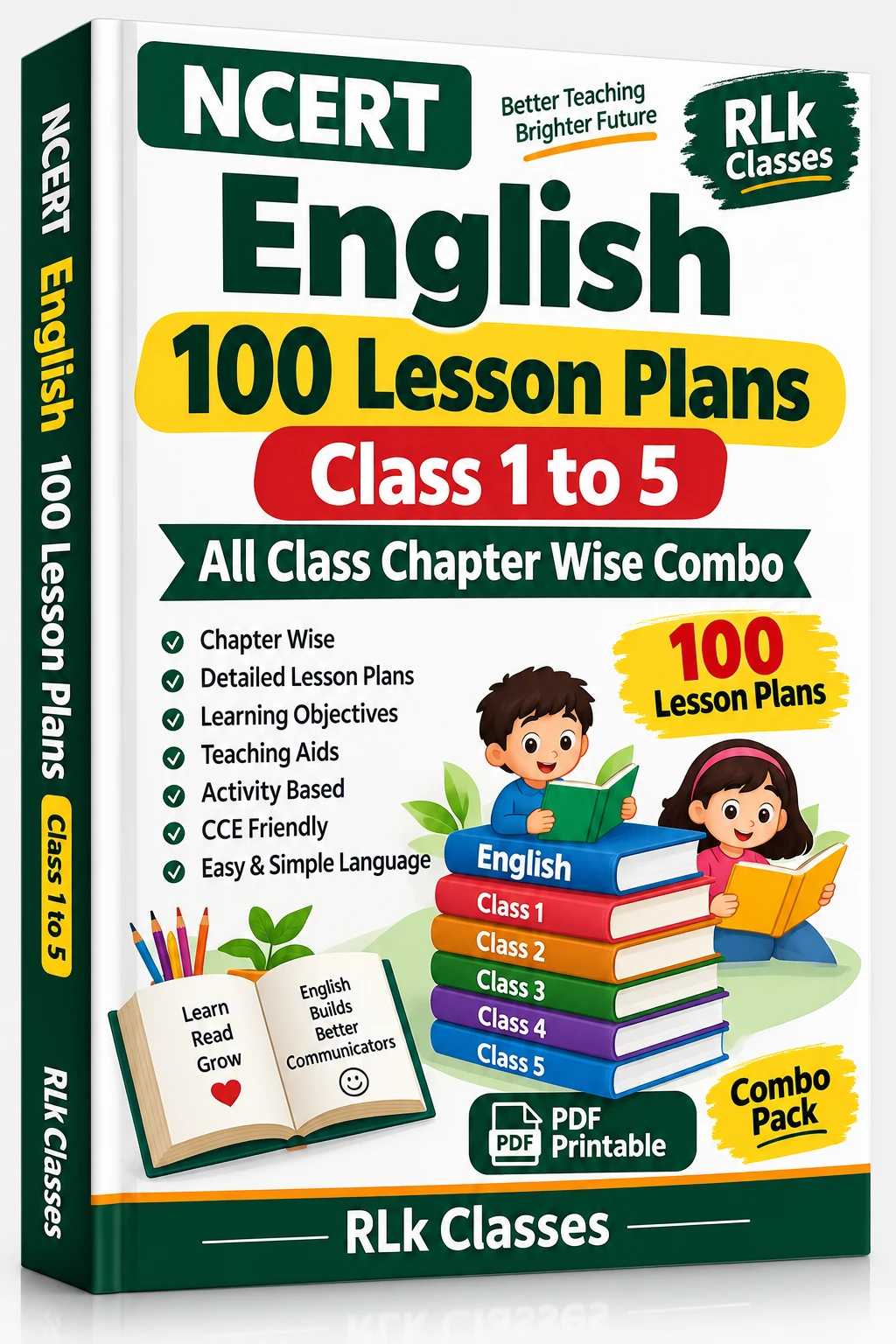
100 NCERT English Combo Class 1–5 — Download Pdf
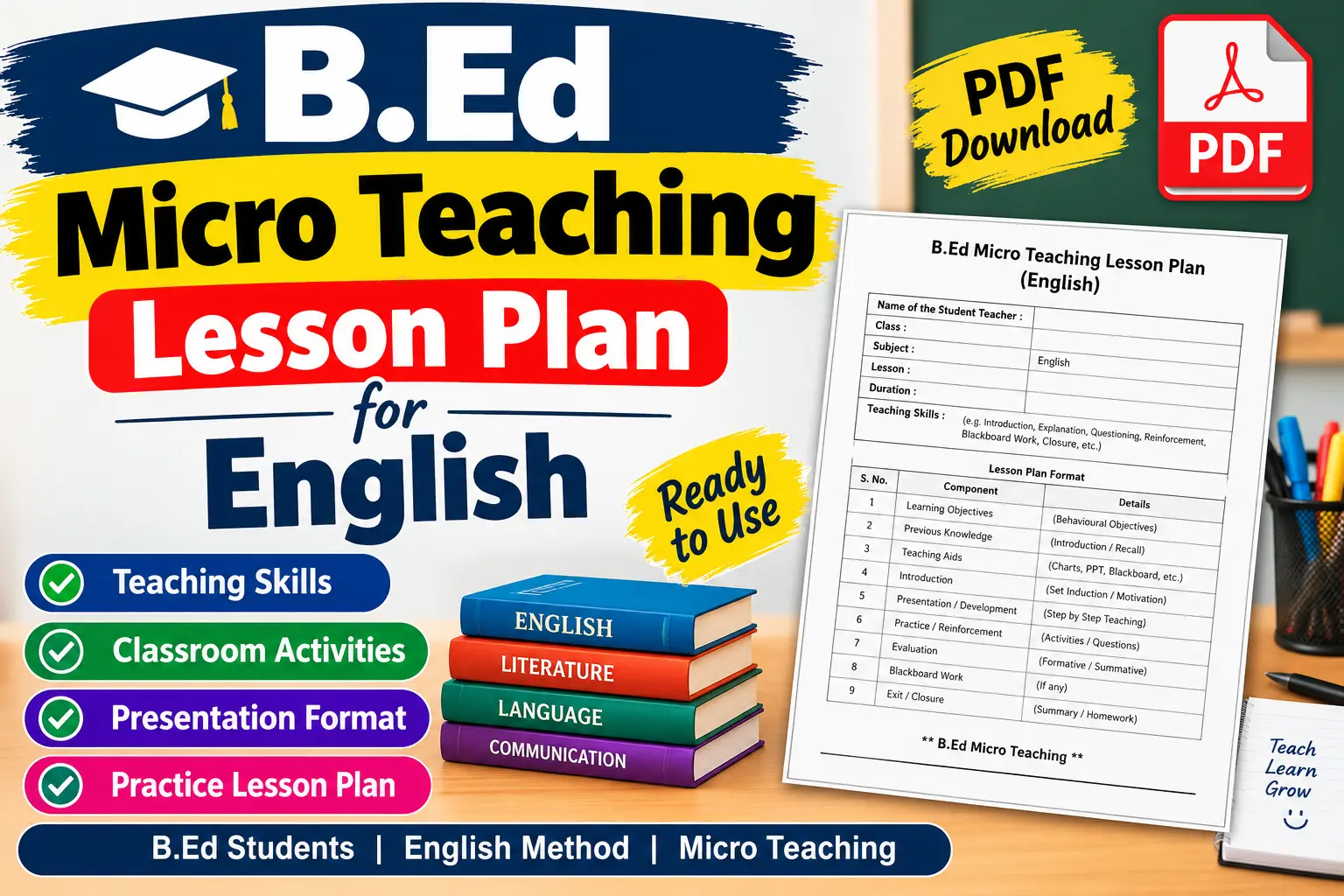
English Lesson Plan Format for D.El.Ed
एक व्यवस्थित English lesson plan में निम्नलिखित sections रखे जा सकते हैं। अपने संस्थान द्वारा दिए गए prescribed format को प्राथमिकता दें।
| Section | क्या लिखें? |
|---|---|
| General Information | Class, subject, topic, date और duration |
| General Objectives | English language learning के व्यापक उद्देश्य |
| Specific Objectives | पाठ के बाद विद्यार्थियों से अपेक्षित learning outcomes |
| Teaching Aids | Blackboard, textbook, flashcards, pictures आदि |
| Previous Knowledge | विद्यार्थियों के पूर्व ज्ञान से संबंधित जानकारी |
| Introduction | पूर्व ज्ञान आधारित प्रश्न और उत्तर |
| Announcement of Topic | पाठ के उद्देश्य की घोषणा |
| Presentation | Teaching points, teacher activity, pupil activity और blackboard work |
| Evaluation | Learning outcomes जाँचने वाले प्रश्न |
| Homework | पाठ से संबंधित अभ्यास कार्य |
Sample English Lesson Plan – Class 3
NCERT • CLASS 3 • ENGLISH
All 12 – English Lesson Plans
SANTOOR – CLASS 3
Complete Chapter-Wise Lesson Plans | English Medium
Teaching Objectives • Introduction • Presentation • Assessment • Homework
RLK CLASSES
Prepared by: Roshan Kanwa
Visit RLK ClassesAbout This lesson plan english class 1 to 5
This collection contains 12 chapter-wise English lesson plans for Class 3 based on the NCERT textbook Santoor. Each plan includes a 40-minute teaching period, specific learning objectives, teaching-learning materials, prior knowledge, five introductory question-answer pairs, a detailed classroom presentation, assessment questions and homework.Teacher note: The activities and questions below are original teaching aids aligned with each chapter’s theme. Check the actual textbook illustrations, wording and exercises while delivering the lesson.
Contents / Index
- Colours
- Badal and Moti
- Best Friends
- Out in the Garden
- Talking Toys
- Paper Boats
- The Big Laddoo
- Thank God!
- Madhu’s Wish
- Night
- Chanda Mama Counts the Stars
- Chandrayaan
Lesson Plan 1: Colours
1. General Objectives
- To develop listening, speaking, reading and writing skills in English.
- To develop observation, imagination and the ability to describe familiar objects.
- To build confidence in using simple English words and sentences.
2. Specific Learning Objectives
- Students will identify and name common colours in English.
- Students will connect colours with familiar objects such as leaves, flowers, the sky and fruits.
- Students will answer simple oral questions using complete sentences.
- Students will read colour words and write short descriptive sentences.
3. Expected Behavioural Changes
- Students will name at least five colours correctly.
- Students will describe familiar objects using colour words, such as “The leaf is green.”
4. Previous Knowledge
Students already see different colours in their surroundings and may know some colour names in their home language.5. Introduction –
| Teacher’s Question | Students’ Answer |
|---|---|
| 1. What do we see in a garden? | Flowers. |
| 2. What colour are many leaves? | Green. |
| 3. Which colour do we see in a ripe banana? | Yellow. |
| 4. What colour is a clear daytime sky? | Blue. |
| 5. What are we going to learn about today? | Colours. |
Announcement of Aim: “Today, we will learn the names of colours and use them to describe the world around us.”
6. Presentation / Teaching-Learning Process
| Teaching Point | Teacher’s Activity | Pupil’s Activity | Blackboard Summary | Time |
|---|---|---|---|---|
| Observation of colours | The teacher displays colour cards and asks learners to observe each colour carefully. The teacher connects the cards with objects found in daily life. | Students observe, point to familiar colours and share examples from the classroom or home. | Colours around us | 7 min |
| Names of colours | The teacher pronounces red, blue, green, yellow, black, white and orange clearly. Students repeat the words, first together and then individually. | Students listen, repeat the words and match the spoken word with the correct card. | Red, blue, green, yellow | 8 min |
| Colour-object association | The teacher shows a leaf, a flower picture and a fruit picture. The teacher models sentences such as “The leaf is green” and “The banana is yellow.” | Students identify the objects and produce similar sentences using colour words. | The leaf is green. The banana is yellow. |
10 min |
| Speaking and reading | The teacher asks learners to read the colour words and describe one object using a complete sentence. Gentle correction is provided for pronunciation. | Students read aloud and speak about one object they can see. | I can see a red flower. | 8 min |
| Recapitulation | The teacher holds up a colour card and asks learners to name it. The teacher checks understanding through quick oral questions. | Students identify the colours and answer independently. | Colours describe objects. | 7 min |
7. Assessment
- MCQ: Which colour are many leaves? (a) Green (b) Pink (c) Black. Answer: Green.
- Fill in the blank: A ripe banana is often _____. Answer: yellow.
- One-word answer: What colour is a clear daytime sky? Answer: Blue.
- One-word answer: Name a colour commonly associated with snow. Answer: White.
- Short answer: Write one sentence about the colour of an object. Sample: My bag is blue.
8. Homework
- Draw and colour five familiar objects in your notebook.
- Write five sentences using colour words, for example, “The grass is green.”
9. Teacher’s Reflection
Did students identify the colours without help? Could they speak in complete sentences? Which learners need more practice with pronunciation or spelling?Lesson Plan 2: Badal and Moti
1. General Objectives
- To improve listening and reading comprehension through a story.
- To develop the ability to describe characters, actions and events.
- To encourage empathy and responsible behaviour towards animals.
2. Specific Learning Objectives
- Students will identify the main characters and describe them using simple words.
- Students will listen to a passage and recall important details.
- Students will practise action words and simple past-tense forms in context.
- Students will express their ideas about friendship and care for animals.
3. Expected Behavioural Changes
- Students will narrate a short event in sequence.
- Students will demonstrate kindness and care when discussing animals.
4. Previous Knowledge
Students know that stories often have characters, actions and a beginning, middle and ending. They may have seen or heard about animals and their behaviour.5. Introduction –
| Teacher’s Question | Students’ Answer |
|---|---|
| 1. Which animals do you see around your home or village? | Dogs, cows, cats. |
| 2. What should we give a pet when it is thirsty? | Water. |
| 3. How should we behave with animals? | Kindly. |
| 4. What do we call the people or animals we care about? | Friends. |
| 5. Which two names are in today’s lesson title? | Badal and Moti. |
Announcement of Aim: “Today, we will read about Badal and Moti, understand the events in their story and learn to describe characters and actions.”
6. Presentation / Teaching-Learning Process
| Teaching Point | Teacher’s Activity | Pupil’s Activity | Blackboard Summary | Time |
|---|---|---|---|---|
| Pre-reading and prediction | The teacher asks learners to look at the textbook title and illustrations. Students are invited to predict who Badal and Moti might be. | Students observe the pictures and share predictions using short sentences. | Title: Badal and Moti | 6 min |
| Listening to the story | The teacher reads the selected passage aloud with clear pronunciation, suitable pauses and expression. The teacher explains unfamiliar words in context. | Students listen attentively, follow the text and identify character names and actions. | Characters and actions | 9 min |
| Comprehension | The teacher asks who appears in the story, what happens and what the characters do. Questions are based on the actual textbook passage. | Students locate details in the text and answer in complete sentences. | Who? What? Where? | 9 min |
| Vocabulary and language | The teacher selects action words from the lesson and models their use in simple sentences. Where appropriate, the teacher demonstrates a base verb and its past form. | Students repeat the words and create their own sentences about an action. | Action words play – played |
9 min |
| Role-play and review | The teacher invites pairs to read or act out a short exchange inspired by the lesson, without changing the original story events. | Students perform the exchange and tell one thing they learnt from the story. | Kindness and care | 7 min |
7. Assessment
- MCQ: What helps us understand a story? (a) Characters and events (b) Only colours (c) Only numbers. Answer: Characters and events.
- Fill in the blank: We should treat animals with _____. Answer: kindness.
- One-word answer: What do we call the people or animals we care about? Answer: Friends.
- One-word answer: Which word asks about a person or character? Answer: Who.
- Short answer: Write one sentence describing a character or event from the textbook story.
8. Homework
- Read the assigned passage aloud at home.
- Write five words from the lesson and use any three in sentences.
- Draw one character from the story and write two sentences about it.
9. Teacher’s Reflection
Could students identify the characters and recall events? Did they use the selected vocabulary correctly? Who needs support with reading fluency?Lesson Plan 3: Best Friends
1. General Objectives
- To strengthen reading comprehension and oral communication.
- To develop positive social values such as cooperation, sharing and respect.
- To help students form simple, meaningful sentences in English.
2. Specific Learning Objectives
- Students will identify the people or characters in the lesson and describe their relationship.
- Students will use words related to friendship, feelings and actions.
- Students will answer questions about events and give simple reasons for their opinions.
- Students will practise the use of “a” and “an” with familiar nouns where appropriate.
3. Expected Behavioural Changes
- Students will show willingness to share and work with classmates.
- Students will express a simple idea about friendship respectfully.
4. Previous Knowledge
Students know classmates, family members and people they enjoy playing or learning with.5. Introduction –
| Teacher’s Question | Students’ Answer |
|---|---|
| 1. Who do you enjoy playing with? | My friend. |
| 2. What can friends do together? | Play. |
| 3. How do you feel when a friend helps you? | Happy. |
| 4. What should you do if a friend needs help? | Help them. |
| 5. What is our topic today? | Best Friends. |
Announcement of Aim: “Today, we will read Best Friends and discuss how friendship, kindness and cooperation make our lives better.”
6. Presentation / Teaching-Learning Process
| Teaching Point | Teacher’s Activity | Pupil’s Activity | Blackboard Summary | Time |
|---|---|---|---|---|
| Warm-up discussion | The teacher asks what makes someone a good friend and records simple responses such as helpful, kind and honest. | Students share examples of helping, sharing and playing fairly. | A good friend is kind. | 6 min |
| Model reading | The teacher introduces the title and reads the assigned passage aloud, pausing to explain difficult words and demonstrate expression. | Students follow the text, listen and repeat selected words. | Listen and read carefully. | 9 min |
| Characters and events | The teacher asks learners to identify the characters, describe what they do and explain how the events show friendship. | Students refer to the text and answer using complete sentences. | Characters – Actions – Feelings | 9 min |
| Vocabulary and grammar | The teacher develops a word bank of friendship words and gives familiar examples of “a” and “an”, such as “a friend” and “an apple”. | Students classify example nouns and create sentences about a friend. | a friend an apple |
9 min |
| Pair activity and review | The teacher asks pairs to practise a short conversation about helping a friend and then summarise one message from the lesson. | Students perform the conversation and share their learning. | Share • Help • Respect | 7 min |
7. Assessment
- MCQ: Which action shows friendship? (a) Helping a classmate (b) Pushing a classmate (c) Hiding a classmate’s book. Answer: Helping a classmate.
- Fill in the blank: We should _____ with our friends. Answer: share.
- One-word answer: What do we call someone we like and care about? Answer: Friend.
- One-word answer: Which article is used before “apple” in “___ apple”? Answer: An.
- Short answer: Write two sentences about how you can be a good friend.
8. Homework
- Write five sentences about your best friend or a person who helps you.
- Learn five new words from the lesson and practise reading them aloud.
9. Teacher’s Reflection
Did students participate respectfully? Could they explain the characters’ actions and use “a” and “an” in familiar examples?Lesson Plan 4: Out in the Garden
1. General Objectives
- To develop descriptive language through observation of nature.
- To improve reading, listening and speaking skills.
- To promote care for plants and the environment.
2. Specific Learning Objectives
- Students will identify common garden objects, plants and living things.
- Students will describe objects using simple nouns, verbs and adjectives.
- Students will ask and answer questions about what they see in a garden.
- Students will follow simple instructions to create or describe a paper-bag puppet activity associated with the lesson.
3. Expected Behavioural Changes
- Students will observe nature carefully and describe it in simple English.
- Students will demonstrate care for plants and avoid damaging them.
4. Previous Knowledge
Students may have visited a garden and seen flowers, leaves, grass, insects and birds.5. Introduction –
| Teacher’s Question | Students’ Answer |
|---|---|
| 1. Where can we see flowers and plants? | In a garden. |
| 2. What do plants need to grow? | Water. |
| 3. Which small creature may visit a flower? | A bee. |
| 4. What should we do to protect plants? | Care for them. |
| 5. Which place are we going to explore in English today? | A garden. |
Announcement of Aim: “Today, we will explore the language of gardens and describe the plants, creatures and activities we observe.”
6. Presentation / Teaching-Learning Process
| Teaching Point | Teacher’s Activity | Pupil’s Activity | Blackboard Summary | Time |
|---|---|---|---|---|
| Picture observation | The teacher displays a garden picture and invites learners to identify visible objects, colours, shapes and living things. | Students name objects and describe what they notice. | Garden: plants, flowers, grass | 6 min |
| Reading and vocabulary | The teacher reads the relevant passage or instructions from the textbook and explains selected words through pictures and gestures. | Students follow the text, repeat new words and match words with pictures. | Flower • Leaf • Bee • Grass | 9 min |
| Describing nature | The teacher models sentences such as “The flower is bright” and “A bee visits a flower”, adapting examples to the pictures and text. | Students make their own descriptive sentences using nouns, action words and describing words. | The flower is bright. | 9 min |
| Speaking and creative work | The teacher guides students to describe a garden scene. If using the book’s craft activity, the teacher demonstrates safe handling of materials and the steps for a paper-bag puppet. | Students describe the scene, follow instructions and create a simple puppet if materials are available. | Observe • Describe • Create | 9 min |
| Review and environment care | The teacher asks what students can do to protect gardens and checks understanding through quick oral questions. | Students suggest watering plants, avoiding litter and not plucking flowers unnecessarily. | Keep gardens clean. | 7 min |
7. Assessment
- MCQ: Which one grows in a garden? (a) Flower (b) Chair (c) Shoe. Answer: Flower.
- Fill in the blank: Plants need water to _____. Answer: grow.
- One-word answer: Name one part of a plant. Answer: Leaf.
- One-word answer: Name an insect that may visit a flower. Answer: Bee.
- Short answer: Write two sentences describing a garden.
8. Homework
- Draw a garden and label five things in English.
- Write five sentences about how to care for plants.
9. Teacher’s Reflection
Could students use descriptive words? Did the activity encourage observation and environmental responsibility?Lesson Plan 5: Talking Toys
1. General Objectives
- To develop speaking and listening through imaginative conversation.
- To encourage creativity and expressive reading.
- To practise describing objects and speaking politely.
2. Specific Learning Objectives
- Students will identify toys and describe them using simple adjectives.
- Students will distinguish between an object and an imagined speaking character.
- Students will practise a short dialogue with suitable expression.
- Students will follow the steps of a simple kite-making activity if the textbook activity is being taught.
3. Expected Behavioural Changes
- Students will communicate ideas creatively and listen when others speak.
- Students will share classroom materials carefully and safely.
4. Previous Knowledge
Students know familiar toys and can describe their colour, size and use.5. Introduction –
| Teacher’s Question | Students’ Answer |
|---|---|
| 1. What do children enjoy playing with? | Toys. |
| 2. Name a toy that has wheels. | A toy car. |
| 3. Can a real toy speak like a person? | No. |
| 4. What do we call a conversation between two people? | A dialogue. |
| 5. What is the title of today’s lesson? | Talking Toys. |
Announcement of Aim: “Today, we will read Talking Toys, describe toys and use imagination to practise a short dialogue.”
6. Presentation / Teaching-Learning Process
| Teaching Point | Teacher’s Activity | Pupil’s Activity | Blackboard Summary | Time |
|---|---|---|---|---|
| Introduction to toys | The teacher displays toy pictures or safe classroom toys and asks learners to name and describe them. | Students identify toys and use words such as small, soft, colourful and round. | My toy is colourful. | 6 min |
| Expressive reading | The teacher reads the selected textbook passage with different voices where suitable, demonstrating how expression can make dialogue lively. | Students follow the text and identify who is speaking in each exchange. | Speaker and listener | 9 min |
| Comprehension | The teacher asks questions about the characters, toys and events in the actual lesson. Unfamiliar words are explained with examples. | Students find relevant details in the text and answer in full sentences. | Who? What? Why? | 9 min |
| Dialogue practice | The teacher models a short original dialogue, for example: “Hello, Teddy!” “Hello! Let us play.” The teacher reminds students to take turns. | Pairs practise the dialogue with clear pronunciation and suitable expression. | Speak clearly. Listen carefully. |
9 min |
| Creative activity and recap | The teacher asks learners to imagine what a favourite toy might say. If teaching the textbook craft, the teacher supervises a safe kite-making demonstration. | Students share an imaginative sentence and describe their toy or craft. | Imagination and expression | 7 min |
7. Assessment
- MCQ: Which is a toy? (a) Toy car (b) River (c) Cloud. Answer: Toy car.
- Fill in the blank: Two people speaking to each other are having a _____. Answer: conversation.
- One-word answer: Name one toy. Answer: Teddy.
- One-word answer: Which word describes size: “small” or “run”? Answer: Small.
- Short answer: Write two lines of an imaginary conversation between you and a toy.
8. Homework
- Draw your favourite toy and write four sentences about it.
- Practise a short dialogue with a family member.
9. Teacher’s Reflection
Did learners speak confidently in pairs? Were they able to follow a dialogue and use descriptive words?Lesson Plan 6: Paper Boats
1. General Objectives
- To develop listening, speaking and reading skills through a poem or text.
- To encourage imagination and enjoyment of language.
- To teach students to follow instructions in the correct sequence.
2. Specific Learning Objectives
- Students will identify the central idea and important images in the lesson.
- Students will read or recite selected lines with suitable rhythm and expression.
- Students will use words associated with water, boats and movement.
- Students will follow simple steps to fold a paper boat and explain the process.
3. Expected Behavioural Changes
- Students will express imaginative ideas using simple English.
- Students will follow instructions carefully and use paper responsibly.
4. Previous Knowledge
Students have seen boats in pictures or on water and know that paper can be folded into different shapes.5. Introduction –
| Teacher’s Question | Students’ Answer |
|---|---|
| 1. What can float on water? | A boat. |
| 2. What material can we fold to make a toy boat? | Paper. |
| 3. What happens when rain fills a small puddle? | It holds water. |
| 4. What helps us enjoy a poem? | Rhythm. |
| 5. Which activity are we learning about today? | Paper boats. |
Announcement of Aim: “Today, we will enjoy Paper Boats, explore its images and practise following instructions to fold a paper boat.”
6. Presentation / Teaching-Learning Process
| Teaching Point | Teacher’s Activity | Pupil’s Activity | Blackboard Summary | Time |
|---|---|---|---|---|
| Picture and idea discussion | The teacher shows a paper-boat picture and asks what children might imagine while watching a boat float. | Students describe their ideas and connect them with rain, water or play. | Paper boats and imagination | 6 min |
| Model reading or recitation | The teacher reads the lesson with clear pronunciation, rhythm and appropriate pauses. The teacher explains the meaning of difficult words without replacing the text. | Students listen, follow the text and repeat selected lines or phrases. | Read with expression. | 9 min |
| Comprehension and imagery | The teacher asks what the speaker sees, imagines or describes in the actual text and encourages students to identify words that create pictures in the mind. | Students respond using details from the lesson and describe a scene in their own words. | Words create pictures. | 9 min |
| Vocabulary and sequencing | The teacher introduces relevant words such as fold, float, water and boat. The teacher demonstrates folding a paper boat in clear steps. | Students repeat the words and follow each folding instruction in sequence. | Fold • Float • Boat | 9 min |
| Recitation and review | The teacher invites students to recite selected lines and explain one thing they imagined or learnt. | Students recite individually or in groups and share their responses. | Rhythm and imagination | 7 min |
7. Assessment
- MCQ: Which material is used to make a paper boat? (a) Paper (b) Stone (c) Glass. Answer: Paper.
- Fill in the blank: A boat can _____ on water. Answer: float.
- One-word answer: What do we fold to make a paper boat? Answer: Paper.
- One-word answer: What do we call the regular beat or flow of a poem? Answer: Rhythm.
- Short answer: Write two sentences about making or playing with a paper boat.
8. Homework
- Make a paper boat with an adult’s guidance and draw it in your notebook.
- Write five words from the lesson and use three of them in sentences.
9. Teacher’s Reflection
Could learners follow the recitation and sequencing? Were they able to explain the poem or text using their own words?Lesson Plan 7: The Big Laddoo
1. General Objectives
- To develop comprehension through a story connected with familiar food.
- To build vocabulary for food, size, quantity and actions.
- To promote sharing, healthy habits and respectful conversation about food.
2. Specific Learning Objectives
- Students will identify the central event and characters in the lesson.
- Students will use describing words such as big, small, round and sweet.
- Students will retell the main events in a logical sequence.
- Students will discuss sharing and responsible eating in simple English.
3. Expected Behavioural Changes
- Students will describe familiar food with appropriate vocabulary.
- Students will show a willingness to share and avoid wasting food.
4. Previous Knowledge
Students have seen or eaten familiar sweets and know that objects and foods can be described by their size, shape and taste.5. Introduction –
| Teacher’s Question | Students’ Answer |
|---|---|
| 1. Name a sweet that is round. | Laddoo. |
| 2. What word describes something very large? | Big. |
| 3. What should we do before eating food? | Wash our hands. |
| 4. What can we do when we have food to share? | Share it. |
| 5. Which story are we going to read? | The Big Laddoo. |
Announcement of Aim: “Today, we will read The Big Laddoo, describe food and characters, and discuss the importance of sharing.”
6. Presentation / Teaching-Learning Process
| Teaching Point | Teacher’s Activity | Pupil’s Activity | Blackboard Summary | Time |
|---|---|---|---|---|
| Introduction to the title | The teacher shows a picture of a laddoo and asks students to describe its shape, size and colour. | Students observe the picture and suggest suitable describing words. | A laddoo is a sweet. | 6 min |
| Reading the story | The teacher reads the assigned story with clear expression and explains difficult words using pictures or gestures. | Students follow the text and identify the characters and important events. | Characters and events | 9 min |
| Understanding the events | The teacher asks what happens in the story, what the characters do and how the events are connected. Questions follow the textbook passage. | Students locate clues in the text and respond in complete sentences. | Beginning – Middle – End | 9 min |
| Vocabulary and describing words | The teacher contrasts big/small, round/flat and sweet/sour using familiar objects. The teacher asks students to create descriptive phrases. | Students match words with pictures and describe a familiar food. | big / small round / sweet |
9 min |
| Value discussion and recap | The teacher leads a discussion on sharing food, avoiding waste and washing hands before meals. | Students explain one good habit and summarise one event from the story. | Share food. Avoid waste. | 7 min |
7. Assessment
- MCQ: Which word describes a large laddoo? (a) Big (b) Tiny (c) Empty. Answer: Big.
- Fill in the blank: We should wash our _____ before eating. Answer: hands.
- One-word answer: Name the sweet in the title. Answer: Laddoo.
- One-word answer: What is the opposite of “big”? Answer: Small.
- Short answer: Write two sentences about sharing food or avoiding food waste.
8. Homework
- Draw a favourite food item and write four descriptive sentences about it.
- Read the assigned part of the story and tell its main event to a family member.
9. Teacher’s Reflection
Were students able to identify the sequence of events? Could they use describing words and discuss sharing respectfully?Lesson Plan 8: Thank God!
1. General Objectives
- To develop reading comprehension and oral expression.
- To encourage gratitude, care and appreciation for the things that support life.
- To develop vocabulary associated with food, nature and everyday experiences.
2. Specific Learning Objectives
- Students will identify the main idea and key details from the assigned text.
- Students will describe what they appreciate in their daily lives.
- Students will answer simple questions in complete sentences.
- Students will practise listening to others and expressing thanks politely.
3. Expected Behavioural Changes
- Students will use polite expressions such as “Thank you” appropriately.
- Students will appreciate food, nature and help received from others.
4. Previous Knowledge
Students have experienced receiving help from family, friends or teachers and know common expressions of thanks.5. Introduction –
| Teacher’s Question | Students’ Answer |
|---|---|
| 1. What do you say when someone helps you? | Thank you. |
| 2. Who helps you learn at school? | My teacher. |
| 3. What should we do with food? | Respect it. |
| 4. How can we show appreciation for help? | Say thanks. |
| 5. What is today’s lesson title? | Thank God! |
Announcement of Aim: “Today, we will read Thank God!, understand its central idea and practise expressing gratitude in simple English.”
6. Presentation / Teaching-Learning Process
| Teaching Point | Teacher’s Activity | Pupil’s Activity | Blackboard Summary | Time |
|---|---|---|---|---|
| Warm-up conversation | The teacher asks students to name people, experiences or things they appreciate, accepting different personal responses respectfully. | Students share examples such as family support, friendship, food or a helpful teacher. | Gratitude means being thankful. | 6 min |
| Guided reading | The teacher reads the relevant textbook passage aloud and explains unfamiliar words using context and illustrations. | Students follow the text, listen and read selected lines with the teacher. | Read for meaning. | 9 min |
| Comprehension | The teacher asks questions about the main idea, important details and feelings expressed in the actual lesson. | Students identify evidence in the passage and answer in complete sentences. | Main idea and details | 9 min |
| Polite expressions | The teacher models short everyday exchanges using “Thank you”, “You are welcome” and “Please”. The teacher explains when each expression is used. | Pairs practise the exchanges with clear pronunciation and suitable manners. | Please • Thank you You are welcome. |
9 min |
| Creative response and review | The teacher asks students to complete the sentence “I am thankful for _____ because _____.” The textbook’s fruit-salad craft can be discussed or demonstrated with attention to hygiene and safety. | Students write or say their response and identify one helpful habit. | I am thankful for… | 7 min |
7. Assessment
- MCQ: Which expression shows gratitude? (a) Thank you (b) Go away (c) Be quiet. Answer: Thank you.
- Fill in the blank: We say “Thank _____” to show gratitude. Answer: you.
- One-word answer: What is the opposite of “thankful” in meaning? Answer: Ungrateful.
- One-word answer: Which polite word can we use when requesting something? Answer: Please.
- Short answer: Write two sentences about something you are thankful for.
8. Homework
- Write five sentences beginning with “I am thankful for…”
- Practise saying “please” and “thank you” in suitable everyday situations.
9. Teacher’s Reflection
Did learners understand the main idea? Could they use polite expressions in the correct context?Lesson Plan 9: Madhu’s Wish
1. General Objectives
- To develop story comprehension, imagination and oral expression.
- To help learners express wishes, feelings and preferences in English.
- To practise sentence formation and connect ideas meaningfully.
2. Specific Learning Objectives
- Students will identify Madhu and the key events in the story.
- Students will explain a character’s wish using details from the text.
- Students will express their own wishes using simple sentences.
- Students will practise joining two related ideas into a meaningful sentence.
3. Expected Behavioural Changes
- Students will express personal ideas confidently and listen respectfully to classmates.
- Students will distinguish between a wish and a plan to work towards a goal.
4. Previous Knowledge
Students have hopes and preferences and can express them using familiar phrases such as “I want…” and “I wish…”.5. Introduction –
| Teacher’s Question | Students’ Answer |
|---|---|
| 1. What do you want to learn or do? | To read well. |
| 2. What word can express a hope or desire? | Wish. |
| 3. Can people have different wishes? | Yes. |
| 4. What should we do to achieve a goal? | Work hard. |
| 5. Whose wish will we read about today? | Madhu’s. |
Announcement of Aim: “Today, we will read Madhu’s Wish, explore the character’s ideas and practise expressing wishes in English.”
6. Presentation / Teaching-Learning Process
| Teaching Point | Teacher’s Activity | Pupil’s Activity | Blackboard Summary | Time |
|---|---|---|---|---|
| Predicting from the title | The teacher writes the title and asks what Madhu might wish for. The teacher welcomes predictions without presenting them as facts about the story. | Students make predictions and explain their ideas briefly. | Madhu’s Wish | 6 min |
| Reading the lesson | The teacher reads the relevant passage and clarifies unfamiliar words. Students are asked to listen for what Madhu wants and why. | Students follow the text and identify details about the character’s wish. | Character • Wish • Reason | 9 min |
| Understanding character and events | The teacher asks questions about Madhu’s wish and the events surrounding it, using the actual text for answers. | Students locate details and answer in complete sentences. | What does Madhu wish for? | 9 min |
| Sentence-building | The teacher models “I wish to…” and “I want to…”. The teacher demonstrates joining two related short sentences with “and” where suitable. | Students complete sentence starters and combine simple ideas with guidance. | I wish to learn. I read and write. |
9 min |
| Personal response and recap | The teacher invites students to share a wish and one practical step that could help them move towards it. | Students speak or write one wish and one action they can take. | Wish + effort | 7 min |
7. Assessment
- MCQ: Which sentence expresses a wish? (a) I wish to learn music. (b) The desk is brown. (c) Open the door. Answer: I wish to learn music.
- Fill in the blank: I _____ to become a good reader. Answer: wish.
- One-word answer: What do we call a hope or desire? Answer: Wish.
- One-word answer: Which word can join “I sing” and “I dance”? Answer: And.
- Short answer: Write two sentences about a wish and how you could work towards it.
8. Homework
- Write five sentences beginning with “I wish…” or “I want to…”.
- Write a short paragraph of four sentences about one personal goal.
9. Teacher’s Reflection
Could students explain the character’s wish using textual evidence? Were they able to form meaningful sentences about their own hopes?Lesson Plan 10: Night
1. General Objectives
- To develop listening, recitation and reading fluency.
- To enrich vocabulary related to the sky, darkness, light and the natural world.
- To encourage observation and appreciation of nature.
2. Specific Learning Objectives
- Students will identify the central idea and imagery of the lesson.
- Students will read or recite selected lines with rhythm and suitable pauses.
- Students will compare familiar features of day and night.
- Students will use simple adjectives and sentences to describe the night sky.
3. Expected Behavioural Changes
- Students will describe natural observations using relevant vocabulary.
- Students will listen attentively and recite with growing confidence.
4. Previous Knowledge
Students know that daytime is generally bright and nighttime is generally dark, and may have observed the Moon and stars.5. Introduction –
| Teacher’s Question | Students’ Answer |
|---|---|
| 1. When do we usually see the stars? | At night. |
| 2. What gives us light during the day? | The Sun. |
| 3. What may we see in the night sky? | The Moon. |
| 4. Which word describes a sky with little light? | Dark. |
| 5. What is today’s lesson title? | Night. |
Announcement of Aim: “Today, we will read Night, notice the pictures created by the words and describe the night sky.”
6. Presentation / Teaching-Learning Process
| Teaching Point | Teacher’s Activity | Pupil’s Activity | Blackboard Summary | Time |
|---|---|---|---|---|
| Day and night observation | The teacher displays day and night pictures and asks students to compare the light, sky and activities they associate with each. | Students identify differences and share their observations. | Day / Night | 6 min |
| Model recitation | The teacher reads the lesson with rhythm, clear pronunciation and pauses. Difficult words are explained in context. | Students listen, follow the printed text and repeat selected lines. | Read with rhythm. | 9 min |
| Imagery and comprehension | The teacher asks what the words make students imagine and checks answers against the actual lesson. | Students describe the scene and identify details from the text. | Images in words | 9 min |
| Vocabulary and description | The teacher introduces relevant words such as dark, quiet, moon and star. The teacher models a descriptive sentence about the night sky. | Students use the words in oral sentences and read them aloud. | The night sky is dark. | 9 min |
| Recitation and review | The teacher leads a group recitation and asks students to share one difference between day and night. | Students recite and explain their observations in simple English. | Observe • Describe • Recite | 7 min |
7. Assessment
- MCQ: When do we usually see stars clearly? (a) At night (b) At noon (c) In a closed cupboard. Answer: At night.
- Fill in the blank: The Sun gives us light during the _____. Answer: day.
- One-word answer: Name one object seen in the night sky. Answer: Moon.
- One-word answer: What is the opposite of “dark”? Answer: Bright.
- Short answer: Write two sentences describing the night sky.
8. Homework
- Draw a night sky and label the Moon and stars.
- Write four sentences comparing day and night.
9. Teacher’s Reflection
Could students recite with suitable pauses? Were they able to identify imagery and describe the night sky?Lesson Plan 11: Chanda Mama Counts the Stars
1. General Objectives
- To integrate language learning with counting and observation.
- To develop fluency, rhythm and vocabulary related to the sky.
- To encourage curiosity and imaginative thinking.
2. Specific Learning Objectives
- Students will identify the main idea and important details in the lesson.
- Students will practise reading or reciting with expression.
- Students will count picture stars and use number words in English.
- Students will ask and answer simple questions about the Moon and stars.
3. Expected Behavioural Changes
- Students will participate confidently in counting and recitation activities.
- Students will express curiosity about the night sky and respond respectfully to classmates.
4. Previous Knowledge
Students know some number names and have seen pictures of the Moon and stars.5. Introduction –
| Teacher’s Question | Students’ Answer |
|---|---|
| 1. What shines in the night sky? | Stars. |
| 2. What is another familiar name for the Moon in this title? | Chanda Mama. |
| 3. What do we do when we say one, two, three? | Count. |
| 4. Which subject also teaches us to count numbers? | Mathematics. |
| 5. What will we count in today’s lesson title? | Stars. |
Announcement of Aim: “Today, we will read Chanda Mama Counts the Stars and practise language, recitation and counting together.”
6. Presentation / Teaching-Learning Process
| Teaching Point | Teacher’s Activity | Pupil’s Activity | Blackboard Summary | Time |
|---|---|---|---|---|
| Picture discussion | The teacher displays a Moon-and-stars picture and asks students what they notice and whether all stars appear equally bright. | Students observe and describe the picture using familiar words. | Moon and stars | 6 min |
| Model reading and rhythm | The teacher reads or recites the assigned text with rhythm and expression, explaining unfamiliar vocabulary. | Students listen, follow the text and repeat selected lines. | Read and recite. | 9 min |
| Understanding the lesson | The teacher asks what happens in the text and how counting is connected with the Moon or stars. Questions are grounded in the textbook. | Students answer with details from the lesson and explain the main idea. | Who? What? How many? | 9 min |
| Number-word activity | The teacher displays a small number of star cards and models counting them aloud. The teacher links number symbols to English number words. | Students count the cards and say the corresponding number words. | One, two, three, four, five | 9 min |
| Recitation and review | The teacher leads a group recitation and asks students to describe the Moon or stars in one sentence. | Students recite and create short descriptive sentences. | The stars shine at night. | 7 min |
7. Assessment
- MCQ: Which object is mentioned in the title? (a) Stars (b) School bus (c) River. Answer: Stars.
- Fill in the blank: We say number words when we _____. Answer: count.
- One-word answer: What do we call the natural object that appears in the night sky and is named in the title? Answer: Moon.
- One-word answer: What number comes after four? Answer: Five.
- Short answer: Write two sentences about the Moon and stars.
8. Homework
- Draw five stars and label them with the number words one to five.
- Write four sentences about the night sky.
9. Teacher’s Reflection
Could students recite the lesson and count correctly? Did they use number words and descriptive sentences confidently?Lesson Plan 12: Chandrayaan
1. General Objectives
- To develop reading comprehension through a science-related topic.
- To encourage curiosity about space exploration and scientific discovery.
- To build vocabulary and communication skills using familiar scientific ideas.
2. Specific Learning Objectives
- Students will identify Chandrayaan as an Indian lunar exploration programme.
- Students will understand the main idea and selected details from the textbook lesson.
- Students will use simple space-related words in oral and written sentences.
- Students will ask and answer questions about the Moon and space missions.
3. Expected Behavioural Changes
- Students will demonstrate curiosity and interest in science and space.
- Students will listen to others’ ideas and use new vocabulary in simple explanations.
4. Previous Knowledge
Students know the Moon is visible in the sky and may have heard about rockets, astronauts or India’s space programme.5. Introduction –
| Teacher’s Question | Students’ Answer |
|---|---|
| 1. What do we see in the sky at night? | The Moon. |
| 2. What can carry equipment into space? | A rocket. |
| 3. Which country do we live in? | India. |
| 4. What do scientists do to learn new things? | Research. |
| 5. What is the name of India’s lunar exploration programme in today’s lesson? | Chandrayaan. |
Announcement of Aim: “Today, we will read Chandrayaan, learn space-related words and discuss how scientists explore the Moon.”
6. Presentation / Teaching-Learning Process
| Teaching Point | Teacher’s Activity | Pupil’s Activity | Blackboard Summary | Time |
|---|---|---|---|---|
| Motivation and prior knowledge | The teacher displays a picture of the Moon and a spacecraft and asks what learners already know about space exploration. | Students share ideas and ask simple questions about the Moon or rockets. | Exploring the Moon | 6 min |
| Guided reading | The teacher reads the textbook passage with clear pronunciation and explains unfamiliar scientific words with pictures. | Students follow the text and identify key words, names and events. | Chandrayaan – India’s lunar mission | 9 min |
| Comprehension and facts | The teacher asks questions about the mission and its purpose, using the textbook to guide accurate responses. The teacher distinguishes between the Moon and Earth. | Students locate details in the lesson and explain the main idea in simple English. | Earth – Moon – Space | 9 min |
| Vocabulary and sentence practice | The teacher introduces relevant words such as Moon, space, rocket, mission and scientist. The teacher models a sentence and reviews the use of “a” and “an” with familiar examples. | Students read the words, match them to pictures and form sentences such as “A rocket travels into space.” | a rocket an astronaut |
9 min |
| Questioning and recap | The teacher asks students to describe one thing they learnt about Chandrayaan and invites them to imagine a question they would ask a scientist. | Students answer, formulate a simple question and share it with the class. | Ask • Explore • Learn | 7 min |
7. Assessment
- MCQ: Chandrayaan is associated with exploring which celestial body? (a) The Moon (b) The ocean (c) A forest. Answer: The Moon.
- Fill in the blank: India’s lunar exploration programme is called _____. Answer: Chandrayaan.
- One-word answer: What do we call the place beyond Earth’s atmosphere where celestial bodies are found? Answer: Space.
- One-word answer: What vehicle is commonly used to carry a spacecraft into space? Answer: Rocket.
- Short answer: Write two sentences about Chandrayaan or the importance of exploring the Moon.
8. Homework
- Draw the Moon and a spacecraft and label the picture in English.
- Write five sentences about the Moon, space or Chandrayaan.
- Learn five new words from the lesson and use any three in sentences.
9. Teacher’s Reflection
Could students identify the main idea and use the new vocabulary correctly? Were they able to explain one fact about space exploration in their own words?General Teaching Notes for All 12 Lessons
- Teaching period: 40 minutes per lesson; adjust the pace to learners’ needs.
- Reading support: Use shared reading, repeated reading, picture clues and pair reading.
- Writing support: Model one sentence first, then let learners complete sentence starters independently.
- Inclusive teaching: Give extra response time, visual support and oral-response options to learners who need them.
- Assessment: Use the textbook’s actual content and exercise questions for final chapter-specific checking.
Frequently Asked Questions
1. Where can I find an Lesson Plan English Class 1 to 5 PDF?
RLK CLASSES के English lesson plan collection और class-wise resource links से संबंधित posts देखें। PDF खरीदने से पहले उसमें शामिल topics और class coverage की पुष्टि करें।
2. Are these lesson plans useful for D.El.Ed teaching practice?
English lesson plans teaching practice की तैयारी में मदद कर सकते हैं। अपने teacher education institute के निर्धारित format और instructions का पालन करें।
3. Can I purchase separate lesson plan english class 1 to 5 PDFs for each class?
Class-wise purchase options तभी उपलब्ध होंगे जब Class 1, 2, 3, 4 और 5 की अलग-अलग PDFs और payment links प्रकाशित कर दिए जाएँ।
4. What is included in an English Lesson Plan Combo?
इसका वास्तविक content आपकी तैयार की गई PDF पर निर्भर करेगा। Product description में classes, chapters, grammar topics, total plans और printable format स्पष्ट लिखें।
5. Does the collection include NCERT English chapters?
NCERT chapter-wise coverage की पुष्टि संबंधित PDF और current textbook के अनुसार करें। अलग-अलग कक्षाओं में book और chapter names अलग हो सकते हैं।
6. Are English grammar lesson plans included?
Grammar lesson plans को अलग product या combo में शामिल किया जा सकता है। खरीदने से पहले actual topic index देखें।
7. Can I print the English lesson plan PDF?
यदि खरीदी गई file printable PDF है, तो उसे compatible printer से print किया जा सकता है। PDF की page size और print settings पहले जाँच लें।
8. Where can I find English lesson plans for higher classes?
English Lesson Plan Class 6 to 10 वाला संबंधित लेख देखें।
![LESSON PLAN IN HINDI PDF Hindi Lesson Plan - हिंदी पाठ योजना - हिंदी लेसन प्लान B.ed lesson plan in hindi pdf 2024 [Free] Hindi Lesson Plan For B.Ed And DELED](https://rlkclasses.in/wp-content/uploads/2025/01/1000000718.webp)