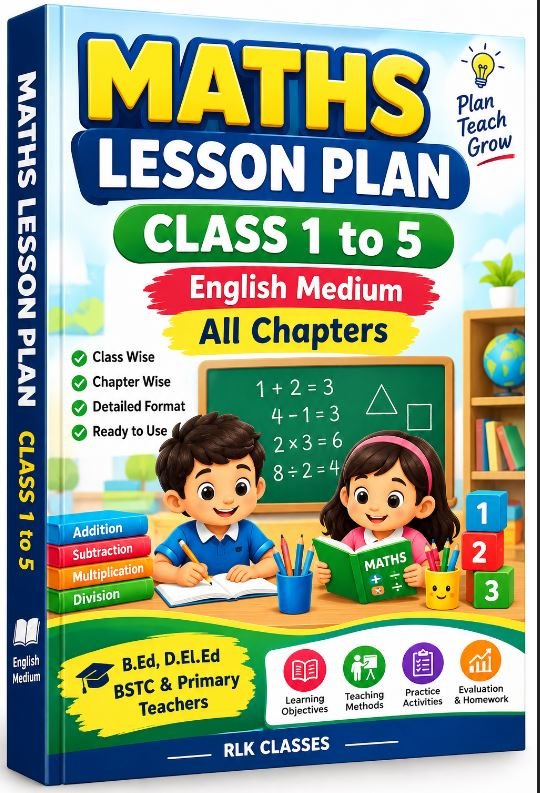
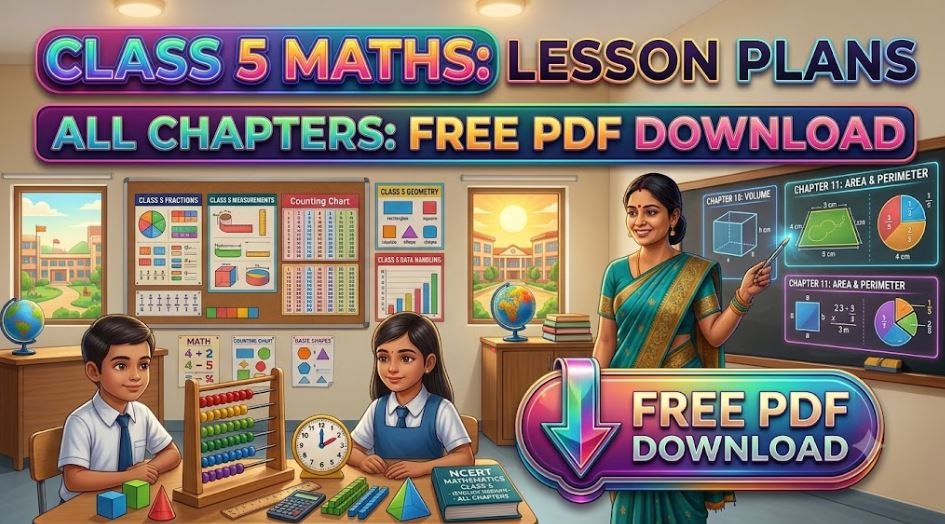
lesson plan math class 5 in English Medium
Class 5 Mathematics Lesson Plans | NCERT | B.Ed | D.El.Ed | BSTC | Primary Teachers
📚 lesson plan math class 5 English Medium
Lesson Plan Math class 5 English Medium primary-level Mathematics teaching को व्यवस्थित और प्रभावी बनाने के लिए उपयोगी resource है। यह B.Ed, D.El.Ed, BSTC students, teacher trainees और primary school teachers के लिए तैयार किया गया है।
Class 5 में विद्यार्थी बड़ी संख्याओं, चारों basic operations, fractions, decimals, geometry, measurement, patterns और वास्तविक जीवन से जुड़े mathematical problems का अभ्यास करते हैं। एक अच्छी lesson plan teacher को objectives, teaching activities, presentation और evaluation को पहले से व्यवस्थित करने में सहायता करती है।
📌 Lesson Plan Math class 5 – Quick Information
🎯 What Is a Lesson Plan Math class 5?
A Lesson Plan Math class 5 is a structured guide that helps teachers organise learning objectives, classroom activities, teaching resources and assessment for a particular lesson.
इसमें previous knowledge, introduction questions, teaching-learning materials, detailed presentation, teacher-pupil activities, blackboard work, evaluation और homework जैसे sections शामिल किए जा सकते हैं।
📝 What Is Included in the Lesson Plan Lesson Plan Math class 5?
- General Information and Subject Details
- Learning Objectives and Learning Outcomes
- Previous Knowledge of Students
- Teaching-Learning Materials
- Introduction with Questions and Answers
- Step-by-Step Teaching Presentation
- Teacher and Student Activities
- Blackboard Summary
- Practice Questions and Classroom Activities
- Evaluation Questions
- Homework and Follow-Up Work
📊 Important Learning Areas in Class 5 Mathematics
| Learning Area | Learning Focus | Suggested Activity |
|---|---|---|
| Numbers and Place Value | Reading, writing, comparing and understanding large numbers | Place-value charts and number cards |
| Addition and Subtraction | Calculations and real-life word problems | Problem-solving cards |
| Multiplication and Division | Multi-step calculations and practical problems | Group tasks and everyday examples |
| Fractions | Equal parts, comparing fractions and practical uses | Paper folding and fraction models |
| Decimals | Decimal notation and everyday applications where prescribed | Money and measurement examples |
| Geometry | Shapes, angles and geometric properties | Shape cards and classroom observation |
| Measurement | Length, weight, capacity and unit conversion as prescribed | Measuring real objects |
| Time and Money | Time calculations and money-related problems | Timetable and pretend-shop activity |
| Patterns and Data | Recognising patterns and interpreting simple data | Pattern puzzles and class surveys |
🎲 Lesson Plan Math class 5 Activity Ideas
Number cards की मदद से विद्यार्थियों को बड़ी संख्याएँ बनाने, compare करने और place value पहचानने का अभ्यास करवाएँ।
Paper strips या circles को बराबर भागों में बाँटकर fractions को चित्रों और practical examples से समझाएँ।
एक pretend shop बनाकर total cost, quantity और change से संबंधित समस्याएँ हल करवाएँ।
Classroom में अलग-अलग shapes और angles के उदाहरण खोजने तथा उनका वर्णन करने को कहें।
🎓 B.Ed, D.El.Ed & BSTC Students के लिए
Teaching practice और internship के दौरान lesson plan classroom teaching की तैयारी को व्यवस्थित करने में मदद करती है। Class 5 Maths lesson plan में objectives, teaching aids, introduction, presentation, pupil participation, blackboard work और evaluation को अपने institute के prescribed format के अनुसार शामिल करें।
🌟 Benefits of a Well-Planned Maths Lesson
 माध्यम से students learning में भाग लेते हैं।
Lesson Plan Math class 5
NCERT MATHS MELA | ENGLISH MEDIUM
ALL 15 CHAPTERS • TEACHING PRACTICE • PRINTABLE FORMAT
CHAPTER INDEX
Lesson Plan Math class 5 Lesson Plan 1: We the Travellers-I
| Subject | Mathematics |
|---|---|
| Topic | Large numbers, number names, place value, estimation and travel problems |
| General Objectives | To develop mathematical reasoning, observation, accuracy, problem-solving skills and the ability to apply mathematics to everyday life. To encourage active participation, logical thinking and clear mathematical communication. |
| Specific Objectives | By the end of the lesson, students will be able to read and write five-digit numbers, expand numbers by place value, round numbers to tens, hundreds and thousands, and solve simple travel-related numerical problems. They will demonstrate understanding through oral responses, practical activities and written exercises. |
| Teaching Aids | Blackboard, chalk, textbook, notebook, worksheets, charts, picture cards and locally available teaching-learning materials related to the topic. |
| Teaching Method | Activity-based learning, demonstration, questioning, discussion, guided practice, observation and individual written work. |
| Previous Knowledge | Learners can count in hundreds and thousands, read three- and four-digit numbers, add and subtract numbers and recognise distances from everyday travel. |
Introduction – Previous Knowledge Testing
The teacher begins with familiar examples, asks the following questions in sequence and uses pupils’ responses to connect previous learning with the new topic.
| Teacher’s Questions | Expected Pupils’ Answers |
|---|---|
| 1. What number comes after 999? (1 min) | 1,000. |
| 2. What is the value of 5 in 5,234? (1 min) | 5,000. |
| 3. Which is greater: 4,500 or 4,050? (1 min) | 4,500. |
| 4. Why do travellers check distance? (1 min) | To plan their journey. |
| 5. What does rounding help us do? (1 min) | Estimate a nearby number. |
Statement of Objective
“Today, we will learn about We the Travellers-I. We will observe examples, discuss mathematical ideas, solve problems and practise applying the concept to everyday situations.”
Presentation
The teacher proceeds from simple examples to the mathematical concept. Questions alternate with demonstrations, pupil responses and practical activities.
| Teaching Point | Pupil-Teacher Activity | Pupil Activity | Blackboard Summary |
|---|---|---|---|
| 1. Reading large numbers (8 min) | The teacher writes 23,456 on the board and asks, “How can we read this number correctly? What does each digit represent?” The teacher groups digits by place value and demonstrates the number name. | Pupils read the number aloud, identify ten-thousands, thousands, hundreds, tens and ones, and write its number name. | Read 5-digit numbers using place-value names. |
| 2. Expanded form and rounding (9 min) | The teacher writes 34,682 and asks, “What is the value of 6? What happens when 682 is rounded to the nearest hundred?” The teacher models expanded form and rounding using the neighbouring tens or hundreds. | Pupils write expanded forms, round numbers to the requested place and explain why the chosen digit determines rounding. | Expanded form: 34,682 = 30,000 + 4,000 + 600 + 80 + 2. |
| 3. Travel and number problems (8 min) | The teacher gives a sample journey of 125 km followed by 240 km. “How far has the traveller gone altogether? How can we estimate the answer first?” The teacher connects addition and estimation with journey planning. | Pupils calculate total distance, estimate before calculating and check whether the answer is reasonable. | Total journey = 125 km + 240 km; estimate, calculate and check. |
Blackboard Work
CLASS V – MATHEMATICS
Topic: We the Travellers-I
34,682 = 30,000 + 4,000 + 600 + 80 + 2
Round to the nearest hundred: check the tens digit.
Estimate first; calculate and check afterwards.
Remember: Show your working, use correct mathematical terms and check your answer.
Inspection Work / Classwork
Written Activity: Write five five-digit numbers in words and expanded form. Round each to the nearest hundred.
Teacher’s Role: The teacher moves around the class, checks pupils’ notebooks, observes their methods, asks follow-up questions and gives individual guidance where necessary.
Recapitulation and Evaluation
The teacher checks understanding using five questions: one multiple-choice question, one fill-in-the-blank, two one-word answers and one short-answer question.
| Question Type and Question | Expected Answer |
|---|---|
| 1. MCQ The value of 7 in 47,215 is: (a) 70 (b) 700 (c) 7,000 |
7,000 |
| 2. Fill in the blank The number after 9,999 is ______. |
10,000 |
| 3. One-word answer Which operation combines two journey distances? |
Addition |
| 4. One-word answer What do we call an approximate value? |
Estimate |
| 5. Short answer Write 25,436 in expanded form. |
20,000 + 5,000 + 400 + 30 + 6. |
Homework
Find five large numbers from newspapers, bills or signs. Write their number names and expanded forms.
Write neatly, show calculation steps wherever needed and bring the completed work to the next class.
Lesson Plan 2: Fractions
| Subject | Mathematics |
|---|---|
| Topic | Meaning, equivalent fractions, comparison and fractions of quantities |
| General Objectives | To develop mathematical reasoning, observation, accuracy, problem-solving skills and the ability to apply mathematics to everyday life. To encourage active participation, logical thinking and clear mathematical communication. |
| Specific Objectives | By the end of the lesson, students will be able to represent fractions, identify numerator and denominator, recognise equivalent fractions, compare familiar fractions, simplify simple fractions and find a fraction of a collection. They will demonstrate understanding through oral responses, practical activities and written exercises. |
| Teaching Aids | Blackboard, chalk, textbook, notebook, worksheets, charts, picture cards and locally available teaching-learning materials related to the topic. |
| Teaching Method | Activity-based learning, demonstration, questioning, discussion, guided practice, observation and individual written work. |
| Previous Knowledge | Learners have shared objects equally, divided shapes into parts and recognised halves and quarters. |
Introduction – Previous Knowledge Testing
The teacher begins with familiar examples, asks the following questions in sequence and uses pupils’ responses to connect previous learning with the new topic.
| Teacher’s Questions | Expected Pupils’ Answers |
|---|---|
| 1. If a pizza is divided into two equal parts, what is each part? (1 min) | One-half. |
| 2. What does the denominator tell us? (1 min) | The total equal parts. |
| 3. What does the numerator tell us? (1 min) | The parts considered. |
| 4. Are one-half and two-quarters equal? (1 min) | Yes. |
| 5. How can we compare two equal-sized pieces? (1 min) | Compare their fractional parts. |
Statement of Objective
“Today, we will learn about Fractions. We will observe examples, discuss mathematical ideas, solve problems and practise applying the concept to everyday situations.”
Presentation
The teacher proceeds from simple examples to the mathematical concept. Questions alternate with demonstrations, pupil responses and practical activities.
| Teaching Point | Pupil-Teacher Activity | Pupil Activity | Blackboard Summary |
|---|---|---|---|
| 1. Meaning of a fraction (8 min) | The teacher draws a rectangle divided into four equal parts and shades one part. “How many equal parts are there? How many are shaded?” The teacher introduces numerator and denominator. | Pupils shade one-half, one-third and one-quarter of shapes and write the corresponding fractions. | Fraction = numerator ÷ denominator; denominator shows equal parts. |
| 2. Equivalent and compared fractions (9 min) | The teacher displays two equally sized shapes, one divided into halves and the other into quarters. “Can two quarters cover the same amount as one half?” The teacher explains equivalent fractions through visual models. | Pupils compare shaded models, identify equivalent fractions and compare fractions with the same denominator or numerator. | Equivalent fractions name the same amount: 1/2 = 2/4. |
| 3. Fractions of collections (8 min) | The teacher places 12 counters in a row. “How can we find one-third of these counters?” The teacher groups the counters equally and demonstrates that one-third means three equal groups with one group selected. | Pupils use counters or drawings to find one-half, one-third and one-quarter of suitable collections and explain their method. | Find a fraction of a collection by making equal groups. |
Blackboard Work
CLASS V – MATHEMATICS
Topic: Fractions
Fraction = numerator / denominator
Numerator: parts considered
Denominator: total equal parts
One-half = two-quarters.
Remember: Show your working, use correct mathematical terms and check your answer.
Inspection Work / Classwork
Written Activity: Draw fraction models for 1/2, 1/3, 3/4 and 2/4. Find one-half of 12 objects.
Teacher’s Role: The teacher moves around the class, checks pupils’ notebooks, observes their methods, asks follow-up questions and gives individual guidance where necessary.
Recapitulation and Evaluation
The teacher checks understanding using five questions: one multiple-choice question, one fill-in-the-blank, two one-word answers and one short-answer question.
| Question Type and Question | Expected Answer |
|---|---|
| 1. MCQ Which fraction equals 1/2? (a) 1/4 (b) 2/4 (c) 3/4 |
2/4 |
| 2. Fill in the blank The bottom number in a fraction is the ______. |
Denominator |
| 3. One-word answer What is the top number of a fraction called? |
Numerator |
| 4. One-word answer What is one out of four equal parts? |
One-quarter |
| 5. Short answer Find one-third of 15. |
15 divided into 3 equal groups gives 5; one-third is 5. |
Homework
Draw and label five fractions. Find one-half of 18, one-third of 21 and one-quarter of 20.
Write neatly, show calculation steps wherever needed and bring the completed work to the next class.
Lesson Plan Math class 5 Lesson Plan 3: Angles as Turns
| Subject | Mathematics |
|---|---|
| Topic | Turns, directions and recognising angles |
| General Objectives | To develop mathematical reasoning, observation, accuracy, problem-solving skills and the ability to apply mathematics to everyday life. To encourage active participation, logical thinking and clear mathematical communication. |
| Specific Objectives | By the end of the lesson, students will be able to recognise angles through turns, distinguish quarter, half and full turns, identify right, acute and obtuse angles and follow clockwise and anticlockwise directions. They will demonstrate understanding through oral responses, practical activities and written exercises. |
| Teaching Aids | Blackboard, chalk, textbook, notebook, worksheets, charts, picture cards and locally available teaching-learning materials related to the topic. |
| Teaching Method | Activity-based learning, demonstration, questioning, discussion, guided practice, observation and individual written work. |
| Previous Knowledge | Learners know left and right, can turn their bodies in different directions and have observed angles in doors and clock hands. |
Introduction – Previous Knowledge Testing
The teacher begins with familiar examples, asks the following questions in sequence and uses pupils’ responses to connect previous learning with the new topic.
| Teacher’s Questions | Expected Pupils’ Answers |
|---|---|
| 1. What happens when you turn around completely? (1 min) | A full turn. |
| 2. What is half of a full turn? (1 min) | A half-turn. |
| 3. How much does a quarter-turn represent? (1 min) | One-quarter of a full turn. |
| 4. What angle is formed at a square corner? (1 min) | A right angle. |
| 5. Can a door show an angle as it opens? (1 min) | Yes. |
Statement of Objective
“Today, we will learn about Angles as Turns. We will observe examples, discuss mathematical ideas, solve problems and practise applying the concept to everyday situations.”
Presentation
The teacher proceeds from simple examples to the mathematical concept. Questions alternate with demonstrations, pupil responses and practical activities.
| Teaching Point | Pupil-Teacher Activity | Pupil Activity | Blackboard Summary |
|---|---|---|---|
| 1. Understanding turns (8 min) | The teacher asks pupils to face the board and make a quarter-turn, half-turn and full turn. “Where are you facing now? How much did you turn?” The teacher links body movement to angle size. | Pupils perform turns, describe the new direction and compare different amounts of turning. | A quarter-turn = 1/4 turn; a half-turn = 1/2 turn. |
| 2. Recognising types of angles (9 min) | The teacher uses two strips joined by a pin to make different openings. “Is this smaller or larger than a right angle?” The teacher introduces acute, right and obtuse angles through comparison. | Pupils form angles with their arms or paper strips and classify them by comparing them with a right angle. | Acute angle < right angle < obtuse angle. |
| 3. Clockwise and anticlockwise movement (8 min) | The teacher demonstrates turning a paper arrow clockwise and then anticlockwise. “Does the arrow reach the same direction after a quarter-turn in both ways?” The teacher encourages pupils to track the direction carefully. | Pupils follow direction instructions, draw arrows and explain the difference between clockwise and anticlockwise turns. | Clockwise and anticlockwise describe opposite turning directions. |
Blackboard Work
CLASS V – MATHEMATICS
Topic: Angles as Turns
Quarter-turn = 1/4 of a full turn
Half-turn = 1/2 of a full turn
Full turn = complete rotation
Acute < right angle < obtuse.
Remember: Show your working, use correct mathematical terms and check your answer.
Inspection Work / Classwork
Written Activity: Draw examples of an acute, right and obtuse angle. Show clockwise and anticlockwise arrows.
Teacher’s Role: The teacher moves around the class, checks pupils’ notebooks, observes their methods, asks follow-up questions and gives individual guidance where necessary.
Recapitulation and Evaluation
The teacher checks understanding using five questions: one multiple-choice question, one fill-in-the-blank, two one-word answers and one short-answer question.
| Question Type and Question | Expected Answer |
|---|---|
| 1. MCQ A square corner is a: (a) Right angle (b) Straight line only (c) Full turn |
Right angle |
| 2. Fill in the blank A complete rotation is called a ______ turn. |
Full |
| 3. One-word answer Which turn is half of a full turn? |
Half-turn |
| 4. One-word answer Which angle is smaller than a right angle? |
Acute |
| 5. Short answer Explain a quarter-turn using a familiar example. |
Turning from facing north to facing east is a quarter-turn clockwise. |
Homework
Observe three objects at home that form angles. Draw them and identify their angles.
Write neatly, show calculation steps wherever needed and bring the completed work to the next class.
Lesson Plan Math class 5 Lesson Plan 4: We the Travellers-II
| Subject | Mathematics |
|---|---|
| Topic | Journey information, distances, time and numerical reasoning |
| General Objectives | To develop mathematical reasoning, observation, accuracy, problem-solving skills and the ability to apply mathematics to everyday life. To encourage active participation, logical thinking and clear mathematical communication. |
| Specific Objectives | By the end of the lesson, students will be able to interpret travel situations, compare distances, calculate totals and differences, estimate journey lengths and organise numerical information about routes. They will demonstrate understanding through oral responses, practical activities and written exercises. |
| Teaching Aids | Blackboard, chalk, textbook, notebook, worksheets, charts, picture cards and locally available teaching-learning materials related to the topic. |
| Teaching Method | Activity-based learning, demonstration, questioning, discussion, guided practice, observation and individual written work. |
| Previous Knowledge | Learners can add and subtract numbers, read simple travel signs and understand that distance can be measured in kilometres. |
Introduction – Previous Knowledge Testing
The teacher begins with familiar examples, asks the following questions in sequence and uses pupils’ responses to connect previous learning with the new topic.
| Teacher’s Questions | Expected Pupils’ Answers |
|---|---|
| 1. Which unit is used for distance between cities? (1 min) | Kilometres. |
| 2. How do we find a total distance? (1 min) | Add the distances. |
| 3. How do we find the difference between distances? (1 min) | Subtract the smaller from the larger. |
| 4. Why is a route map useful? (1 min) | It helps plan a journey. |
| 5. What does an estimate provide? (1 min) | An approximate answer. |
Statement of Objective
“Today, we will learn about We the Travellers-II. We will observe examples, discuss mathematical ideas, solve problems and practise applying the concept to everyday situations.”
Presentation
The teacher proceeds from simple examples to the mathematical concept. Questions alternate with demonstrations, pupil responses and practical activities.
| Teaching Point | Pupil-Teacher Activity | Pupil Activity | Blackboard Summary |
|---|---|---|---|
| 1. Reading journey information (8 min) | The teacher presents a sample route with distances between towns. “Which two towns are farthest apart? Which journey is shorter?” The teacher models reading the route carefully before calculating. | Pupils identify distances, compare route segments and explain how the numbers support their answers. | Read the route map/table before selecting distances. |
| 2. Calculating travel totals (9 min) | The teacher gives a sample route of 135 km and 248 km. “What is the total distance? How can we check the addition?” The teacher models column addition and estimation. | Pupils add the distances, estimate the total and check their calculations using a second method. | Total distance = sum of route segments. |
| 3. Solving route problems (8 min) | The teacher asks, “If a traveller has covered 275 km of a 400 km journey, how much remains?” The teacher explains the relationship between total distance, travelled distance and remaining distance. | Pupils subtract, write the answer with the correct unit and create a similar problem for a partner. | Remaining distance = total distance − distance travelled; write km. |
Blackboard Work
CLASS V – MATHEMATICS
Topic: We the Travellers-II
Total distance = add route segments
Remaining distance = total − travelled distance
Always write km with a distance.
Remember: Show your working, use correct mathematical terms and check your answer.
Inspection Work / Classwork
Written Activity: Create a three-part fictional journey and calculate total distance and remaining distance.
Teacher’s Role: The teacher moves around the class, checks pupils’ notebooks, observes their methods, asks follow-up questions and gives individual guidance where necessary.
Recapitulation and Evaluation
The teacher checks understanding using five questions: one multiple-choice question, one fill-in-the-blank, two one-word answers and one short-answer question.
| Question Type and Question | Expected Answer |
|---|---|
| 1. MCQ A traveller covers 120 km and then 80 km. Total distance is: (a) 180 km (b) 200 km (c) 220 km |
200 km |
| 2. Fill in the blank Distance between towns is often measured in ______. |
Kilometres |
| 3. One-word answer Which operation finds the remaining distance? |
Subtraction |
| 4. One-word answer What do we call an approximate answer? |
Estimate |
| 5. Short answer A 500 km journey has 325 km completed. How far remains? |
500 − 325 = 175 km. |
Homework
Write three journey problems using imaginary distances and solve them.
Write neatly, show calculation steps wherever needed and bring the completed work to the next class.
Lesson Plan Math class 5 Lesson Plan 5: Far and Near
| Subject | Mathematics |
|---|---|
| Topic | Distance, position, estimation and comparing lengths |
| General Objectives | To develop mathematical reasoning, observation, accuracy, problem-solving skills and the ability to apply mathematics to everyday life. To encourage active participation, logical thinking and clear mathematical communication. |
| Specific Objectives | By the end of the lesson, students will be able to compare distances, estimate how far objects or places are, choose appropriate measurement units and explain the difference between near and far using numerical examples. They will demonstrate understanding through oral responses, practical activities and written exercises. |
| Teaching Aids | Blackboard, chalk, textbook, notebook, worksheets, charts, picture cards and locally available teaching-learning materials related to the topic. |
| Teaching Method | Activity-based learning, demonstration, questioning, discussion, guided practice, observation and individual written work. |
| Previous Knowledge | Learners can compare longer and shorter objects, recognise metres and kilometres and use everyday location words. |
Introduction – Previous Knowledge Testing
The teacher begins with familiar examples, asks the following questions in sequence and uses pupils’ responses to connect previous learning with the new topic.
| Teacher’s Questions | Expected Pupils’ Answers |
|---|---|
| 1. Which is nearer, your desk or the school gate? (1 min) | The desk. |
| 2. Which unit is suitable for a short pencil? (1 min) | Centimetres. |
| 3. Which unit suits a road between villages? (1 min) | Kilometres. |
| 4. Why do we estimate distance? (1 min) | To make a sensible prediction. |
| 5. How can we check an estimate? (1 min) | Measure or use reliable information. |
Statement of Objective
“Today, we will learn about Far and Near. We will observe examples, discuss mathematical ideas, solve problems and practise applying the concept to everyday situations.”
Presentation
The teacher proceeds from simple examples to the mathematical concept. Questions alternate with demonstrations, pupil responses and practical activities.
| Teaching Point | Pupil-Teacher Activity | Pupil Activity | Blackboard Summary |
|---|---|---|---|
| 1. Comparing near and far (8 min) | The teacher shows a classroom layout and asks, “Which object is nearer to the door? Which is farther away?” The teacher distinguishes relative distance from exact measurement. | Pupils compare object positions and describe distances using nearer, farther, shorter and longer. | Near and far describe relative distance. |
| 2. Choosing measurement units (9 min) | The teacher compares a pencil, classroom and route between towns. “Would the same unit be convenient for all three?” The teacher discusses centimetres, metres and kilometres. | Pupils match objects and journeys to suitable units and explain their choices. | Choose a suitable unit: cm, m or km. |
| 3. Estimating and checking distance (8 min) | The teacher asks pupils to estimate the length of the classroom and then compare it with a measured value. “Was your estimate reasonable? Why?” The teacher explains that estimates should be close enough for the purpose. | Pupils make estimates, record actual measurements where possible and discuss why their estimates differ. | Estimate → measure → compare; record the unit. |
Blackboard Work
Lesson Plan Math class 5
Topic: Far and Near
Small lengths: cm
Room-sized lengths: m
Long journeys: km
Estimate → Measure → Compare.
Remember: Show your working, use correct mathematical terms and check your answer.
Inspection Work / Classwork
Written Activity: Choose a suitable unit for ten objects or distances. Estimate three lengths and check them where possible.
Teacher’s Role: The teacher moves around the class, checks pupils’ notebooks, observes their methods, asks follow-up questions and gives individual guidance where necessary.
Recapitulation and Evaluation
The teacher checks understanding using five questions: one multiple-choice question, one fill-in-the-blank, two one-word answers and one short-answer question.
| Question Type and Question | Expected Answer |
|---|---|
| 1. MCQ Distance between two cities is best expressed in: (a) cm (b) km (c) g |
km |
| 2. Fill in the blank A classroom’s length is commonly measured in ______. |
Metres |
| 3. One-word answer Which word means at a smaller distance? |
Nearer |
| 4. One-word answer Which unit is larger: metre or kilometre? |
Kilometre |
| 5. Short answer Why should we choose an appropriate unit when measuring? |
A suitable unit makes the measurement practical, clear and easy to compare. |
Homework
Draw a simple map of your home and nearby places. Mark three places and describe which is nearer or farther.
Write neatly, show calculation steps wherever needed and bring the completed work to the next class.
Lesson Plan Math class 5 Plan 6: The Dairy Farm
| Subject | Mathematics |
|---|---|
| Topic | Multiplication, division, measurement and data in a dairy setting |
| General Objectives | To develop mathematical reasoning, observation, accuracy, problem-solving skills and the ability to apply mathematics to everyday life. To encourage active participation, logical thinking and clear mathematical communication. |
| Specific Objectives | By the end of the lesson, students will be able to solve practical problems involving quantities, repeated groups, addition, multiplication, division and measurement using examples from dairy farming. They will demonstrate understanding through oral responses, practical activities and written exercises. |
| Teaching Aids | Blackboard, chalk, textbook, notebook, worksheets, charts, picture cards and locally available teaching-learning materials related to the topic. |
| Teaching Method | Activity-based learning, demonstration, questioning, discussion, guided practice, observation and individual written work. |
| Previous Knowledge | Learners can count groups, perform basic addition and multiplication and understand everyday quantities such as litres and containers. |
Introduction – Previous Knowledge Testing
The teacher begins with familiar examples, asks the following questions in sequence and uses pupils’ responses to connect previous learning with the new topic.
| Teacher’s Questions | Expected Pupils’ Answers |
|---|---|
| 1. What products come from a dairy farm? (1 min) | Milk, curd and butter. |
| 2. What unit measures milk? (1 min) | Litres. |
| 3. How can we find the total from equal containers? (1 min) | Multiply or add. |
| 4. What does fair sharing mean? (1 min) | Equal shares. |
| 5. Why should quantities be recorded accurately? (1 min) | For correct planning and accounting. |
Statement of Objective
“Today, we will learn about The Dairy Farm. We will observe examples, discuss mathematical ideas, solve problems and practise applying the concept to everyday situations.”
Presentation
The teacher proceeds from simple examples to the mathematical concept. Questions alternate with demonstrations, pupil responses and practical activities.
| Teaching Point | Pupil-Teacher Activity | Pupil Activity | Blackboard Summary |
|---|---|---|---|
| 1. Counting and grouping (8 min) | The teacher shows four containers holding 5 litres each. “How much milk is there altogether?” The teacher connects repeated addition with multiplication. | Pupils draw equal groups, write 5 + 5 + 5 + 5 and calculate 4 × 5. | Equal groups can be shown by repeated addition and multiplication. |
| 2. Measuring capacity (9 min) | The teacher shows litre and millilitre labels. “Which is more suitable for a large milk can? Which for a small cup?” The teacher discusses choosing units for capacity. | Pupils match containers to suitable units and compare quantities in simple examples. | Capacity: litre (L) and millilitre (mL). |
| 3. Sharing and recording quantities (8 min) | The teacher asks, “If 24 litres are divided equally into 4 containers, how much goes in each?” The teacher demonstrates division as equal grouping and records the calculation. | Pupils solve sharing questions, explain their grouping strategy and record results with units. | 24 L ÷ 4 = 6 L per container; include the unit. |
Blackboard Work
Lesson Plan Math class 5
Topic: The Dairy Farm
4 containers × 5 L = 20 L
24 L ÷ 4 = 6 L per container
Capacity is measured in L or mL.
Remember: Show your working, use correct mathematical terms and check your answer.
Inspection Work / Classwork
Written Activity: Write three dairy-farm word problems involving litres, equal groups and total quantities.
Teacher’s Role: The teacher moves around the class, checks pupils’ notebooks, observes their methods, asks follow-up questions and gives individual guidance where necessary.
Recapitulation and Evaluation
The teacher checks understanding using five questions: one multiple-choice question, one fill-in-the-blank, two one-word answers and one short-answer question.
| Question Type and Question | Expected Answer |
|---|---|
| 1. MCQ Five cans hold 4 litres each. Total capacity is: (a) 9 L (b) 20 L (c) 25 L |
20 L |
| 2. Fill in the blank Milk capacity is commonly measured in ______. |
Litres |
| 3. One-word answer Which operation finds the total in equal groups? |
Multiplication |
| 4. One-word answer 24 litres shared into 4 equal containers gives how many litres each? |
6 |
| 5. Short answer A farm fills 6 cans with 3 litres each. Find the total milk. |
6 × 3 = 18 litres. |
Homework
Create a daily milk record for a fictional farm for three days and calculate the total.
Write neatly, show calculation steps wherever needed and bring the completed work to the next class.
Lesson Plan Math class 5 Plan 7: Shapes and Patterns
| Subject | Mathematics |
|---|---|
| Topic | Geometric shapes, properties and repeating or growing patterns |
| General Objectives | To develop mathematical reasoning, observation, accuracy, problem-solving skills and the ability to apply mathematics to everyday life. To encourage active participation, logical thinking and clear mathematical communication. |
| Specific Objectives | By the end of the lesson, students will be able to identify and compare shapes, describe sides and corners, recognise patterns, extend sequences and explain the rule used to build a pattern. They will demonstrate understanding through oral responses, practical activities and written exercises. |
| Teaching Aids | Blackboard, chalk, textbook, notebook, worksheets, charts, picture cards and locally available teaching-learning materials related to the topic. |
| Teaching Method | Activity-based learning, demonstration, questioning, discussion, guided practice, observation and individual written work. |
| Previous Knowledge | Learners can identify common two-dimensional shapes and recognise repeated colours, objects and number sequences. |
Introduction – Previous Knowledge Testing
The teacher begins with familiar examples, asks the following questions in sequence and uses pupils’ responses to connect previous learning with the new topic.
| Teacher’s Questions | Expected Pupils’ Answers |
|---|---|
| 1. How many sides does a triangle have? (1 min) | Three. |
| 2. How many corners does a rectangle have? (1 min) | Four. |
| 3. What comes next: 2, 4, 6, 8? (1 min) | 10. |
| 4. What makes a pattern predictable? (1 min) | A rule. |
| 5. Can shapes form a repeating pattern? (1 min) | Yes. |
Statement of Objective
“Today, we will learn about Shapes and Patterns. We will observe examples, discuss mathematical ideas, solve problems and practise applying the concept to everyday situations.”
Presentation
The teacher proceeds from simple examples to the mathematical concept. Questions alternate with demonstrations, pupil responses and practical activities.
| Teaching Point | Pupil-Teacher Activity | Pupil Activity | Blackboard Summary |
|---|---|---|---|
| 1. Describing shapes (8 min) | The teacher displays triangles, rectangles and other shape cards. “How can you distinguish these shapes by sides and corners?” The teacher encourages pupils to use mathematical vocabulary. | Pupils sort shape cards, count sides and corners and explain how they classified each shape. | Describe shapes by their sides and corners. |
| 2. Finding pattern rules (9 min) | The teacher writes 3, 6, 9, 12, __. “How much does the number increase each time?” The teacher demonstrates identifying the difference between consecutive terms. | Pupils extend number sequences, state the rule and check whether the next terms follow it. | Find the rule in a sequence: 3, 6, 9, 12, 15 (add 3). |
| 3. Creating and explaining patterns (8 min) | The teacher makes a sequence of square, circle, square, circle. “What will come next? Can you create a pattern that grows instead of repeating?” The teacher compares repeating and growing patterns. | Pupils create their own shape and number patterns and exchange them with classmates to identify the rule. | A pattern repeats or grows according to a rule. |
Blackboard Work
Lesson Plan Math class 5
Topic: Shapes and Patterns
A pattern follows a rule.
3, 6, 9, 12, 15: add 3.
Describe shapes using sides and corners.
Remember: Show your working, use correct mathematical terms and check your answer.
Inspection Work / Classwork
Written Activity: Draw three shapes and create one repeating and one growing pattern.
Teacher’s Role: The teacher moves around the class, checks pupils’ notebooks, observes their methods, asks follow-up questions and gives individual guidance where necessary.
Recapitulation and Evaluation
The teacher checks understanding using five questions: one multiple-choice question, one fill-in-the-blank, two one-word answers and one short-answer question.
| Question Type and Question | Expected Answer |
|---|---|
| 1. MCQ What comes next: 5, 10, 15, 20, __? (a) 22 (b) 25 (c) 30 |
25 |
| 2. Fill in the blank A sequence follows a ______. |
Rule |
| 3. One-word answer How many sides does a triangle have? |
Three |
| 4. One-word answer What comes next: circle, square, circle, square, circle, ______? |
Square |
| 5. Short answer Write a growing number pattern and explain its rule. |
Example: 4, 8, 12, 16; add 4 each time. |
Homework
Create two geometric patterns and two number patterns. Write the rule for each.
Write neatly, show calculation steps wherever needed and bring the completed work to the next class.
Lesson Plan Math class 5 Plan 8: Weight and Capacity
| Subject | Mathematics |
|---|---|
| Topic | Comparing and measuring weight and capacity |
| General Objectives | To develop mathematical reasoning, observation, accuracy, problem-solving skills and the ability to apply mathematics to everyday life. To encourage active participation, logical thinking and clear mathematical communication. |
| Specific Objectives | By the end of the lesson, students will be able to compare weights and capacities, estimate quantities, choose grams, kilograms, millilitres or litres and solve simple practical measurement problems. They will demonstrate understanding through oral responses, practical activities and written exercises. |
| Teaching Aids | Blackboard, chalk, textbook, notebook, worksheets, charts, picture cards and locally available teaching-learning materials related to the topic. |
| Teaching Method | Activity-based learning, demonstration, questioning, discussion, guided practice, observation and individual written work. |
| Previous Knowledge | Learners can identify heavy and light objects, compare full and empty containers and use familiar measuring tools. |
Introduction – Previous Knowledge Testing
The teacher begins with familiar examples, asks the following questions in sequence and uses pupils’ responses to connect previous learning with the new topic.
| Teacher’s Questions | Expected Pupils’ Answers |
|---|---|
| 1. Which is usually heavier, a book or a leaf? (1 min) | A book. |
| 2. What does capacity tell us? (1 min) | How much a container can hold. |
| 3. Which unit is suitable for a bag of rice? (1 min) | Kilograms. |
| 4. Which unit is suitable for a glass of water? (1 min) | Millilitres. |
| 5. How can we compare two containers fairly? (1 min) | Measure using the same method. |
Statement of Objective
“Today, we will learn about Weight and Capacity. We will observe examples, discuss mathematical ideas, solve problems and practise applying the concept to everyday situations.”
Presentation
The teacher proceeds from simple examples to the mathematical concept. Questions alternate with demonstrations, pupil responses and practical activities.
| Teaching Point | Pupil-Teacher Activity | Pupil Activity | Blackboard Summary |
|---|---|---|---|
| 1. Comparing weight (8 min) | The teacher displays a book and a paper sheet. “Which feels heavier? How could a balance help us check?” The teacher introduces grams and kilograms for different quantities. | Pupils compare objects, predict their relative weights and choose suitable units. | Weight is measured in grams (g) and kilograms (kg). |
| 2. Understanding capacity (9 min) | The teacher pours water into containers using a measuring cup. “Which container holds more? Why must we use the same cup each time?” The teacher explains fair comparison. | Pupils estimate, measure using equal cupfuls and record the results in a table. | Capacity is measured in millilitres (mL) and litres (L). |
| 3. Solving measurement problems (8 min) | The teacher gives examples involving 2 kg and 3 kg packets or a 1 L bottle filled twice. “How can we find the total quantity?” The teacher models calculations with correct units. | Pupils add or compare quantities, write the correct units and check their answers. | Use the same unit for fair comparison; add or compare quantities. |
Blackboard Work
Lesson Plan Math class 5
Topic: Weight and Capacity
Weight: g and kg
Capacity: mL and L
Choose a suitable unit and measure fairly.
Remember: Show your working, use correct mathematical terms and check your answer.
Inspection Work / Classwork
Written Activity: List five objects whose weight could be measured and five containers whose capacity could be measured.
Teacher’s Role: The teacher moves around the class, checks pupils’ notebooks, observes their methods, asks follow-up questions and gives individual guidance where necessary.
Recapitulation and Evaluation
The teacher checks understanding using five questions: one multiple-choice question, one fill-in-the-blank, two one-word answers and one short-answer question.
| Question Type and Question | Expected Answer |
|---|---|
| 1. MCQ A large bag of flour is best measured in: (a) kg (b) cm (c) minutes |
kg |
| 2. Fill in the blank 1,000 millilitres make one ______. |
Litre |
| 3. One-word answer Which unit is suitable for a small amount of liquid? |
Millilitre |
| 4. One-word answer Which is heavier: 2 kg or 500 g? |
2 kg |
| 5. Short answer Why should the same measuring cup be used when comparing capacity? |
It keeps the measuring units equal and makes the comparison fair. |
Homework
Write five measurement examples from home and give the appropriate unit for each.
Write neatly, show calculation steps wherever needed and bring the completed work to the next class.
Lesson Plan Math class 5 Plan 9: Coconut Farm
| Subject | Mathematics |
|---|---|
| Topic | Arrays, multiplication, division and grouping in a farm setting |
| General Objectives | To develop mathematical reasoning, observation, accuracy, problem-solving skills and the ability to apply mathematics to everyday life. To encourage active participation, logical thinking and clear mathematical communication. |
| Specific Objectives | By the end of the lesson, students will be able to represent equal groups using arrays, calculate totals by multiplication, divide collections equally and solve practical farm-related problems. They will demonstrate understanding through oral responses, practical activities and written exercises. |
| Teaching Aids | Blackboard, chalk, textbook, notebook, worksheets, charts, picture cards and locally available teaching-learning materials related to the topic. |
| Teaching Method | Activity-based learning, demonstration, questioning, discussion, guided practice, observation and individual written work. |
| Previous Knowledge | Learners can skip-count, add equal quantities and identify rows and columns in simple arrangements. |
Introduction – Previous Knowledge Testing
The teacher begins with familiar examples, asks the following questions in sequence and uses pupils’ responses to connect previous learning with the new topic.
| Teacher’s Questions | Expected Pupils’ Answers |
|---|---|
| 1. What is an equal group? (1 min) | A group with the same number of objects. |
| 2. How many coconuts are in 3 groups of 4? (1 min) | 12. |
| 3. Which operation can quickly find equal-group totals? (1 min) | Multiplication. |
| 4. What does division help us do? (1 min) | Share or group equally. |
| 5. What is an array? (1 min) | An arrangement in rows and columns. |
Statement of Objective
“Today, we will learn about Coconut Farm. We will observe examples, discuss mathematical ideas, solve problems and practise applying the concept to everyday situations.”
Presentation
The teacher proceeds from simple examples to the mathematical concept. Questions alternate with demonstrations, pupil responses and practical activities.
| Teaching Point | Pupil-Teacher Activity | Pupil Activity | Blackboard Summary |
|---|---|---|---|
| 1. Arranging equal groups (8 min) | The teacher places counters in four groups of five. “How many counters are there altogether? Can we count by fives?” The teacher connects repeated addition and multiplication. | Pupils count by groups, write repeated addition and express the total as multiplication. | 4 groups of 5 = 5 + 5 + 5 + 5 = 20. |
| 2. Using arrays (9 min) | The teacher arranges 3 rows of 6 dots. “How many dots are there? What do the rows and columns tell us?” The teacher explains how arrays represent multiplication. | Pupils draw arrays, count rows and columns and write matching multiplication sentences. | Array: 3 rows × 6 columns = 18. |
| 3. Sharing a farm collection (8 min) | The teacher presents 24 coconuts to be packed equally into 4 baskets. “How many coconuts go into each basket?” The teacher demonstrates division by equal grouping. | Pupils draw baskets or use counters, share equally and verify that the total is unchanged. | 24 coconuts ÷ 4 baskets = 6 coconuts per basket. |
Blackboard Work
Lesson Plan Math class 5
Topic: Coconut Farm
4 groups of 5 = 4 × 5 = 20
24 ÷ 4 = 6
Arrays show rows and columns.
Remember: Show your working, use correct mathematical terms and check your answer.
Inspection Work / Classwork
Written Activity: Draw arrays for 3 × 5 and 4 × 6. Solve 20 coconuts shared equally among 5 baskets.
Teacher’s Role: The teacher moves around the class, checks pupils’ notebooks, observes their methods, asks follow-up questions and gives individual guidance where necessary.
Recapitulation and Evaluation
The teacher checks understanding using five questions: one multiple-choice question, one fill-in-the-blank, two one-word answers and one short-answer question.
| Question Type and Question | Expected Answer |
|---|---|
| 1. MCQ 4 rows of 5 objects contain: (a) 9 (b) 20 (c) 25 |
20 |
| 2. Fill in the blank Equal groups can be represented using ______. |
Multiplication |
| 3. One-word answer Which arrangement uses rows and columns? |
Array |
| 4. One-word answer 20 divided equally among 5 baskets gives how many in each? |
4 |
| 5. Short answer A farmer places 6 coconuts in each of 7 baskets. How many coconuts are there? |
6 × 7 = 42 coconuts. |
Homework
Write three multiplication and two division problems based on a farm. Solve them.
Write neatly, show calculation steps wherever needed and bring the completed work to the next class.
Lesson Plan Math class 5 Plan 10: Symmetrical Designs
| Subject | Mathematics |
|---|---|
| Topic | Lines of symmetry and creating symmetrical patterns |
| General Objectives | To develop mathematical reasoning, observation, accuracy, problem-solving skills and the ability to apply mathematics to everyday life. To encourage active participation, logical thinking and clear mathematical communication. |
| Specific Objectives | By the end of the lesson, students will be able to recognise symmetrical shapes, identify possible lines of symmetry, complete half-designs and create symmetrical designs using folding and drawing. They will demonstrate understanding through oral responses, practical activities and written exercises. |
| Teaching Aids | Blackboard, chalk, textbook, notebook, worksheets, charts, picture cards and locally available teaching-learning materials related to the topic. |
| Teaching Method | Activity-based learning, demonstration, questioning, discussion, guided practice, observation and individual written work. |
| Previous Knowledge | Learners can compare matching halves, recognise common shapes and fold paper along a straight line. |
Introduction – Previous Knowledge Testing
The teacher begins with familiar examples, asks the following questions in sequence and uses pupils’ responses to connect previous learning with the new topic.
| Teacher’s Questions | Expected Pupils’ Answers |
|---|---|
| 1. What happens when two matching halves overlap? (1 min) | They cover each other. |
| 2. What is a line of symmetry? (1 min) | A line dividing a shape into matching halves. |
| 3. Can a square have more than one symmetry line? (1 min) | Yes. |
| 4. How can we test a paper shape? (1 min) | Fold it. |
| 5. Can we make symmetrical art? (1 min) | Yes. |
Statement of Objective
“Today, we will learn about Symmetrical Designs. We will observe examples, discuss mathematical ideas, solve problems and practise applying the concept to everyday situations.”
Presentation
The teacher proceeds from simple examples to the mathematical concept. Questions alternate with demonstrations, pupil responses and practical activities.
| Teaching Point | Pupil-Teacher Activity | Pupil Activity | Blackboard Summary |
|---|---|---|---|
| 1. Observing symmetrical objects (8 min) | The teacher shows a butterfly, leaf and square. “Do the two sides match? How can we test this?” The teacher introduces symmetry through observation and folding. | Pupils compare both sides, predict whether the objects are symmetrical and test paper examples. | Symmetry means two matching parts. |
| 2. Finding symmetry lines (9 min) | The teacher folds a square in different directions. “Does the fold divide the square into matching parts each time?” The teacher marks valid symmetry lines. | Pupils fold paper squares and rectangles and draw lines that create matching halves. | A line of symmetry divides a shape into matching halves. |
| 3. Completing a design (8 min) | The teacher draws half a simple design beside a vertical line. “Where should each point be placed on the other side?” The teacher models copying the same distance from the line. | Pupils complete half-drawings, compare the two sides and create their own symmetrical patterns. | Fold, check and then draw the line of symmetry. |
Blackboard Work
Lesson Plan Math class 5
Topic: Symmetrical Designs
Symmetry means matching parts.
A line of symmetry divides a shape into matching halves.
Fold and check before drawing the line.
Remember: Show your working, use correct mathematical terms and check your answer.
Inspection Work / Classwork
Written Activity: Draw a square, rectangle and butterfly-like design. Mark the lines of symmetry you can identify.
Teacher’s Role: The teacher moves around the class, checks pupils’ notebooks, observes their methods, asks follow-up questions and gives individual guidance where necessary.
Recapitulation and Evaluation
The teacher checks understanding using five questions: one multiple-choice question, one fill-in-the-blank, two one-word answers and one short-answer question.
| Question Type and Question | Expected Answer |
|---|---|
| 1. MCQ A line of symmetry divides a shape into: (a) Matching halves (b) Unequal parts (c) Three shapes |
Matching halves |
| 2. Fill in the blank A paper fold can help us test ______. |
Symmetry |
| 3. One-word answer What is a line dividing matching halves called? |
Line of symmetry |
| 4. One-word answer Can a square have multiple lines of symmetry? |
Yes |
| 5. Short answer How do you check whether a line is a line of symmetry? |
Fold along it and check whether the two halves overlap exactly. |
Homework
Create two symmetrical designs and mark their lines of symmetry.
Write neatly, show calculation steps wherever needed and bring the completed work to the next class.
Lesson Plan Math class 5 Lesson Plan 11: Grandmother’s Quilt
| Subject | Mathematics |
|---|---|
| Topic | Geometric designs, repeated units, patterns and fractions |
| General Objectives | To develop mathematical reasoning, observation, accuracy, problem-solving skills and the ability to apply mathematics to everyday life. To encourage active participation, logical thinking and clear mathematical communication. |
| Specific Objectives | By the end of the lesson, students will be able to identify repeated geometric units, describe quilt patterns, recognise symmetry and fractions in designs, and extend or create a pattern. They will demonstrate understanding through oral responses, practical activities and written exercises. |
| Teaching Aids | Blackboard, chalk, textbook, notebook, worksheets, charts, picture cards and locally available teaching-learning materials related to the topic. |
| Teaching Method | Activity-based learning, demonstration, questioning, discussion, guided practice, observation and individual written work. |
| Previous Knowledge | Learners recognise shapes, colour sequences, equal parts and simple repeating patterns. |
Introduction – Previous Knowledge Testing
The teacher begins with familiar examples, asks the following questions in sequence and uses pupils’ responses to connect previous learning with the new topic.
| Teacher’s Questions | Expected Pupils’ Answers |
|---|---|
| 1. What is a quilt made from? (1 min) | Pieces of fabric stitched together. |
| 2. Can a quilt have a repeating pattern? (1 min) | Yes. |
| 3. Which shapes can make a quilt design? (1 min) | Squares, triangles and other shapes. |
| 4. What does one-quarter mean? (1 min) | One of four equal parts. |
| 5. How can we describe a pattern? (1 min) | By stating its repeating rule. |
Statement of Objective
“Today, we will learn about Grandmother’s Quilt. We will observe examples, discuss mathematical ideas, solve problems and practise applying the concept to everyday situations.”
Presentation
The teacher proceeds from simple examples to the mathematical concept. Questions alternate with demonstrations, pupil responses and practical activities.
| Teaching Point | Pupil-Teacher Activity | Pupil Activity | Blackboard Summary |
|---|---|---|---|
| 1. Observing quilt patterns (8 min) | The teacher displays a geometric quilt picture. “Which shapes repeat? Can you find a unit that appears more than once?” The teacher explains how repeated units build a larger design. | Pupils identify shapes and repeated units and describe the arrangement using mathematical language. | A repeated unit creates a larger quilt pattern. |
| 2. Exploring symmetry and fractions (9 min) | The teacher divides a square design into four equal parts. “If one part is shaded, what fraction is shaded? Does the design have matching halves?” The teacher links fractions with symmetry. | Pupils shade fractional parts, compare halves and identify lines that create matching portions. | One of four equal parts = 1/4. |
| 3. Designing a quilt square (8 min) | The teacher asks pupils to plan a square using two or three shapes. “How will you repeat your unit so the design looks organised?” The teacher guides pupils to describe the rule. | Pupils draw a quilt tile, repeat the design, colour it and explain its pattern or symmetry. | A design may combine shapes, fractions, repetition and symmetry. |
Blackboard Work
CLASS V – MATHEMATICS
Topic: Grandmother’s Quilt
A repeated unit creates a pattern.
One of four equal parts = 1/4.
Shapes, symmetry and colour can organise a design.
Remember: Show your working, use correct mathematical terms and check your answer.
Inspection Work / Classwork
Written Activity: Draw a square quilt tile using at least two shapes. Repeat it to make a larger pattern.
Teacher’s Role: The teacher moves around the class, checks pupils’ notebooks, observes their methods, asks follow-up questions and gives individual guidance where necessary.
Recapitulation and Evaluation
The teacher checks understanding using five questions: one multiple-choice question, one fill-in-the-blank, two one-word answers and one short-answer question.
| Question Type and Question | Expected Answer |
|---|---|
| 1. MCQ A design that repeats the same unit forms a: (a) Pattern (b) Measurement unit (c) Clock |
Pattern |
| 2. Fill in the blank One out of four equal parts is ______. |
1/4 |
| 3. One-word answer What do we call matching halves in a design? |
Symmetry |
| 4. One-word answer Name one shape often used in a quilt. |
Square |
| 5. Short answer How can repeated shapes make a quilt design? |
Repeating a selected shape or unit in an organised order forms a larger pattern. |
Homework
Create a colourful quilt pattern and write which shapes and repeated units you used.
Write neatly, show calculation steps wherever needed and bring the completed work to the next class.
Lesson Plan Math class 5 Lesson Plan 12: Racing Seconds
| Subject | Mathematics |
|---|---|
| Topic | Time, seconds, minutes and comparing durations |
| General Objectives | To develop mathematical reasoning, observation, accuracy, problem-solving skills and the ability to apply mathematics to everyday life. To encourage active participation, logical thinking and clear mathematical communication. |
| Specific Objectives | By the end of the lesson, students will be able to read simple time information, compare durations, convert familiar units of time and solve elapsed-time problems involving daily activities and races. They will demonstrate understanding through oral responses, practical activities and written exercises. |
| Teaching Aids | Blackboard, chalk, textbook, notebook, worksheets, charts, picture cards and locally available teaching-learning materials related to the topic. |
| Teaching Method | Activity-based learning, demonstration, questioning, discussion, guided practice, observation and individual written work. |
| Previous Knowledge | Learners know clocks, hours and minutes and can sequence everyday activities. |
Introduction – Previous Knowledge Testing
The teacher begins with familiar examples, asks the following questions in sequence and uses pupils’ responses to connect previous learning with the new topic.
| Teacher’s Questions | Expected Pupils’ Answers |
|---|---|
| 1. How many seconds are in one minute? (1 min) | 60 seconds. |
| 2. Which is shorter, a second or a minute? (1 min) | A second. |
| 3. What tool can time a race? (1 min) | A stopwatch. |
| 4. How can we compare two race times? (1 min) | Compare the durations. |
| 5. Why do we record time carefully? (1 min) | To compare results accurately. |
Statement of Objective
“Today, we will learn about Racing Seconds. We will observe examples, discuss mathematical ideas, solve problems and practise applying the concept to everyday situations.”
Presentation
The teacher proceeds from simple examples to the mathematical concept. Questions alternate with demonstrations, pupil responses and practical activities.
| Teaching Point | Pupil-Teacher Activity | Pupil Activity | Blackboard Summary |
|---|---|---|---|
| 1. Understanding seconds and minutes (8 min) | The teacher uses a stopwatch to time a short classroom activity. “How many seconds make a minute? Why is a second useful for a short race?” The teacher relates time units to activities. | Pupils count seconds, observe the stopwatch and identify suitable units for different durations. | 1 minute = 60 seconds. |
| 2. Comparing race times (9 min) | The teacher writes sample times of 42 seconds and 48 seconds. “Who finished faster? By how many seconds?” The teacher models comparison and subtraction. | Pupils compare the values, calculate the difference and explain that the smaller duration is the faster time when the race distance is the same. | Elapsed time = finish time − start time. |
| 3. Calculating elapsed time (8 min) | The teacher presents a simple example of an activity starting at 10:15 and ending at 10:35. “How long did it last?” The teacher uses a timeline to demonstrate elapsed time. | Pupils mark start and finish times, count the elapsed minutes and solve similar time questions. | For the same distance, the smaller time is faster. |
Blackboard Work
CLASS V – MATHEMATICS
Topic: Racing Seconds
1 minute = 60 seconds
Elapsed time = finish time − start time
For the same distance, a smaller time means a faster finish.
Remember: Show your working, use correct mathematical terms and check your answer.
Inspection Work / Classwork
Written Activity: Record five daily activities and estimate their duration. Solve two elapsed-time questions.
Teacher’s Role: The teacher moves around the class, checks pupils’ notebooks, observes their methods, asks follow-up questions and gives individual guidance where necessary.
Recapitulation and Evaluation
The teacher checks understanding using five questions: one multiple-choice question, one fill-in-the-blank, two one-word answers and one short-answer question.
| Question Type and Question | Expected Answer |
|---|---|
| 1. MCQ One minute contains: (a) 30 seconds (b) 60 seconds (c) 100 seconds |
60 seconds |
| 2. Fill in the blank A device used to time races is a ______. |
Stopwatch |
| 3. One-word answer Which is shorter: a second or a minute? |
Second |
| 4. One-word answer Which time is faster for the same race: 35 seconds or 40 seconds? |
35 seconds |
| 5. Short answer A race starts at 10:15 and ends at 10:35. Find its duration. |
20 minutes. |
Homework
Write the duration of three daily activities and solve three simple time-difference questions.
Write neatly, show calculation steps wherever needed and bring the completed work to the next class.
Lesson Plan Math class 5 Lesson Plan 13: Animal Jumps
| Subject | Mathematics |
|---|---|
| Topic | Distance, number lines, repeated jumps and number patterns |
| General Objectives | To develop mathematical reasoning, observation, accuracy, problem-solving skills and the ability to apply mathematics to everyday life. To encourage active participation, logical thinking and clear mathematical communication. |
| Specific Objectives | By the end of the lesson, students will be able to represent jumps on a number line, calculate total distance using equal jumps, compare jump lengths and explain numerical patterns. They will demonstrate understanding through oral responses, practical activities and written exercises. |
| Teaching Aids | Blackboard, chalk, textbook, notebook, worksheets, charts, picture cards and locally available teaching-learning materials related to the topic. |
| Teaching Method | Activity-based learning, demonstration, questioning, discussion, guided practice, observation and individual written work. |
| Previous Knowledge | Learners can count forward, skip-count and compare distances using familiar units. |
Introduction – Previous Knowledge Testing
The teacher begins with familiar examples, asks the following questions in sequence and uses pupils’ responses to connect previous learning with the new topic.
| Teacher’s Questions | Expected Pupils’ Answers |
|---|---|
| 1. What is a number line useful for? (1 min) | Showing numbers in order. |
| 2. If you jump forward by 2 each time, what comes after 4? (1 min) | 6. |
| 3. How can we find the total of equal jumps? (1 min) | Repeated addition or multiplication. |
| 4. Which unit could measure a long jump? (1 min) | Centimetres or metres, depending on the distance. |
| 5. What is a number pattern? (1 min) | Numbers following a rule. |
Statement of Objective
“Today, we will learn about Animal Jumps. We will observe examples, discuss mathematical ideas, solve problems and practise applying the concept to everyday situations.”
Presentation
The teacher proceeds from simple examples to the mathematical concept. Questions alternate with demonstrations, pupil responses and practical activities.
| Teaching Point | Pupil-Teacher Activity | Pupil Activity | Blackboard Summary |
|---|---|---|---|
| 1. Representing jumps (8 min) | The teacher draws a number line and marks jumps of 2 units. “If we start at zero and make three jumps of 2, where do we land?” The teacher explains equal steps on a number line. | Pupils draw number lines, mark jumps and identify the landing number. | Equal jumps can be shown on a number line. |
| 2. Finding total distance (9 min) | The teacher gives four equal jumps of 3 units. “Can we add 3 four times? Can multiplication make it shorter?” The teacher connects repeated addition with multiplication. | Pupils calculate totals using addition and multiplication and check the results using a drawing. | 4 jumps of 3 = 3 + 3 + 3 + 3 = 12. |
| 3. Comparing jump patterns (8 min) | The teacher displays two sequences, such as 0, 2, 4, 6 and 0, 3, 6, 9. “Which sequence increases faster? What rule is followed?” The teacher supports pupils in comparing patterns. | Pupils describe each rule, extend the sequences and explain the difference between the step sizes. | Compare sequences by their step size or jump length. |
Blackboard Work
CLASS V – MATHEMATICS
Topic: Animal Jumps
Equal jumps: repeated addition
4 jumps of 3 = 3 + 3 + 3 + 3 = 12
Number lines show the landing points.
Remember: Show your working, use correct mathematical terms and check your answer.
Inspection Work / Classwork
Written Activity: Draw a number line showing five jumps of 2 and four jumps of 3. Record each landing point.
Teacher’s Role: The teacher moves around the class, checks pupils’ notebooks, observes their methods, asks follow-up questions and gives individual guidance where necessary.
Recapitulation and Evaluation
The teacher checks understanding using five questions: one multiple-choice question, one fill-in-the-blank, two one-word answers and one short-answer question.
| Question Type and Question | Expected Answer |
|---|---|
| 1. MCQ Four jumps of 3 units cover: (a) 7 (b) 12 (c) 15 |
12 |
| 2. Fill in the blank A number line shows numbers in ______ order. |
Numerical |
| 3. One-word answer Which operation represents equal jumps efficiently? |
Multiplication |
| 4. One-word answer What comes after 2, 4, 6, 8? |
10 |
| 5. Short answer Explain how to show three jumps of 4 on a number line. |
Start at zero and mark three equal jumps: 0 to 4, 4 to 8 and 8 to 12. |
Homework
Create two number-line jump activities and write the total distance for each.
Write neatly, show calculation steps wherever needed and bring the completed work to the next class.
Lesson Plan Math class 5 Lesson Plan 14: Maps and Locations
| Subject | Mathematics |
|---|---|
| Topic | Reading maps, symbols, directions and relative locations |
| General Objectives | To develop mathematical reasoning, observation, accuracy, problem-solving skills and the ability to apply mathematics to everyday life. To encourage active participation, logical thinking and clear mathematical communication. |
| Specific Objectives | By the end of the lesson, students will be able to interpret simple maps, use direction words, identify locations using symbols and grids, and describe routes from one place to another. They will demonstrate understanding through oral responses, practical activities and written exercises. |
| Teaching Aids | Blackboard, chalk, textbook, notebook, worksheets, charts, picture cards and locally available teaching-learning materials related to the topic. |
| Teaching Method | Activity-based learning, demonstration, questioning, discussion, guided practice, observation and individual written work. |
| Previous Knowledge | Learners know familiar places, left and right, and can follow simple oral directions. |
Introduction – Previous Knowledge Testing
The teacher begins with familiar examples, asks the following questions in sequence and uses pupils’ responses to connect previous learning with the new topic.
| Teacher’s Questions | Expected Pupils’ Answers |
|---|---|
| 1. What does a map show? (1 min) | Places and their locations. |
| 2. Name the four main directions. (1 min) | North, south, east and west. |
| 3. Why do maps use symbols? (1 min) | To represent places clearly. |
| 4. What can a map key explain? (1 min) | The meaning of symbols. |
| 5. How can we describe a route? (1 min) | Using directions and landmarks. |
Statement of Objective
“Today, we will learn about Maps and Locations. We will observe examples, discuss mathematical ideas, solve problems and practise applying the concept to everyday situations.”
Presentation
The teacher proceeds from simple examples to the mathematical concept. Questions alternate with demonstrations, pupil responses and practical activities.
| Teaching Point | Pupil-Teacher Activity | Pupil Activity | Blackboard Summary |
|---|---|---|---|
| 1. Reading map symbols (8 min) | The teacher displays a simple map with a school, park, road and hospital. “Which symbol represents the park? How can we know?” The teacher explains map keys and labels. | Pupils identify map symbols, locate landmarks and match each symbol with the key. | Map key explains the symbols used on a map. |
| 2. Understanding directions (9 min) | The teacher marks north on the map and asks, “If the park is east of the school, where should we look?” The teacher demonstrates directions relative to the map’s orientation. | Pupils use north, south, east and west to describe the positions of places. | Main directions: North, South, East and West. |
| 3. Following and describing routes (8 min) | The teacher traces a route from the school to the park. “Which turn should we take first? What landmark can confirm the route?” The teacher models giving instructions in order. | Pupils write route instructions, exchange them with partners and check whether the instructions lead to the intended location. | Describe a route with ordered turns and familiar landmarks. |
Blackboard Work
CLASS V – MATHEMATICS
Topic: Maps and Locations
Main directions: North, South, East, West
Map key explains symbols.
Use landmarks and ordered instructions to describe a route.
Remember: Show your working, use correct mathematical terms and check your answer.
Inspection Work / Classwork
Written Activity: Draw a simple map of your neighbourhood or imaginary town. Include a key and four labelled places.
Teacher’s Role: The teacher moves around the class, checks pupils’ notebooks, observes their methods, asks follow-up questions and gives individual guidance where necessary.
Recapitulation and Evaluation
The teacher checks understanding using five questions: one multiple-choice question, one fill-in-the-blank, two one-word answers and one short-answer question.
| Question Type and Question | Expected Answer |
|---|---|
| 1. MCQ A map key explains: (a) Symbols (b) Time only (c) Weight |
Symbols |
| 2. Fill in the blank The four main directions include north, south, east and ______. |
West |
| 3. One-word answer What shows the location of places on paper? |
Map |
| 4. One-word answer What helps explain symbols on a map? |
Key |
| 5. Short answer How can you describe a route from school to a park? |
Give ordered directions using turns, directions and recognisable landmarks. |
Homework
Draw a map with five places, add a symbol key and write directions from one place to another.
Write neatly, show calculation steps wherever needed and bring the completed work to the next class.
Lesson Plan Math class 5 Lesson Plan 15: Data Through Pictures
| Subject | Mathematics |
|---|---|
| Topic | Representing and interpreting data through pictographs |
| General Objectives | To develop mathematical reasoning, observation, accuracy, problem-solving skills and the ability to apply mathematics to everyday life. To encourage active participation, logical thinking and clear mathematical communication. |
| Specific Objectives | By the end of the lesson, students will be able to collect and organise simple data, read pictographs, understand picture keys, compare categories and answer questions using the data shown. They will demonstrate understanding through oral responses, practical activities and written exercises. |
| Teaching Aids | Blackboard, chalk, textbook, notebook, worksheets, charts, picture cards and locally available teaching-learning materials related to the topic. |
| Teaching Method | Activity-based learning, demonstration, questioning, discussion, guided practice, observation and individual written work. |
| Previous Knowledge | Learners can count objects, compare totals and read simple tables or picture-based information. |
Introduction – Previous Knowledge Testing
The teacher begins with familiar examples, asks the following questions in sequence and uses pupils’ responses to connect previous learning with the new topic.
| Teacher’s Questions | Expected Pupils’ Answers |
|---|---|
| 1. What is data? (1 min) | Collected information. |
| 2. What does a pictograph use? (1 min) | Pictures or symbols. |
| 3. Why is a key important in a pictograph? (1 min) | It tells what each picture represents. |
| 4. How can we find the most popular choice? (1 min) | Compare the category totals. |
| 5. Can pictures represent more than one item? (1 min) | Yes, if the key says so. |
Statement of Objective
“Today, we will learn about Data Through Pictures. We will observe examples, discuss mathematical ideas, solve problems and practise applying the concept to everyday situations.”
Presentation
The teacher proceeds from simple examples to the mathematical concept. Questions alternate with demonstrations, pupil responses and practical activities.
| Teaching Point | Pupil-Teacher Activity | Pupil Activity | Blackboard Summary |
|---|---|---|---|
| 1. Understanding pictographs (8 min) | The teacher displays a pictograph of favourite fruits with one picture representing two pupils. “What does one picture stand for? How many pupils chose apples?” The teacher explains the key before counting. | Pupils read the key, count picture symbols and calculate totals represented by the pictures. | A pictograph represents data using pictures or symbols. |
| 2. Comparing categories (9 min) | The teacher asks, “Which fruit is most popular? How many more pupils chose mangoes than bananas?” The teacher demonstrates multiplying picture counts by the key value and then comparing totals. | Pupils find the greatest and smallest categories, calculate differences and explain how they used the key. | Read the key before counting: total = symbols × key value. |
| 3. Creating a pictograph (8 min) | The teacher asks pupils to record a small class survey. “How can we represent the results clearly? What should the title and key say?” The teacher demonstrates a title, category labels and picture key. | Pupils create a pictograph from sample data, label it and exchange questions for classmates to answer. | Use a title, category labels and a clear key when creating a pictograph. |
Blackboard Work
CLASS V – MATHEMATICS
Topic: Data Through Pictures
Pictograph = data shown using pictures
Always read the key first.
Total = number of pictures × value of each picture.
Remember: Show your working, use correct mathematical terms and check your answer.
Inspection Work / Classwork
Written Activity: Create a pictograph showing favourite fruits for 10 fictional pupils. Add a key and three questions.
Teacher’s Role: The teacher moves around the class, checks pupils’ notebooks, observes their methods, asks follow-up questions and gives individual guidance where necessary.
Recapitulation and Evaluation
The teacher checks understanding using five questions: one multiple-choice question, one fill-in-the-blank, two one-word answers and one short-answer question.
| Question Type and Question | Expected Answer |
|---|---|
| 1. MCQ A pictograph represents data using: (a) Pictures (b) Only sentences (c) Clock hands |
Pictures |
| 2. Fill in the blank The pictograph’s ______ tells what each picture represents. |
Key |
| 3. One-word answer What do we call collected information? |
Data |
| 4. One-word answer Which category has the largest count? It is the ______ category. |
Most popular |
| 5. Short answer If one picture represents 2 pupils and there are 4 pictures, how many pupils are represented? |
4 × 2 = 8 pupils. |
Homework
Collect or invent data for five categories, draw a pictograph with a clear key and write four questions.
Write neatly, show calculation steps wherever needed and bring the completed work to the next class.