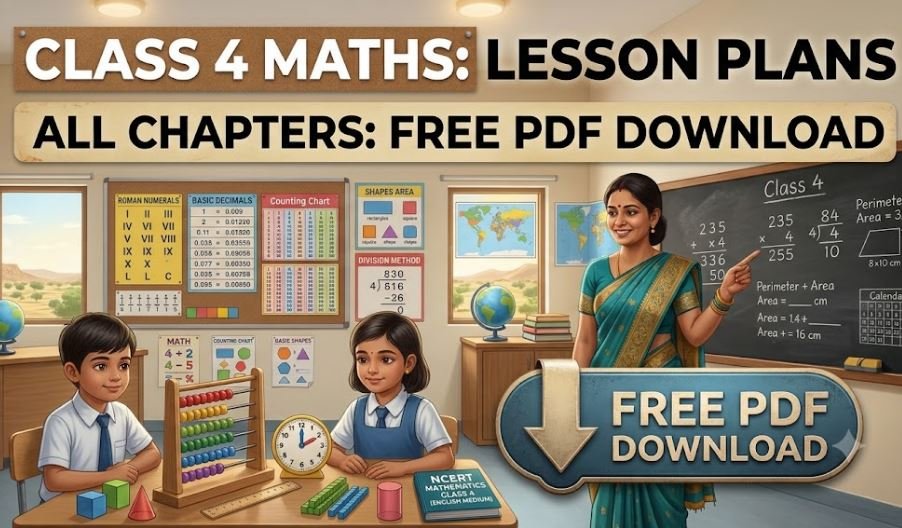
Class 4 Maths Lesson Plan English Medium PDF
NCERT Maths Mela | Class 4 Mathematics Lesson Plans
Chapter-wise lesson plans for classroom teaching practice, B.Ed, D.El.Ed and teacher-training work.
Class 4 Maths Lesson Plan English Medium
This Class 4 Maths Lesson Plan English Medium collection is designed in a practical classroom-friendly format. The lesson plans connect NCERT Mathematics concepts with questions, activities, observation, guided practice, blackboard work, classwork, evaluation and homework.
The complete collection covers 14 Class 4 Mathematics lesson plans and is suitable for teachers, student-teachers and teaching-practice files. The original lesson-plan content below has been kept intact and placed inside the same lightweight RLK Classes design.
What You Get in These Maths Lesson Plans
All 14 chapters are organised with an easy index for quick navigation.
General and specific objectives are clearly included for classroom planning.
Previous-knowledge questions help connect familiar experiences with the new concept.
Teacher-pupil activities are organised around observation, questioning and guided practice.
Important mathematical points are separated into a clear blackboard section.
Each lesson includes five assessment questions with different question types.
Class 4 Mathematics Topics Covered
The lesson-plan collection includes topics such as Shapes Around Us, Hide and Seek, Pattern Around Us, Thousands Around Us, Sharing and Measuring, Measuring Length, The Cleanest Village, Weigh it Pour it, Equal Groups, Elephants Tigers and Leopards, Fun with Symmetry, Ticking Clocks and Turning Calendar, The Transport Museum and Data Handling.
Why Use a Chapter-wise Maths Lesson Plan?
A chapter-wise lesson plan helps the teacher organise the lesson before entering the classroom. It makes the sequence of teaching clearer and gives space for questioning, activities, practice, assessment and follow-up work.
For primary mathematics, activity-based teaching is especially useful because learners can understand numbers, shapes, measurement, patterns and data through familiar objects and situations. These plans therefore combine mathematical concepts with classroom interaction and practical examples.
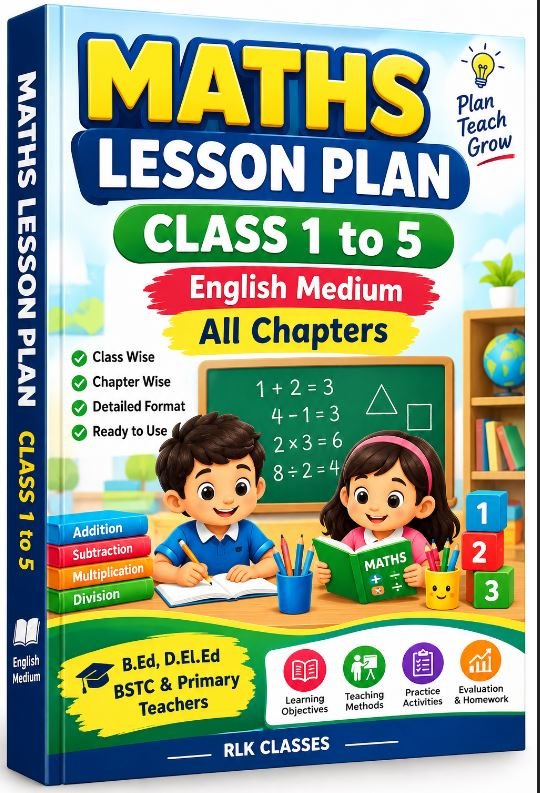
Class 4 Maths Lesson Plans
NCERT MATHS MELA | ENGLISH MEDIUM
All 14 Chapters • Teaching Practice • Printable Lesson Plan Format
Prepared for classroom teaching practice and teacher-training work.
INDEX – ALL CHAPTERS
Chapter 1: Shapes Around UsChapter 2: Hide and SeekChapter 3: Pattern Around UsChapter 4: Thousands Around UsChapter 5: Sharing and MeasuringChapter 6: Measuring LengthChapter 7: The Cleanest VillageChapter 8: Weigh it, Pour itChapter 9: Equal GroupsChapter 10: Elephants, Tigers, and LeopardsChapter 11: Fun with SymmetryChapter 12: Ticking Clocks and Turning CalendarChapter 13: The Transport MuseumChapter 14: Data HandlingLesson Plan 1: Shapes Around Us
| Subject | Mathematics |
|---|---|
| Topic | Recognising and describing 2D and 3D shapes |
| General Objectives | To develop mathematical understanding, logical reasoning, observation, problem-solving ability and the habit of applying mathematics to everyday situations. To encourage active participation, clear communication and accuracy in calculations. |
| Specific Objectives | By the end of the lesson, learners will be able to Students will identify common shapes, describe their features, compare flat and solid shapes, and connect geometry with objects in their surroundings. They will explain their methods, participate in classroom activities and complete the related written exercises. |
| Teaching Aids | Blackboard, chalk, textbook, notebook, worksheets, picture cards and locally available objects related to the topic. |
| Teaching Method | Activity-based teaching, demonstration, questioning, discussion, guided practice, observation and individual written work. |
| Previous Knowledge | Learners have seen balls, boxes, books, doors, windows, plates and other familiar objects. They can recognise simple circles, triangles, squares and rectangles. |
Introduction – Previous Knowledge Testing
The teacher connects the topic with familiar objects and experiences. Questions are asked in sequence, pupils respond, and the teacher uses their answers to introduce the new concept.
| Teacher’s Questions | Expected Pupils’ Answers |
|---|---|
| 1. Which shape does a round wall clock resemble? | A circle. |
| 2. How many sides does a triangle have? | Three sides. |
| 3. What shape do we see on the front of a book? | A rectangle. |
| 4. Which object looks like a ball? | A spherical object. |
| 5. Can you name an object that looks like a box? | A carton or cuboid-shaped box. |
Statement of Objective
“Today, we will learn about Shapes Around Us. We will observe examples, discuss mathematical ideas, solve questions and practise applying the concept in everyday situations.”
Presentation
The teacher proceeds from concrete examples to mathematical explanation. Questions and activities alternate so pupils observe, predict, answer, practise and explain rather than merely listen.
| Teaching Point | Pupil-Teacher Activity | Pupil Activity |
|---|---|---|
| 1. Recognising flat shapes | The teacher displays a circle, triangle, square and rectangle. “Look carefully at the outline. Which shape has three straight sides? Which has four?” The teacher asks pupils to trace each outline and compare the number of sides and corners. | Pupils name the shapes, trace them in the air and count sides and corners. They find similar shapes in their books, notebooks and classroom windows. |
| 2. Exploring solid objects | The teacher shows a ball, a box and a cylindrical container. “Can we hold this object? Does it roll, slide or remain stable? How is a flat drawing different from a solid object?” The teacher explains that solid objects occupy space and have different surfaces. | Pupils handle the objects, observe their surfaces and describe whether they roll or slide. They classify the objects according to their observed features. |
| 3. Comparing and classifying shapes | The teacher invites pupils to sort classroom objects by shape. “Can two objects look different but have a similar shape? How can you justify your choice?” The teacher discusses sides, corners, curved surfaces and familiar examples. | Pupils sort picture cards, explain their choices and draw two flat shapes and one solid object in their notebooks. |
Blackboard Work
Class 4 Maths Lesson Plan
Topic: Shapes Around Us
FLAT SHAPES: circle, triangle, square, rectangle
SOLID OBJECTS: ball, box, cylinder
Observe sides, corners, surfaces and shape.
Remember: Observe carefully, show your working and check your answer.
Inspection Work / Classwork
Written Activity: Draw a circle, triangle, square and rectangle. Write one familiar example beside each shape.
Teacher’s Role: The teacher moves around the classroom, checks pupils’ work, asks pupils to explain their methods and gives individual guidance wherever needed.
Recapitulation and Evaluation
The teacher assesses understanding through the following five questions. The set contains one multiple-choice question, one fill-in-the-blank, two one-word answers and one short-answer question.
| Question Type and Question | Expected Answer |
|---|---|
| 1. MCQ Which shape has three sides? (a) Circle (b) Triangle (c) Square |
Triangle |
| 2. Fill in the blank A rectangle has ______ corners. |
Four |
| 3. One-word answer Name the shape of a coin’s face. |
Circle |
| 4. One-word answer Name a solid object shaped like a ball. |
Sphere |
| 5. Short answer Write two differences between a flat shape and a solid object. |
A flat shape is drawn on a surface; a solid object occupies space and has surfaces. |
Homework
Find five objects at home. Draw them and write the shape each object resembles.
Write neatly, show the steps wherever a calculation is required, and bring the completed work to the next class.
Lesson Plan 2: Hide and Seek
| Subject | Mathematics |
|---|---|
| Topic | Position, direction, spatial reasoning and views of objects |
| General Objectives | To develop mathematical understanding, logical reasoning, observation, problem-solving ability and the habit of applying mathematics to everyday situations. To encourage active participation, clear communication and accuracy in calculations. |
| Specific Objectives | By the end of the lesson, learners will be able to Students will describe the position of objects, follow simple directions, observe objects from different viewpoints and explain relative locations using suitable words. They will explain their methods, participate in classroom activities and complete the related written exercises. |
| Teaching Aids | Blackboard, chalk, textbook, notebook, worksheets, picture cards and locally available objects related to the topic. |
| Teaching Method | Activity-based teaching, demonstration, questioning, discussion, guided practice, observation and individual written work. |
| Previous Knowledge | Learners can identify objects in the classroom and understand everyday expressions such as above, below, near, far, left, right, in front and behind. |
Introduction – Previous Knowledge Testing
The teacher connects the topic with familiar objects and experiences. Questions are asked in sequence, pupils respond, and the teacher uses their answers to introduce the new concept.
| Teacher’s Questions | Expected Pupils’ Answers |
|---|---|
| 1. Where is your school bag kept? | Beside or under the desk. |
| 2. What is on top of your desk? | Books or notebooks. |
| 3. Where is the blackboard in relation to you? | In front of me. |
| 4. What do we mean by behind the door? | At the back of the door. |
| 5. Can the same object look different from different sides? | Yes, its view can change. |
Statement of Objective
“Today, we will learn about Hide and Seek. We will observe examples, discuss mathematical ideas, solve questions and practise applying the concept in everyday situations.”
Presentation
The teacher proceeds from concrete examples to mathematical explanation. Questions and activities alternate so pupils observe, predict, answer, practise and explain rather than merely listen.
| Teaching Point | Pupil-Teacher Activity | Pupil Activity |
|---|---|---|
| 1. Using position words | The teacher places a book under a chair and a pencil beside a notebook. “Where is the pencil? Where is the book? What changes if I move the book onto the chair?” The teacher models accurate position words. | Pupils describe the positions in complete sentences and use words such as above, below, beside, between, in front of and behind. |
| 2. Following directions | The teacher gives a sequence of instructions: take two steps forward, turn left and point to the window. “What happens if we turn right instead?” The teacher demonstrates that direction words guide movement. | Pupils follow instructions in pairs, take turns giving directions and check whether their partners reach the correct place. |
| 3. Observing different views | The teacher places a box on a table and asks pupils to observe it from the front and side. “Will every side show the same view? How can we describe where an object is hidden?” The teacher connects observation with spatial thinking. | Pupils sketch a simple object from two viewpoints and describe the location of a hidden classroom object using clues. |
Blackboard Work
Class IV – Mathematics
Topic: Hide and Seek
POSITION WORDS: above, below, beside, between
DIRECTION WORDS: left, right, forward, backward
Describe where an object is and how to reach it.
Remember: Observe carefully, show your working and check your answer.
Inspection Work / Classwork
Written Activity: Draw a classroom with a table, chair, bag and door. Write four sentences describing their positions.
Teacher’s Role: The teacher moves around the classroom, checks pupils’ work, asks pupils to explain their methods and gives individual guidance wherever needed.
Recapitulation and Evaluation
The teacher assesses understanding through the following five questions. The set contains one multiple-choice question, one fill-in-the-blank, two one-word answers and one short-answer question.
| Question Type and Question | Expected Answer |
|---|---|
| 1. MCQ A book is beneath a table. It is: (a) Above (b) Under (c) Beside |
Under |
| 2. Fill in the blank The opposite of left is ______. |
Right |
| 3. One-word answer What word means at the back of something? |
Behind |
| 4. One-word answer What word means next to something? |
Beside |
| 5. Short answer Give two directions that can help a friend reach your classroom. |
Answers may include walk forward, turn left or turn right, according to the classroom route. |
Homework
Draw a simple map of your room and write five position clues for objects in it.
Write neatly, show the steps wherever a calculation is required, and bring the completed work to the next class.
Lesson Plan 3: Pattern Around Us
| Subject | Mathematics |
|---|---|
| Topic | Recognising, extending and creating patterns |
| General Objectives | To develop mathematical understanding, logical reasoning, observation, problem-solving ability and the habit of applying mathematics to everyday situations. To encourage active participation, clear communication and accuracy in calculations. |
| Specific Objectives | By the end of the lesson, learners will be able to Students will identify repeating and growing patterns, describe the rule of a pattern, extend number and shape sequences, and create their own patterns. They will explain their methods, participate in classroom activities and complete the related written exercises. |
| Teaching Aids | Blackboard, chalk, textbook, notebook, worksheets, picture cards and locally available objects related to the topic. |
| Teaching Method | Activity-based teaching, demonstration, questioning, discussion, guided practice, observation and individual written work. |
| Previous Knowledge | Learners can recognise colours, shapes and counting sequences and can compare objects according to size, colour and order. |
Introduction – Previous Knowledge Testing
The teacher connects the topic with familiar objects and experiences. Questions are asked in sequence, pupils respond, and the teacher uses their answers to introduce the new concept.
| Teacher’s Questions | Expected Pupils’ Answers |
|---|---|
| 1. What comes next in red, blue, red, blue? | Red. |
| 2. What number comes after 2, 4, 6? | Eight. |
| 3. Can flowers on a garland form a pattern? | Yes. |
| 4. What should we find to continue a pattern? | Its rule. |
| 5. Can we make patterns using shapes? | Yes. |
Statement of Objective
“Today, we will learn about Pattern Around Us. We will observe examples, discuss mathematical ideas, solve questions and practise applying the concept in everyday situations.”
Presentation
The teacher proceeds from concrete examples to mathematical explanation. Questions and activities alternate so pupils observe, predict, answer, practise and explain rather than merely listen.
| Teaching Point | Pupil-Teacher Activity | Pupil Activity |
|---|---|---|
| 1. Finding repeating patterns | The teacher displays a sequence of red-blue-red-blue circles. “What repeats? If I add one more circle, which colour should I choose?” The teacher explains that repeating patterns follow a recognisable order. | Pupils identify the repeating unit, predict the next colour and make a similar sequence using coloured paper or drawn shapes. |
| 2. Extending number patterns | The teacher writes 5, 10, 15, 20, __. “How much does the number increase each time? What should come next?” The teacher models finding the difference between consecutive numbers. | Pupils count forward, state the rule, complete the sequence and explain how they found the missing number. |
| 3. Creating and explaining patterns | The teacher asks pupils to create a pattern using triangles and circles or numbers. “Can your partner discover your rule? Could two different patterns follow different rules?” The teacher reinforces clear mathematical explanations. | Pupils create a pattern, exchange notebooks with a partner, identify one another’s rules and extend the sequences correctly. |
Blackboard Work
Class IV – Mathematics
Topic: Pattern Around Us
A PATTERN follows a rule.
Repeating: red, blue, red, blue…
Growing: 5, 10, 15, 20, 25…
Find the rule to continue the sequence.
Remember: Observe carefully, show your working and check your answer.
Inspection Work / Classwork
Written Activity: Create one repeating shape pattern and two number patterns. Write the rule for each.
Teacher’s Role: The teacher moves around the classroom, checks pupils’ work, asks pupils to explain their methods and gives individual guidance wherever needed.
Recapitulation and Evaluation
The teacher assesses understanding through the following five questions. The set contains one multiple-choice question, one fill-in-the-blank, two one-word answers and one short-answer question.
| Question Type and Question | Expected Answer |
|---|---|
| 1. MCQ What comes next: 3, 6, 9, 12, __? (a) 13 (b) 15 (c) 18 |
15 |
| 2. Fill in the blank A pattern continues according to a ______. |
Rule |
| 3. One-word answer What comes next: circle, square, circle, square, circle, ______? |
Square |
| 4. One-word answer What comes after 20, 30, 40? |
50 |
| 5. Short answer Write a number pattern and explain its rule. |
Example: 2, 4, 6, 8; add 2 each time. |
Homework
Make a colourful pattern using at least two shapes and write a number pattern with its rule.
Write neatly, show the steps wherever a calculation is required, and bring the completed work to the next class.
Lesson Plan 4: Thousands Around Us
| Subject | Mathematics |
|---|---|
| Topic | Place value and numbers up to thousands |
| General Objectives | To develop mathematical understanding, logical reasoning, observation, problem-solving ability and the habit of applying mathematics to everyday situations. To encourage active participation, clear communication and accuracy in calculations. |
| Specific Objectives | By the end of the lesson, learners will be able to Students will read, write, compare and arrange numbers up to thousands, identify place values and represent numbers in expanded form. They will explain their methods, participate in classroom activities and complete the related written exercises. |
| Teaching Aids | Blackboard, chalk, textbook, notebook, worksheets, picture cards and locally available objects related to the topic. |
| Teaching Method | Activity-based teaching, demonstration, questioning, discussion, guided practice, observation and individual written work. |
| Previous Knowledge | Learners can count in hundreds, read three-digit numbers and identify ones, tens and hundreds in familiar numbers. |
Introduction – Previous Knowledge Testing
The teacher connects the topic with familiar objects and experiences. Questions are asked in sequence, pupils respond, and the teacher uses their answers to introduce the new concept.
| Teacher’s Questions | Expected Pupils’ Answers |
|---|---|
| 1. How many hundreds make one thousand? | Ten hundreds. |
| 2. What is the place of 5 in 352? | Tens. |
| 3. Which is greater: 245 or 254? | 254. |
| 4. What is the value of 7 in 7,000? | Seven thousand. |
| 5. How can we compare two numbers? | By comparing their place values from left to right. |
Statement of Objective
“Today, we will learn about Thousands Around Us. We will observe examples, discuss mathematical ideas, solve questions and practise applying the concept in everyday situations.”
Presentation
The teacher proceeds from concrete examples to mathematical explanation. Questions and activities alternate so pupils observe, predict, answer, practise and explain rather than merely listen.
| Teaching Point | Pupil-Teacher Activity | Pupil Activity |
|---|---|---|
| 1. Understanding thousands | The teacher groups bundles of hundreds and introduces 1,000 as ten hundreds. “If we have nine hundreds and add one more hundred, what total do we get?” The teacher connects grouping with the written numeral 1,000. | Pupils count bundles, explain how hundreds combine into a thousand and write the numeral in their notebooks. |
| 2. Place value and expanded form | The teacher writes 3,482 and asks, “What does the digit 4 represent? What is the value of 8?” The teacher separates the number into thousands, hundreds, tens and ones: 3,000 + 400 + 80 + 2. | Pupils identify each digit’s place and value, read the number aloud and write its expanded form. |
| 3. Comparing and ordering numbers | The teacher writes 3,405 and 3,450. “Both have 3 thousands and 4 hundreds. Which place helps us decide?” The teacher explains comparison from the greatest place value toward the right. | Pupils compare numbers using greater than and less than, arrange number cards in ascending order and explain their reasoning. |
Blackboard Work
Class IV – Mathematics
Topic: Thousands Around Us
3,482 = 3,000 + 400 + 80 + 2
Thousands | Hundreds | Tens | Ones
Compare digits from left to right.
Remember: Observe carefully, show your working and check your answer.
Inspection Work / Classwork
Written Activity: Write five four-digit numbers in words and expanded form. Arrange them from smallest to greatest.
Teacher’s Role: The teacher moves around the classroom, checks pupils’ work, asks pupils to explain their methods and gives individual guidance wherever needed.
Recapitulation and Evaluation
The teacher assesses understanding through the following five questions. The set contains one multiple-choice question, one fill-in-the-blank, two one-word answers and one short-answer question.
| Question Type and Question | Expected Answer |
|---|---|
| 1. MCQ The value of 6 in 6,215 is: (a) 6 (b) 600 (c) 6,000 |
6,000 |
| 2. Fill in the blank Ten hundreds make one ______. |
Thousand |
| 3. One-word answer What is the place value of 5 in 2,753? |
Tens |
| 4. One-word answer Which is greater: 4,208 or 4,280? |
4,280 |
| 5. Short answer Write 5,364 in expanded form. |
5,000 + 300 + 60 + 4. |
Homework
Write any five four-digit numbers, their number names, place values and expanded forms.
Write neatly, show the steps wherever a calculation is required, and bring the completed work to the next class.
Lesson Plan 5: Sharing and Measuring
| Subject | Mathematics |
|---|---|
| Topic | Fair sharing, equal parts and measurement through everyday situations |
| General Objectives | To develop mathematical understanding, logical reasoning, observation, problem-solving ability and the habit of applying mathematics to everyday situations. To encourage active participation, clear communication and accuracy in calculations. |
| Specific Objectives | By the end of the lesson, learners will be able to Students will explore fair sharing, divide collections into equal groups, compare parts and connect sharing with practical measurement situations. They will explain their methods, participate in classroom activities and complete the related written exercises. |
| Teaching Aids | Blackboard, chalk, textbook, notebook, worksheets, picture cards and locally available objects related to the topic. |
| Teaching Method | Activity-based teaching, demonstration, questioning, discussion, guided practice, observation and individual written work. |
| Previous Knowledge | Learners can count objects, share small collections and recognise that equal groups contain the same number of objects. |
Introduction – Previous Knowledge Testing
The teacher connects the topic with familiar objects and experiences. Questions are asked in sequence, pupils respond, and the teacher uses their answers to introduce the new concept.
| Teacher’s Questions | Expected Pupils’ Answers |
|---|---|
| 1. If four children share eight pencils equally, how many does each get? | Two pencils. |
| 2. What does fair sharing mean? | Everyone receives an equal share. |
| 3. Can we share a roti into equal parts? | Yes. |
| 4. What can we count before sharing objects? | The total number. |
| 5. How can we check if sharing is fair? | Compare the number in each share. |
Statement of Objective
“Today, we will learn about Sharing and Measuring. We will observe examples, discuss mathematical ideas, solve questions and practise applying the concept in everyday situations.”
Presentation
The teacher proceeds from concrete examples to mathematical explanation. Questions and activities alternate so pupils observe, predict, answer, practise and explain rather than merely listen.
| Teaching Point | Pupil-Teacher Activity | Pupil Activity |
|---|---|---|
| 1. Understanding equal sharing | The teacher places twelve counters before four pupils. “How can everyone receive an equal number without leaving any counter unused?” The teacher distributes counters one by one and explains equal sharing. | Pupils distribute counters among four groups, count each group and verify that all groups contain the same number. |
| 2. Sharing into equal parts | The teacher draws a rectangle representing a roti and divides it into equal parts. “Would two unequal pieces be a fair share if both children expected the same amount?” The teacher highlights the importance of equal-sized parts. | Pupils draw shapes divided into two or four equal parts and distinguish equal parts from unequal parts. |
| 3. Checking and explaining results | The teacher presents 15 objects to be shared among three groups. “How many will each group receive? How can we check the result?” The teacher links repeated distribution with grouping and division. | Pupils use counters or drawings to share the objects, record the result and explain their method to a partner. |
Blackboard Work
Class IV – Mathematics
Topic: Sharing and Measuring
FAIR SHARING = EQUAL SHARES
12 objects shared by 4 children = 3 each
Check that each group receives the same amount.
Remember: Observe carefully, show your working and check your answer.
Inspection Work / Classwork
Written Activity: Draw 12 stars and share them equally among 3 children. Repeat with 16 stars shared by 4 children.
Teacher’s Role: The teacher moves around the classroom, checks pupils’ work, asks pupils to explain their methods and gives individual guidance wherever needed.
Recapitulation and Evaluation
The teacher assesses understanding through the following five questions. The set contains one multiple-choice question, one fill-in-the-blank, two one-word answers and one short-answer question.
| Question Type and Question | Expected Answer |
|---|---|
| 1. MCQ 12 objects shared equally among 3 children gives each child: (a) 3 (b) 4 (c) 6 |
4 |
| 2. Fill in the blank Fair sharing means giving ______ shares. |
Equal |
| 3. One-word answer How many objects does each child get when 10 objects are shared by 2 children? |
Five |
| 4. One-word answer What is the total number of objects called before sharing? |
Total |
| 5. Short answer Explain how you would share 20 pencils equally among five pupils. |
Give four pencils to each pupil and check that all five shares are equal. |
Homework
Make three drawings showing fair sharing. Write the total number and the number received by each person.
Write neatly, show the steps wherever a calculation is required, and bring the completed work to the next class.
Lesson Plan 6: Measuring Length
| Subject | Mathematics |
|---|---|
| Topic | Estimating and measuring length using standard units |
| General Objectives | To develop mathematical understanding, logical reasoning, observation, problem-solving ability and the habit of applying mathematics to everyday situations. To encourage active participation, clear communication and accuracy in calculations. |
| Specific Objectives | By the end of the lesson, learners will be able to Students will estimate and measure lengths, select suitable units, use a ruler correctly and compare measurements accurately. They will explain their methods, participate in classroom activities and complete the related written exercises. |
| Teaching Aids | Blackboard, chalk, textbook, notebook, worksheets, picture cards and locally available objects related to the topic. |
| Teaching Method | Activity-based teaching, demonstration, questioning, discussion, guided practice, observation and individual written work. |
| Previous Knowledge | Learners can compare objects as longer or shorter and have experience using a ruler or measuring tape informally. |
Introduction – Previous Knowledge Testing
The teacher connects the topic with familiar objects and experiences. Questions are asked in sequence, pupils respond, and the teacher uses their answers to introduce the new concept.
| Teacher’s Questions | Expected Pupils’ Answers |
|---|---|
| 1. Which is longer, a pencil or a classroom wall? | The classroom wall. |
| 2. Which tool can measure a notebook? | A ruler. |
| 3. What unit is suitable for a pencil? | Centimetres. |
| 4. What unit may be suitable for a road? | Metres or kilometres. |
| 5. Why should we use a standard unit? | To obtain consistent measurements. |
Statement of Objective
“Today, we will learn about Measuring Length. We will observe examples, discuss mathematical ideas, solve questions and practise applying the concept in everyday situations.”
Presentation
The teacher proceeds from concrete examples to mathematical explanation. Questions and activities alternate so pupils observe, predict, answer, practise and explain rather than merely listen.
| Teaching Point | Pupil-Teacher Activity | Pupil Activity |
|---|---|---|
| 1. Estimating length | The teacher shows a pencil and a notebook. “Before measuring, which is longer? Can you estimate the pencil’s length?” The teacher explains that estimation gives an approximate value before actual measurement. | Pupils predict the lengths of classroom objects, record their estimates and compare them with measurements. |
| 2. Using a ruler | The teacher demonstrates placing the zero mark at one end of an object. “What happens if we begin at the 1 cm mark but forget to account for it?” The teacher explains correct alignment and reading the scale. | Pupils measure pencils, erasers and notebooks in centimetres, record results and help partners check the starting point. |
| 3. Choosing suitable units | The teacher compares the length of a pencil, classroom and playground. “Would centimetres be convenient for every measurement?” The teacher introduces centimetres and metres as useful units for different lengths. | Pupils choose an appropriate unit for different objects and explain why a metre is more convenient for larger lengths. |
Blackboard Work
Class IV – Mathematics
Topic: Measuring Length
Length units: centimetre (cm), metre (m)
Align one end with zero on the ruler.
Estimate first, measure carefully, then compare.
Remember: Observe carefully, show your working and check your answer.
Inspection Work / Classwork
Written Activity: Measure five objects in your classroom. Record your estimate, actual measurement and unit.
Teacher’s Role: The teacher moves around the classroom, checks pupils’ work, asks pupils to explain their methods and gives individual guidance wherever needed.
Recapitulation and Evaluation
The teacher assesses understanding through the following five questions. The set contains one multiple-choice question, one fill-in-the-blank, two one-word answers and one short-answer question.
| Question Type and Question | Expected Answer |
|---|---|
| 1. MCQ A pencil is best measured in: (a) Kilometres (b) Centimetres (c) Litres |
Centimetres |
| 2. Fill in the blank 100 centimetres make one ______. |
Metre |
| 3. One-word answer Which tool is commonly used to measure a pencil? |
Ruler |
| 4. One-word answer Which unit is suitable for the length of a classroom? |
Metre |
| 5. Short answer Write two steps for measuring an object accurately with a ruler. |
Align one end with zero, keep the ruler straight and read the mark at the other end. |
Homework
Measure three small objects in centimetres and two longer objects in metres, where possible.
Write neatly, show the steps wherever a calculation is required, and bring the completed work to the next class.
Lesson Plan 7: The Cleanest Village
| Subject | Mathematics |
|---|---|
| Topic | Using numbers and data in real-life cleanliness situations |
| General Objectives | To develop mathematical understanding, logical reasoning, observation, problem-solving ability and the habit of applying mathematics to everyday situations. To encourage active participation, clear communication and accuracy in calculations. |
| Specific Objectives | By the end of the lesson, learners will be able to Students will use counting, grouping, comparison and simple data to understand cleanliness-related information and solve practical mathematical problems. They will explain their methods, participate in classroom activities and complete the related written exercises. |
| Teaching Aids | Blackboard, chalk, textbook, notebook, worksheets, picture cards and locally available objects related to the topic. |
| Teaching Method | Activity-based teaching, demonstration, questioning, discussion, guided practice, observation and individual written work. |
| Previous Knowledge | Learners can count objects, compare numbers, make simple lists and recognise the importance of keeping their surroundings clean. |
Introduction – Previous Knowledge Testing
The teacher connects the topic with familiar objects and experiences. Questions are asked in sequence, pupils respond, and the teacher uses their answers to introduce the new concept.
| Teacher’s Questions | Expected Pupils’ Answers |
|---|---|
| 1. Why should we keep our classroom clean? | To maintain a healthy environment. |
| 2. What can we count during a cleanliness activity? | Collected waste bags or cleaned areas. |
| 3. How can we compare two groups? | By counting their totals. |
| 4. What can a tally chart help us do? | Record and count items. |
| 5. How can mathematics help keep a village clean? | By recording and comparing information. |
Statement of Objective
“Today, we will learn about The Cleanest Village. We will observe examples, discuss mathematical ideas, solve questions and practise applying the concept in everyday situations.”
Presentation
The teacher proceeds from concrete examples to mathematical explanation. Questions and activities alternate so pupils observe, predict, answer, practise and explain rather than merely listen.
| Teaching Point | Pupil-Teacher Activity | Pupil Activity |
|---|---|---|
| 1. Counting cleanliness items | The teacher displays a picture or sample record of waste collected from two areas. “Which area collected more bags? How can we check?” The teacher demonstrates accurate counting and recording. | Pupils count the items in the given record, compare totals and explain which group has the larger number. |
| 2. Organising information | The teacher creates categories such as paper, plastic and organic waste. “Why should we keep separate counts for different categories?” The teacher models a simple tally chart and its use in organising information. | Pupils sort picture cards into categories, make tally marks and write totals for each category. |
| 3. Using numbers to make decisions | The teacher asks, “If one area has more litter than another, what could the class do first?” The teacher shows how recorded information can guide planning without guessing. | Pupils read the completed chart, identify the category with the greatest and least count and suggest a practical cleanliness action. |
Blackboard Work
Class IV – Mathematics
Topic: The Cleanest Village
Count carefully → Record → Compare → Decide
Use tally marks to organise information.
Clean surroundings require everyone’s participation.
Remember: Observe carefully, show your working and check your answer.
Inspection Work / Classwork
Written Activity: Make a simple tally chart for paper, plastic and organic waste using a sample of 20 picture cards.
Teacher’s Role: The teacher moves around the classroom, checks pupils’ work, asks pupils to explain their methods and gives individual guidance wherever needed.
Recapitulation and Evaluation
The teacher assesses understanding through the following five questions. The set contains one multiple-choice question, one fill-in-the-blank, two one-word answers and one short-answer question.
| Question Type and Question | Expected Answer |
|---|---|
| 1. MCQ A tally chart is used to: (a) Record counts (b) Measure temperature (c) Tell time |
Record counts |
| 2. Fill in the blank A tally chart helps us organise ______. |
Data |
| 3. One-word answer What do we call the number of items counted? |
Total |
| 4. One-word answer Which should be kept clean: our surroundings or only our desk? |
Surroundings |
| 5. Short answer How can counting and recording help a cleanliness drive? |
They show how much waste is collected and help compare areas and plan action. |
Homework
Observe your surroundings and make a cleanliness checklist with five items. Record how many need attention.
Write neatly, show the steps wherever a calculation is required, and bring the completed work to the next class.
Lesson Plan 8: Weigh it, Pour it
| Subject | Mathematics |
|---|---|
| Topic | Comparing weight and capacity |
| General Objectives | To develop mathematical understanding, logical reasoning, observation, problem-solving ability and the habit of applying mathematics to everyday situations. To encourage active participation, clear communication and accuracy in calculations. |
| Specific Objectives | By the end of the lesson, learners will be able to Students will compare heavy and light objects, estimate and measure weight, compare container capacity and select suitable units for everyday situations. They will explain their methods, participate in classroom activities and complete the related written exercises. |
| Teaching Aids | Blackboard, chalk, textbook, notebook, worksheets, picture cards and locally available objects related to the topic. |
| Teaching Method | Activity-based teaching, demonstration, questioning, discussion, guided practice, observation and individual written work. |
| Previous Knowledge | Learners can compare objects by holding them, identify full and empty containers and have experience pouring water or other materials. |
Introduction – Previous Knowledge Testing
The teacher connects the topic with familiar objects and experiences. Questions are asked in sequence, pupils respond, and the teacher uses their answers to introduce the new concept.
| Teacher’s Questions | Expected Pupils’ Answers |
|---|---|
| 1. Which feels heavier, a book or a sheet of paper? | The book. |
| 2. Which is lighter, an empty bottle or a full bottle of water? | The empty bottle. |
| 3. What do we measure when we compare how much a bottle holds? | Capacity. |
| 4. Which unit is used for milk? | Litres. |
| 5. Can a large-looking container always hold more? | Not always; we should compare its capacity. |
Statement of Objective
“Today, we will learn about Weigh it, Pour it. We will observe examples, discuss mathematical ideas, solve questions and practise applying the concept in everyday situations.”
Presentation
The teacher proceeds from concrete examples to mathematical explanation. Questions and activities alternate so pupils observe, predict, answer, practise and explain rather than merely listen.
| Teaching Point | Pupil-Teacher Activity | Pupil Activity |
|---|---|---|
| 1. Comparing weight | The teacher shows a book, pencil box and paper sheet. “Which is heavier? Can our hands help us estimate?” The teacher explains that weight comparisons should be checked carefully and that balance scales can help. | Pupils predict which objects are heavier, compare them safely and arrange the objects from lightest to heaviest. |
| 2. Measuring weight | The teacher demonstrates a balance scale and introduces grams and kilograms. “Would grams or kilograms be more suitable for a school bag?” The teacher explains that the unit depends on the amount being measured. | Pupils compare sample weights or picture cards and choose a suitable unit for a pencil, fruit bag and school bag. |
| 3. Exploring capacity | The teacher pours water from one container into another using equal cups. “Which container holds more? How can we make the comparison fair?” The teacher introduces litres and millilitres and stresses using the same measuring cup. | Pupils estimate container capacity, compare using equal cups and record which container holds more or less. |
Blackboard Work
Class IV – Mathematics
Topic: Weigh it, Pour it
Weight: gram (g), kilogram (kg)
Capacity: millilitre (mL), litre (L)
Compare with suitable units and fair measuring methods.
Remember: Observe carefully, show your working and check your answer.
Inspection Work / Classwork
Written Activity: List five items and classify whether you would measure their weight or capacity. Choose a suitable unit.
Teacher’s Role: The teacher moves around the classroom, checks pupils’ work, asks pupils to explain their methods and gives individual guidance wherever needed.
Recapitulation and Evaluation
The teacher assesses understanding through the following five questions. The set contains one multiple-choice question, one fill-in-the-blank, two one-word answers and one short-answer question.
| Question Type and Question | Expected Answer |
|---|---|
| 1. MCQ Milk is commonly measured in: (a) Litres (b) Metres (c) Hours |
Litres |
| 2. Fill in the blank 1000 grams make one ______. |
Kilogram |
| 3. One-word answer Which is usually heavier: a stone or a leaf? |
Stone |
| 4. One-word answer Which unit is suitable for a small amount of medicine liquid? |
Millilitre |
| 5. Short answer How can we compare the capacity of two containers fairly? |
Use the same measuring cup and count how many equal cupfuls each container holds. |
Homework
Draw two containers and two objects. Write a suitable unit for measuring the capacity or weight of each.
Write neatly, show the steps wherever a calculation is required, and bring the completed work to the next class.
Lesson Plan 9: Equal Groups
| Subject | Mathematics |
|---|---|
| Topic | Multiplication through equal groups and repeated addition |
| General Objectives | To develop mathematical understanding, logical reasoning, observation, problem-solving ability and the habit of applying mathematics to everyday situations. To encourage active participation, clear communication and accuracy in calculations. |
| Specific Objectives | By the end of the lesson, learners will be able to Students will form equal groups, represent repeated addition as multiplication, use arrays and solve simple multiplication problems. They will explain their methods, participate in classroom activities and complete the related written exercises. |
| Teaching Aids | Blackboard, chalk, textbook, notebook, worksheets, picture cards and locally available objects related to the topic. |
| Teaching Method | Activity-based teaching, demonstration, questioning, discussion, guided practice, observation and individual written work. |
| Previous Knowledge | Learners can count objects, skip-count in familiar sequences and add small numbers. |
Introduction – Previous Knowledge Testing
The teacher connects the topic with familiar objects and experiences. Questions are asked in sequence, pupils respond, and the teacher uses their answers to introduce the new concept.
| Teacher’s Questions | Expected Pupils’ Answers |
|---|---|
| 1. If there are three plates with two apples on each, how many apples are there? | Six apples. |
| 2. What does equal groups mean? | Each group has the same number. |
| 3. How can we find 2 + 2 + 2? | By adding to get 6. |
| 4. What operation can represent equal groups quickly? | Multiplication. |
| 5. How many groups of five make ten? | Two groups. |
Statement of Objective
“Today, we will learn about Equal Groups. We will observe examples, discuss mathematical ideas, solve questions and practise applying the concept in everyday situations.”
Presentation
The teacher proceeds from concrete examples to mathematical explanation. Questions and activities alternate so pupils observe, predict, answer, practise and explain rather than merely listen.
| Teaching Point | Pupil-Teacher Activity | Pupil Activity |
|---|---|---|
| 1. Making equal groups | The teacher arranges 12 counters into three groups. “How many counters are in each group? What would change if one group had fewer?” The teacher explains that equal groups contain the same number of objects. | Pupils arrange counters into equal groups, draw the groups and count the total by skip-counting. |
| 2. Repeated addition and multiplication | The teacher writes 4 + 4 + 4 and asks, “How many fours are added? What is the total?” The teacher connects the expression to 3 × 4 and explains that three groups of four contain twelve objects. | Pupils convert drawings into repeated addition and multiplication sentences and explain what each number represents. |
| 3. Arrays and word problems | The teacher draws three rows of four dots. “Can we count each dot or count four in each row? How can an array help us?” The teacher models a simple equal-group word problem. | Pupils draw arrays, write multiplication sentences and solve everyday problems involving equal groups. |
Blackboard Work
Class IV – Mathematics
Topic: Equal Groups
3 groups of 4 = 4 + 4 + 4 = 12
3 × 4 = 12
Multiplication represents equal groups.
Remember: Observe carefully, show your working and check your answer.
Inspection Work / Classwork
Written Activity: Draw arrays for 2 × 5, 3 × 4 and 4 × 3. Write repeated addition for each.
Teacher’s Role: The teacher moves around the classroom, checks pupils’ work, asks pupils to explain their methods and gives individual guidance wherever needed.
Recapitulation and Evaluation
The teacher assesses understanding through the following five questions. The set contains one multiple-choice question, one fill-in-the-blank, two one-word answers and one short-answer question.
| Question Type and Question | Expected Answer |
|---|---|
| 1. MCQ 4 groups of 3 equals: (a) 7 (b) 12 (c) 15 |
12 |
| 2. Fill in the blank 5 + 5 + 5 can be written as 3 × ______. |
5 |
| 3. One-word answer How many objects are in 2 groups of 6? |
12 |
| 4. One-word answer Which operation represents equal groups? |
Multiplication |
| 5. Short answer Explain how to find the total in four groups of five pencils. |
Add 5 four times or multiply 4 × 5 to get 20 pencils. |
Homework
Write five multiplication situations from daily life and represent each with a drawing or repeated addition.
Write neatly, show the steps wherever a calculation is required, and bring the completed work to the next class.
Lesson Plan 10: Elephants, Tigers, and Leopards
| Subject | Mathematics |
|---|---|
| Topic | Reading and interpreting animal-related numerical information |
| General Objectives | To develop mathematical understanding, logical reasoning, observation, problem-solving ability and the habit of applying mathematics to everyday situations. To encourage active participation, clear communication and accuracy in calculations. |
| Specific Objectives | By the end of the lesson, learners will be able to Students will organise and compare animal counts, use place value and arithmetic to interpret numerical information and explain conclusions based on data. They will explain their methods, participate in classroom activities and complete the related written exercises. |
| Teaching Aids | Blackboard, chalk, textbook, notebook, worksheets, picture cards and locally available objects related to the topic. |
| Teaching Method | Activity-based teaching, demonstration, questioning, discussion, guided practice, observation and individual written work. |
| Previous Knowledge | Learners can read numbers, compare quantities, count groups and answer simple questions about lists and tables. |
Introduction – Previous Knowledge Testing
The teacher connects the topic with familiar objects and experiences. Questions are asked in sequence, pupils respond, and the teacher uses their answers to introduce the new concept.
| Teacher’s Questions | Expected Pupils’ Answers |
|---|---|
| 1. Where can we find information about animals? | In books, charts or wildlife records. |
| 2. If one group has 12 animals and another has 9, which is larger? | The group of 12. |
| 3. What does a total tell us? | The number of all items together. |
| 4. How can we find the difference between two counts? | By subtraction. |
| 5. Why should animal counts be recorded carefully? | To keep information accurate. |
Statement of Objective
“Today, we will learn about Elephants, Tigers, and Leopards. We will observe examples, discuss mathematical ideas, solve questions and practise applying the concept in everyday situations.”
Presentation
The teacher proceeds from concrete examples to mathematical explanation. Questions and activities alternate so pupils observe, predict, answer, practise and explain rather than merely listen.
| Teaching Point | Pupil-Teacher Activity | Pupil Activity |
|---|---|---|
| 1. Reading animal counts | The teacher displays a sample chart showing different animal counts. “Which animal has the greatest count? Which has the smallest?” The teacher models reading the figures before drawing conclusions. | Pupils read the chart, identify the greatest and smallest numbers and support their answers with the recorded counts. |
| 2. Comparing and finding differences | The teacher gives sample counts of 24 elephants and 17 tigers. “How many more elephants are recorded in this example?” The teacher demonstrates subtraction and checks the result by addition. | Pupils calculate differences, compare numbers and explain the operation they selected. |
| 3. Solving animal data problems | The teacher presents a fictional table of animal observations. “What is the total number of the listed animals? What information would we need before making a real wildlife claim?” The teacher distinguishes practice data from verified wildlife statistics. | Pupils add the sample counts, write answers in sentences and recognise that numerical conclusions must match the information provided. |
Blackboard Work
Class IV – Mathematics
Topic: Elephants, Tigers, and Leopards
Read the data carefully.
Difference = greater number − smaller number
Total = sum of the listed quantities.
Remember: Observe carefully, show your working and check your answer.
Inspection Work / Classwork
Written Activity: Create a fictional animal-count table with three animals. Write two comparison questions and one total question.
Teacher’s Role: The teacher moves around the classroom, checks pupils’ work, asks pupils to explain their methods and gives individual guidance wherever needed.
Recapitulation and Evaluation
The teacher assesses understanding through the following five questions. The set contains one multiple-choice question, one fill-in-the-blank, two one-word answers and one short-answer question.
| Question Type and Question | Expected Answer |
|---|---|
| 1. MCQ To find how many more animals are in one group, we usually use: (a) Addition (b) Subtraction (c) Division |
Subtraction |
| 2. Fill in the blank The sum of quantities gives their ______. |
Total |
| 3. One-word answer Which operation finds the difference? |
Subtraction |
| 4. One-word answer What should we read before answering questions from a chart? |
Data |
| 5. Short answer How can a table help us compare animal counts? |
It organises the counts so we can identify greater, smaller and total values. |
Homework
Make a table of three fictional animal counts and write three questions that can be answered from it.
Write neatly, show the steps wherever a calculation is required, and bring the completed work to the next class.
Lesson Plan 11: Fun with Symmetry
| Subject | Mathematics |
|---|---|
| Topic | Identifying symmetry and lines of symmetry |
| General Objectives | To develop mathematical understanding, logical reasoning, observation, problem-solving ability and the habit of applying mathematics to everyday situations. To encourage active participation, clear communication and accuracy in calculations. |
| Specific Objectives | By the end of the lesson, learners will be able to Students will recognise symmetrical shapes, identify a line of symmetry, fold paper shapes and create symmetrical drawings. They will explain their methods, participate in classroom activities and complete the related written exercises. |
| Teaching Aids | Blackboard, chalk, textbook, notebook, worksheets, picture cards and locally available objects related to the topic. |
| Teaching Method | Activity-based teaching, demonstration, questioning, discussion, guided practice, observation and individual written work. |
| Previous Knowledge | Learners can recognise common shapes, compare matching halves and fold paper along a line. |
Introduction – Previous Knowledge Testing
The teacher connects the topic with familiar objects and experiences. Questions are asked in sequence, pupils respond, and the teacher uses their answers to introduce the new concept.
| Teacher’s Questions | Expected Pupils’ Answers |
|---|---|
| 1. What happens when you fold a square into two matching halves? | The halves overlap. |
| 2. What is a line of symmetry? | A line dividing a shape into matching halves. |
| 3. Can a butterfly appear symmetrical? | Yes, its wings often show symmetry. |
| 4. Do all shapes have a line of symmetry? | No. |
| 5. How can folding paper help us check symmetry? | It shows whether the halves match. |
Statement of Objective
“Today, we will learn about Fun with Symmetry. We will observe examples, discuss mathematical ideas, solve questions and practise applying the concept in everyday situations.”
Presentation
The teacher proceeds from concrete examples to mathematical explanation. Questions and activities alternate so pupils observe, predict, answer, practise and explain rather than merely listen.
| Teaching Point | Pupil-Teacher Activity | Pupil Activity |
|---|---|---|
| 1. Recognising symmetry | The teacher displays a butterfly picture, a square and an irregular shape. “Which pictures have two matching sides? How can we check instead of guessing?” The teacher introduces the idea of symmetry. | Pupils compare both sides, identify matching parts and discuss whether the shapes appear symmetrical. |
| 2. Finding a line of symmetry | The teacher folds a paper square and marks the fold. “If the two halves overlap exactly, what does the fold show?” The teacher explains that a line of symmetry divides a shape into matching halves. | Pupils fold paper shapes, draw possible symmetry lines and test whether both sides overlap. |
| 3. Making symmetrical designs | The teacher draws half a simple pattern beside a line. “How can we complete the other side so that every part matches?” The teacher demonstrates copying points and shapes across the line. | Pupils complete half-drawings, check the matching parts and create their own symmetrical designs. |
Blackboard Work
Class IV – Mathematics
Topic: Fun with Symmetry
SYMMETRY: matching halves
A line of symmetry divides a shape into two matching parts.
Check by folding or comparing both sides.
Remember: Observe carefully, show your working and check your answer.
Inspection Work / Classwork
Written Activity: Draw a square, rectangle and a simple leaf. Mark any lines of symmetry you can identify.
Teacher’s Role: The teacher moves around the classroom, checks pupils’ work, asks pupils to explain their methods and gives individual guidance wherever needed.
Recapitulation and Evaluation
The teacher assesses understanding through the following five questions. The set contains one multiple-choice question, one fill-in-the-blank, two one-word answers and one short-answer question.
| Question Type and Question | Expected Answer |
|---|---|
| 1. MCQ A line of symmetry divides a shape into: (a) Matching halves (b) Unequal random parts (c) Three circles |
Matching halves |
| 2. Fill in the blank Paper folding can help us check ______. |
Symmetry |
| 3. One-word answer What do we call the line that divides a symmetrical shape into matching halves? |
Line of symmetry |
| 4. One-word answer Name an object that often appears symmetrical: butterfly or stone? |
Butterfly |
| 5. Short answer How can you test whether a paper shape has a line of symmetry? |
Fold it along the proposed line and check whether the halves overlap exactly. |
Homework
Make two symmetrical designs using paper folding. Draw and mark the fold line in each.
Write neatly, show the steps wherever a calculation is required, and bring the completed work to the next class.
Lesson Plan 12: Ticking Clocks and Turning Calendar
| Subject | Mathematics |
|---|---|
| Topic | Reading clocks, days, months and calendar dates |
| General Objectives | To develop mathematical understanding, logical reasoning, observation, problem-solving ability and the habit of applying mathematics to everyday situations. To encourage active participation, clear communication and accuracy in calculations. |
| Specific Objectives | By the end of the lesson, learners will be able to Students will read clock times, relate hours and minutes, identify dates on a calendar and solve simple problems involving days and months. They will explain their methods, participate in classroom activities and complete the related written exercises. |
| Teaching Aids | Blackboard, chalk, textbook, notebook, worksheets, picture cards and locally available objects related to the topic. |
| Teaching Method | Activity-based teaching, demonstration, questioning, discussion, guided practice, observation and individual written work. |
| Previous Knowledge | Learners know the names of days and months and can recognise a clock and familiar daily routines. |
Introduction – Previous Knowledge Testing
The teacher connects the topic with familiar objects and experiences. Questions are asked in sequence, pupils respond, and the teacher uses their answers to introduce the new concept.
| Teacher’s Questions | Expected Pupils’ Answers |
|---|---|
| 1. How many hours are there in a day? | Twenty-four hours. |
| 2. How many minutes make one hour? | Sixty minutes. |
| 3. Which hand usually shows minutes on an analogue clock? | The long hand. |
| 4. How many days are there in a week? | Seven days. |
| 5. What information does a calendar show? | Days, dates and months. |
Statement of Objective
“Today, we will learn about Ticking Clocks and Turning Calendar. We will observe examples, discuss mathematical ideas, solve questions and practise applying the concept in everyday situations.”
Presentation
The teacher proceeds from concrete examples to mathematical explanation. Questions and activities alternate so pupils observe, predict, answer, practise and explain rather than merely listen.
| Teaching Point | Pupil-Teacher Activity | Pupil Activity |
|---|---|---|
| 1. Reading an analogue clock | The teacher shows a model clock and moves the hands to 3 o’clock. “Where should the minute hand point for an exact hour? What does the short hand show?” The teacher explains hour and minute hands. | Pupils read model clock times, move the hands and match times with daily activities. |
| 2. Understanding hours and minutes | The teacher writes 1 hour = 60 minutes and asks, “How many minutes are in two hours?” The teacher uses a number line or repeated addition to explain the relationship. | Pupils calculate simple hour-minute conversions and explain their steps using addition or grouping. |
| 3. Using a calendar | The teacher displays a monthly calendar. “How can we find the date of the second Monday? How many days separate two selected dates?” The teacher models reading rows, columns and weekday headings. | Pupils locate dates, name weekdays, count days between selected dates and plan a simple weekly activity. |
Blackboard Work
Class IV – Mathematics
Topic: Ticking Clocks and Turning Calendar
1 hour = 60 minutes
1 week = 7 days
A calendar shows dates, weekdays and months.
Read the clock hands carefully.
Remember: Observe carefully, show your working and check your answer.
Inspection Work / Classwork
Written Activity: Draw two clock faces showing different times. Write the date and weekday for three dates on a monthly calendar.
Teacher’s Role: The teacher moves around the classroom, checks pupils’ work, asks pupils to explain their methods and gives individual guidance wherever needed.
Recapitulation and Evaluation
The teacher assesses understanding through the following five questions. The set contains one multiple-choice question, one fill-in-the-blank, two one-word answers and one short-answer question.
| Question Type and Question | Expected Answer |
|---|---|
| 1. MCQ How many minutes are in one hour? (a) 30 (b) 60 (c) 100 |
60 |
| 2. Fill in the blank A week has ______ days. |
Seven |
| 3. One-word answer Which tool shows dates and weekdays? |
Calendar |
| 4. One-word answer Which clock hand is usually longer? |
Minute hand |
| 5. Short answer How can you find the weekday for a date shown on a monthly calendar? |
Locate the date in the calendar grid and read the weekday heading above its column. |
Homework
Make a weekly timetable with at least five activities and write their starting times.
Write neatly, show the steps wherever a calculation is required, and bring the completed work to the next class.
Lesson Plan 13: The Transport Museum
| Subject | Mathematics |
|---|---|
| Topic | Distance, travel information and organising transport data |
| General Objectives | To develop mathematical understanding, logical reasoning, observation, problem-solving ability and the habit of applying mathematics to everyday situations. To encourage active participation, clear communication and accuracy in calculations. |
| Specific Objectives | By the end of the lesson, learners will be able to Students will interpret simple transport-related information, compare distances, use addition and subtraction in travel situations and record information in tables. They will explain their methods, participate in classroom activities and complete the related written exercises. |
| Teaching Aids | Blackboard, chalk, textbook, notebook, worksheets, picture cards and locally available objects related to the topic. |
| Teaching Method | Activity-based teaching, demonstration, questioning, discussion, guided practice, observation and individual written work. |
| Previous Knowledge | Learners know common means of transport, can read simple numbers and can add or subtract familiar quantities. |
Introduction – Previous Knowledge Testing
The teacher connects the topic with familiar objects and experiences. Questions are asked in sequence, pupils respond, and the teacher uses their answers to introduce the new concept.
| Teacher’s Questions | Expected Pupils’ Answers |
|---|---|
| 1. Name two means of transport. | Bus and train. |
| 2. Which unit may be used for the distance between cities? | Kilometres. |
| 3. How can we compare two travel distances? | Compare their measurements. |
| 4. What information can a transport table show? | Types, counts or distances. |
| 5. If a journey has two parts, how can we find the total distance? | Add the distances. |
Statement of Objective
“Today, we will learn about The Transport Museum. We will observe examples, discuss mathematical ideas, solve questions and practise applying the concept in everyday situations.”
Presentation
The teacher proceeds from concrete examples to mathematical explanation. Questions and activities alternate so pupils observe, predict, answer, practise and explain rather than merely listen.
| Teaching Point | Pupil-Teacher Activity | Pupil Activity |
|---|---|---|
| 1. Identifying transport and distance | The teacher displays pictures of a bus, bicycle, train and aeroplane. “Which might be useful for a short trip? Which units are useful for longer journeys?” The teacher connects transport with appropriate distance units. | Pupils classify means of transport and suggest suitable units for journeys of different lengths. |
| 2. Calculating total and remaining distance | The teacher gives an example: a vehicle travels 25 km and then 15 km. “How far has it travelled altogether? What if it returns 10 km?” The teacher demonstrates addition and subtraction with units. | Pupils solve the sample journey, write calculations with kilometres and check the result using estimation. |
| 3. Reading a transport table | The teacher displays a sample table of vehicle types and counts. “Which type appears most often? How many more buses than bicycles are listed?” The teacher models reading rows and comparing quantities. | Pupils answer questions from the sample table, find totals and differences, and write a short interpretation. |
Blackboard Work
Class IV – Mathematics
Topic: The Transport Museum
Total distance = add journey parts
Remaining distance = subtract the travelled part
Write the correct unit with every measurement.
Remember: Observe carefully, show your working and check your answer.
Inspection Work / Classwork
Written Activity: Create a sample transport table with four vehicle types and counts. Write two comparison questions.
Teacher’s Role: The teacher moves around the classroom, checks pupils’ work, asks pupils to explain their methods and gives individual guidance wherever needed.
Recapitulation and Evaluation
The teacher assesses understanding through the following five questions. The set contains one multiple-choice question, one fill-in-the-blank, two one-word answers and one short-answer question.
| Question Type and Question | Expected Answer |
|---|---|
| 1. MCQ A distance between two cities is commonly measured in: (a) Centimetres (b) Kilometres (c) Grams |
Kilometres |
| 2. Fill in the blank To find the total distance of two journey parts, we ______ them. |
Add |
| 3. One-word answer Which operation finds how much more one distance is than another? |
Subtraction |
| 4. One-word answer Name a means of transport that runs on railway tracks. |
Train |
| 5. Short answer A bus travels 18 km and then 12 km. What is the total distance? |
18 + 12 = 30 km. |
Homework
Write a simple travel plan with three journey parts and calculate the total distance using fictional numbers.
Write neatly, show the steps wherever a calculation is required, and bring the completed work to the next class.
Lesson Plan 14: Data Handling
| Subject | Mathematics |
|---|---|
| Topic | Collecting, organising, representing and interpreting data |
| General Objectives | To develop mathematical understanding, logical reasoning, observation, problem-solving ability and the habit of applying mathematics to everyday situations. To encourage active participation, clear communication and accuracy in calculations. |
| Specific Objectives | By the end of the lesson, learners will be able to Students will collect simple information, organise it in tally marks and tables, compare frequencies and answer questions based on data. They will explain their methods, participate in classroom activities and complete the related written exercises. |
| Teaching Aids | Blackboard, chalk, textbook, notebook, worksheets, picture cards and locally available objects related to the topic. |
| Teaching Method | Activity-based teaching, demonstration, questioning, discussion, guided practice, observation and individual written work. |
| Previous Knowledge | Learners can count, compare numbers, read simple lists and record results using marks or numerals. |
Introduction – Previous Knowledge Testing
The teacher connects the topic with familiar objects and experiences. Questions are asked in sequence, pupils respond, and the teacher uses their answers to introduce the new concept.
| Teacher’s Questions | Expected Pupils’ Answers |
|---|---|
| 1. What is data? | Collected information. |
| 2. How can we record classmates’ favourite fruits? | Using a tally chart or table. |
| 3. What does the greatest count show? | The most frequent choice. |
| 4. Why should we label a table? | To understand what its numbers represent. |
| 5. Can a chart help us answer questions quickly? | Yes. |
Statement of Objective
“Today, we will learn about Data Handling. We will observe examples, discuss mathematical ideas, solve questions and practise applying the concept in everyday situations.”
Presentation
The teacher proceeds from concrete examples to mathematical explanation. Questions and activities alternate so pupils observe, predict, answer, practise and explain rather than merely listen.
| Teaching Point | Pupil-Teacher Activity | Pupil Activity |
|---|---|---|
| 1. Collecting information | The teacher asks a class question, such as favourite fruit, and records responses. “Why must we count each response only once?” The teacher explains that reliable data depends on careful collection. | Pupils contribute one response, observe how information is collected and check that every response is included. |
| 2. Recording data in a tally chart | The teacher groups responses and demonstrates tally marks in a table. “How can tally marks help us keep track while counting a large group?” The teacher converts tallies into totals. | Pupils make tally marks from a small data set, count each category and enter the totals in a table. |
| 3. Interpreting data | The teacher asks, “Which category has the highest count? Which has the lowest? How many responses were recorded altogether?” The teacher models reading labels and using totals and differences. | Pupils answer questions from the table, calculate totals and differences and explain each answer using the recorded data. |
Blackboard Work
Class IV – Mathematics
Topic: Data Handling
DATA = collected information
Collect → Organise → Record → Interpret
Always read the table title and labels.
Remember: Observe carefully, show your working and check your answer.
Inspection Work / Classwork
Written Activity: Collect favourite-fruit responses from 10 people and prepare a tally chart with totals.
Teacher’s Role: The teacher moves around the classroom, checks pupils’ work, asks pupils to explain their methods and gives individual guidance wherever needed.
Recapitulation and Evaluation
The teacher assesses understanding through the following five questions. The set contains one multiple-choice question, one fill-in-the-blank, two one-word answers and one short-answer question.
| Question Type and Question | Expected Answer |
|---|---|
| 1. MCQ Which is useful for recording category counts? (a) Tally chart (b) Ruler only (c) Clock only |
Tally chart |
| 2. Fill in the blank Collected information is called ______. |
Data |
| 3. One-word answer What do we call marks used to record counts? |
Tallies |
| 4. One-word answer Which category has the largest count? It has the ______ frequency. |
Highest |
| 5. Short answer Write two questions that can be answered from a tally chart. |
Examples: Which category is most common? How many responses were recorded altogether? |
Homework
Collect information about a favourite game from 10 people. Make a table and write three questions with answers.
Write neatly, show the steps wherever a calculation is required, and bring the completed work to the next class.
FAQs – Class 4 Maths Lesson Plan
Yes. The lesson-plan collection is prepared for English-medium Class 4 Mathematics teaching practice.
The supplied collection contains 14 chapter-wise Mathematics lesson plans.
Yes. The structure includes objectives, previous knowledge, introduction, presentation, blackboard work, classwork, evaluation and homework, making it useful for teacher-training practice.
Yes. The design uses lightweight responsive CSS so tables and lesson-plan sections remain usable on smaller screens.