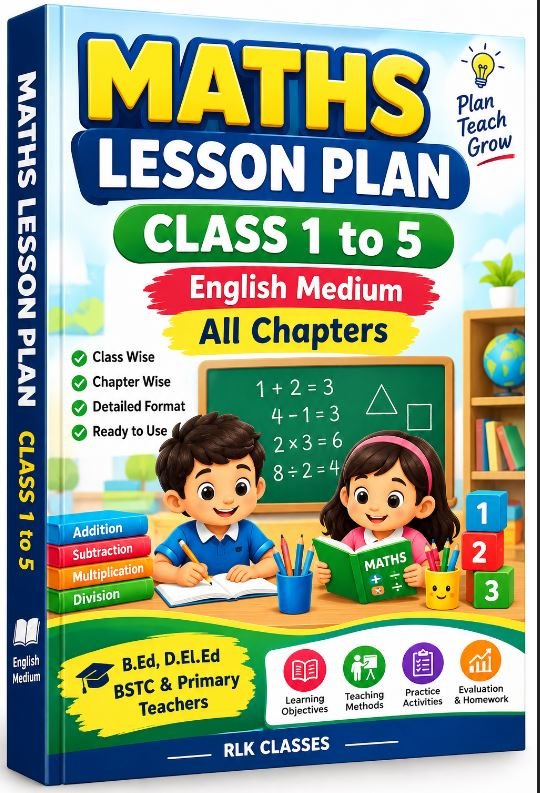
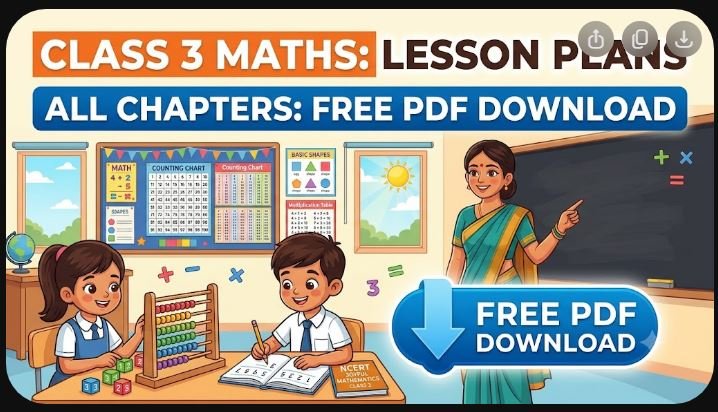
Maths Lesson Plan Class 3 English Medium
Class 3 Mathematics Lesson Plans | NCERT | B.Ed | D.El.Ed | BSTC | Primary Teachers
📚 Maths Lesson Plan Class 3 (All Chapters) PDF Download – NCERT English Medium
Maths Lesson Plan Class 3 English Medium प्राथमिक स्तर के विद्यार्थियों को Mathematics पढ़ाने के लिए एक उपयोगी teaching resource है। यह पोस्ट B.Ed, D.El.Ed, BSTC students, teacher trainees और primary school teachers को ध्यान में रखकर तैयार की गई है।
Class 3 में बच्चे numbers, addition, subtraction, multiplication, division, shapes, measurement, patterns और daily-life mathematical situations के बारे में अधिक व्यवस्थित ढंग से सीखते हैं। एक अच्छी lesson plan teacher को objectives, classroom activities, presentation और evaluation की तैयारी करने में सहायता करती है।
Maths Lesson Plan Class 3 (All Chapters) PDF Download – NCERT English Medium
📌 Maths Lesson Plan Class 3 – Quick Information
🎯 What Is a Class 3 Maths Lesson Plan?
A Mathematics Lesson Plan for Class 3 is a step-by-step teaching guide that helps teachers organise classroom instruction, explain mathematical concepts and assess students’ learning.
इसमें teaching objectives, previous knowledge, teaching-learning materials, introduction questions, detailed presentation, teacher-pupil activities, blackboard work, evaluation और homework जैसे sections शामिल किए जा सकते हैं।
📝 What Is Included in the Lesson Plan?
- General Information and Subject Details
- Learning Objectives and Learning Outcomes
- Previous Knowledge of Students
- Teaching-Learning Materials
- Introduction with Questions and Answers
- Step-by-Step Teaching Presentation
- Teacher and Student Activities
- Blackboard Summary
- Classroom Practice and Activities
- Evaluation Questions
- Homework and Follow-Up Work
📊 Important Learning Areas in Class 3 Mathematics
| Learning Area | Learning Focus | Suggested Activity |
|---|---|---|
| Numbers | Number recognition, place value and comparison | Number cards and place-value chart |
| Addition | Adding numbers in practical situations | Counting objects and solving word problems |
| Subtraction | Taking away and finding differences | Object-based subtraction |
| Multiplication | Equal groups and repeated addition | Grouping pencils, counters or blocks |
| Division | Sharing quantities equally | Distributing objects among groups |
| Shapes and Patterns | Recognising shapes and continuing patterns | Shape cards and pattern games |
| Measurement | Comparing length, weight and capacity | Classroom object comparison |
| Time and Money | Everyday time and money situations | Clock and pretend-shop activity |
📖 Maths Lesson Plan Class 3– Chapter-Wise Content
Class 3 Mathematics Lesson Plans
NCERT Maths Mela | English Medium
All 14 Chapters | Detailed Teaching Plans | Printable Format
Academic Session 2026–27
Chapter-wise Lesson Plan Index
Chapter 1: What’s in a Name? Maths Lesson Plan Class 3
| Subject | Mathematics (Maths Lesson Plan Class 3) |
| Class | III |
| Topic | What’s in a Name? – Counting, Number Names and Organising Information |
| Duration | 40 minutes |
| Teaching Method | Activity-based, discussion, demonstration and learning by doing |
| General Objectives | To develop interest in mathematics; to improve observation, counting, classification and logical thinking; to connect mathematical learning with everyday classroom situations. |
| Specific Objectives | Students will be able to count objects accurately, arrange objects into groups, record quantities using numerals or tally marks, read simple number names and explain how organised counting makes information easier to understand. |
| Teaching Aids | Number cards, classroom objects, counters, pencils, buttons, picture cards, chalkboard and worksheet. |
| Previous Knowledge | Students can count familiar objects, recognise basic numerals and answer simple questions about quantities. |
Introduction – Previous Knowledge Testing
| Q1. Teacher | How many fingers do you have on one hand? |
| Student | Five fingers. |
| Q2. Teacher | How many students are sitting in your group? |
| Student | Students count and tell the number. |
| Q3. Teacher | What do we use to write a number? |
| Student | We use numerals. |
| Q4. Teacher | How can we count a large number of pencils without missing any? |
| Student | We can arrange them in groups. |
| Q5. Teacher | Can we write the number of books in our classroom? |
| Student | Yes, we can count and write the number. |
| Statement of Aim | Today we will learn how counting, grouping and writing number information help us organise and understand quantities. |
| Presentation | Teacher introduces the lesson through classroom objects and guided counting activities. |
Presentation –
| Teaching Point | Pupil-Teacher Activity | Pupil Activity |
|---|---|---|
| 1. Counting objects | Teacher asks: “How many pencils are placed on this table?” The teacher invites learners to touch or move each pencil while counting aloud. The teacher explains that one object must be counted only once. | Students count the pencils one by one, compare their answers and explain how they avoided counting an object twice. |
| 2. Grouping quantities | Teacher asks: “If we have many buttons, how can we count them easily?” The teacher makes small groups and demonstrates how grouping helps us keep track of a quantity. | Students arrange counters into groups, count each group and combine the totals. |
| 3. Recording a count | Teacher asks: “How can we remember the number of red and blue counters?” The teacher records the categories and quantities on the board using numerals and simple tally marks. | Students record the number of counters in each category and check their records against the actual objects. |
| 4. Reading number information | Teacher asks: “Which group has more objects? How do you know?” The teacher guides learners to read the recorded numbers and compare the quantities. | Students identify the group with more or fewer objects and support their answer with the recorded count. |
| 5. Using counting in daily life | Teacher asks: “Where do people count objects outside school?” The teacher discusses counting fruits, books, tickets and items in a shop. | Students give everyday examples and explain why accurate counting is useful. |
Blackboard Work
Counting and Organising Information
Count carefully: one object = one count.
Group objects to make counting easier.
Record the quantity using numerals or tally marks.
Compare the recorded quantities to find more or fewer.
| Evaluation | 1. Why should we count objects carefully? 2. How can grouping help us? 3. What is a numeral? 4. If one group has 8 counters and another has 5, which has more? 5. Name one situation in which counting is useful. |
| Homework | Count five kinds of objects at home. Write the name of each object and its quantity in a table. Draw one group of objects and write the total number below it. |
Chapter 2: Toy Joy Maths Lesson Plan Class 3
| Subject | Mathematics |
| Class | III |
| Topic | Recognising, Describing and Sorting Shapes through Toys |
| Duration | 40 minutes |
| Teaching Method | Demonstration, observation, discussion and hands-on activity |
| General Objectives | To develop spatial awareness, observation and the ability to identify mathematical shapes in familiar objects. |
| Specific Objectives | Students will identify common flat and solid shapes, describe simple features, sort objects by shape and relate geometric forms to toys and objects in their surroundings. |
| Teaching Aids | Toy blocks, ball, box, cone-shaped object, shape cards, paper cut-outs and classroom objects. |
| Previous Knowledge | Students have seen common objects such as balls, boxes, plates, wheels and building blocks. |
Introduction – Previous Knowledge Testing
| Q1. Teacher | Which toy do you like to play with? |
| Student | Students name their favourite toys. |
| Q2. Teacher | What is the shape of a ball? |
| Student | It is round like a sphere. |
| Q3. Teacher | Which object looks like a box? |
| Student | A gift box or a building block. |
| Q4. Teacher | Can a ball roll? |
| Student | Yes, a ball can roll. |
| Q5. Teacher | Can we sort toys according to their shapes? |
| Student | Yes, we can group similar shapes together. |
| Statement of Aim | Today we will explore shapes by observing toys, describing their features and grouping objects that have similar shapes. |
Presentation –
| Teaching Point | Pupil-Teacher Activity | Pupil Activity |
|---|---|---|
| 1. Observing toys | Teacher asks: “What do you notice about this ball, box and toy block?” The teacher displays the objects and encourages learners to describe their appearance and surfaces. | Students observe, touch and describe the objects using words such as round, flat, curved and box-shaped. |
| 2. Flat shapes | Teacher asks: “How many sides can you see on this square cut-out?” The teacher shows a circle, triangle, rectangle and square and discusses their visible features. | Students count sides and corners where applicable and compare the shapes. |
| 3. Solid shapes | Teacher asks: “Which object can roll easily—a ball or a flat card?” The teacher demonstrates how a sphere differs from a flat shape and displays a box-shaped solid. | Students predict, test and describe which objects roll, slide or stand on a flat surface. |
| 4. Sorting objects | Teacher asks: “How can we arrange these toys into groups?” The teacher invites learners to make groups based on shape or a shared feature. | Students sort the toys, explain their grouping rule and check whether each object belongs in the selected group. |
| 5. Shapes around us | Teacher asks: “Can you find a shape like a circle or rectangle in our classroom?” The teacher guides learners to look at a clock, book, board and other familiar objects. | Students name objects and identify the shapes they resemble. |
Blackboard Work
Shapes and Toys
Circle – round, with no corners.
Triangle – 3 sides and 3 corners.
Square – 4 equal sides.
Rectangle – 4 sides; opposite sides are equal.
Sphere and box-shaped solids are found in toys and everyday objects.
| Evaluation | 1. Name one round object. 2. How many sides does a triangle have? 3. Name an object shaped like a box. 4. Which solid shape resembles a ball? 5. Name two objects that resemble a rectangle. |
| Homework | Draw four toys or household objects. Write the shape each object resembles and group your drawings into similar shapes. |
Chapter 3: Double CenturyMathematics Lesson Plan | Class 3
| Subject | Mathematics |
| Class | III |
| Topic | Numbers up to 200, Number Sequence and Place Value |
| Duration | 40 minutes |
| Teaching Method | Demonstration, number-card activity, questioning and guided practice |
| General Objectives | To strengthen number sense, counting skills and understanding of how numbers represent quantities. |
| Specific Objectives | Students will read and write numbers up to 200, count forward and backward, identify hundreds, tens and ones in suitable numbers and compare quantities using number knowledge. |
| Teaching Aids | Number line, bundles of sticks, place-value cards, counters, number chart and worksheets. |
| Previous Knowledge | Students can count, recognise two-digit numbers and understand groups of tens and ones. |
Introduction – Previous Knowledge Testing
| Q1. Teacher | What number comes after 99? |
| Student | 100. |
| Q2. Teacher | How many tens make 100? |
| Student | Ten tens. |
| Q3. Teacher | Which is greater, 45 or 54? |
| Student | 54 is greater. |
| Q4. Teacher | What number comes before 120? |
| Student | 119. |
| Q5. Teacher | Can you read the number 100? |
| Student | One hundred. |
| Statement of Aim | Today we will explore numbers up to 200 and understand how hundreds, tens and ones help us read and write numbers. |
Presentation –
| Teaching Point | Pupil-Teacher Activity | Pupil Activity |
|---|---|---|
| 1. Crossing 100 | Teacher asks: “If we count 98, 99, what comes next?” The teacher uses a number line to show how counting continues beyond 99. | Students say 100, 101, 102 and continue the sequence with teacher support. |
| 2. Reading numbers | Teacher asks: “How do we read 146?” The teacher models reading numbers slowly and connects the spoken name with the written numeral. | Students read numbers from cards and write dictated numbers in their notebooks. |
| 3. Hundreds, tens and ones | Teacher asks: “In 135, how many hundreds, tens and ones are there?” The teacher uses a place-value chart and bundles or counters to demonstrate the value of each digit. | Students represent 135 as 1 hundred, 3 tens and 5 ones and practise with other numbers. |
| 4. Number comparison | Teacher asks: “Which is greater, 128 or 182? How can we decide?” The teacher compares hundreds first, then tens and ones when necessary. | Students compare pairs of numbers and explain the place-value reasoning behind their answers. |
| 5. Number sequence | Teacher asks: “What numbers are missing: 146, 147, __, __, 150?” The teacher gives forward and backward counting patterns. | Students complete sequences, identify missing numbers and create one sequence for a partner. |
Blackboard Work
Numbers up to 200
100 = One hundred
135 = 1 hundred + 3 tens + 5 ones
146 comes before 147.
182 is greater than 128.
Number sequences increase or decrease according to the counting pattern.
| Evaluation | 1. What comes after 199? 2. Write 157 in words. 3. How many hundreds are there in 143? 4. Which is greater: 126 or 162? 5. Complete: 171, 172, __, __. |
| Homework | Write number names for ten numbers between 100 and 200. Choose any three numbers and show their hundreds, tens and ones in a place-value chart. |
Chapter 4: Vacation with My Nani Maa
Maths Lesson Plan Class 3
| Subject | Mathematics |
| Class | III |
| Topic | Addition and Subtraction in Everyday Situations |
| Duration | 40 minutes |
| Teaching Method | Storytelling, demonstration, problem-solving and guided practice |
| General Objectives | To develop computational ability and help learners use addition and subtraction to solve practical problems. |
| Specific Objectives | Students will identify when to add or subtract, solve simple story problems, represent calculations using objects or number sentences and explain the steps used to find an answer. |
| Teaching Aids | Picture cards, counters, number line, toy fruits, travel-story cards and worksheets. |
| Previous Knowledge | Students can count objects and solve simple addition and subtraction problems using small numbers. |
Introduction – Previous Knowledge Testing
| Q1. Teacher | If you have 5 mangoes and get 3 more, how many mangoes do you have? |
| Student | 8 mangoes. |
| Q2. Teacher | What happens to a quantity when some objects are taken away? |
| Student | The quantity becomes smaller. |
| Q3. Teacher | What sign do we use for addition? |
| Student | The plus sign (+). |
| Q4. Teacher | What sign do we use for subtraction? |
| Student | The minus sign (−). |
| Q5. Teacher | Where might we add or subtract during a visit to a relative’s home? |
| Student | While counting fruits, toys or other things. |
| Statement of Aim | Today we will use addition and subtraction to solve everyday problems through a story about a family vacation. |
Presentation –
| Teaching Point | Pupil-Teacher Activity | Pupil Activity |
|---|---|---|
| 1. Understanding the story | Teacher asks: “If Nani Maa has 24 guavas and buys 10 more, will the total increase or decrease?” The teacher tells a short story and asks learners to identify the quantities. | Students listen, identify the starting quantity and the quantity added, and predict that the total will increase. |
| 2. Addition with objects | Teacher asks: “How many guavas are there altogether: 24 and 10?” The teacher groups counters and shows that adding ten increases the tens by one. | Students combine groups and write 24 + 10 = 34. |
| 3. Subtraction in context | Teacher asks: “If 34 guavas are available and 6 are given to visitors, how many remain?” The teacher removes six counters and records the calculation. | Students take away six counters, count the remainder and write 34 − 6 = 28. |
| 4. Choosing the operation | Teacher asks: “A basket has 18 oranges. Five more are placed in it. Should we add or subtract?” The teacher discusses clue words while reminding learners to understand the story, not rely only on one word. | Students identify that the quantity increases and solve 18 + 5 = 23. |
| 5. Solving a story problem | Teacher asks: “There were 40 biscuits. The family ate 12. How many are left?” The teacher guides learners through identifying facts, choosing the operation and checking the answer. | Students write 40 − 12 = 28 and explain how subtraction represents the biscuits eaten. |
Blackboard Work
Addition and Subtraction
24 + 10 = 34
34 − 6 = 28
18 + 5 = 23
40 − 12 = 28
Read the story, identify the quantities, choose the operation and check the answer.
| Evaluation | 1. What is 35 + 10? 2. Solve 42 − 8. 3. A child has 16 shells and finds 7 more. How many shells are there? 4. There are 30 sweets and 9 are eaten. How many remain? 5. How do you decide whether to add or subtract in a story problem? |
| Homework | Write two addition and two subtraction story problems based on a family visit, shopping or a picnic. Solve each problem and write one sentence explaining the operation used. |
Chapter 5: Fun with ShapesMaths Lesson Plan Class 3
| Subject | Mathematics |
| Class | III |
| Topic | Plane Shapes, Solid Shapes and Their Features |
| Duration | 40 minutes |
| Teaching Method | Activity-based learning, observation, drawing and demonstration |
| General Objectives | To improve visual discrimination, spatial understanding and the ability to describe shapes mathematically. |
| Specific Objectives | Students will identify common two-dimensional shapes, recognise simple three-dimensional objects, count sides and corners where applicable, compare shapes and make simple shape pictures. |
| Teaching Aids | Shape cut-outs, blocks, balls, boxes, paper, crayons, clay and classroom objects. |
| Previous Knowledge | Students recognise familiar shapes in objects such as doors, books, balls and plates. |
Introduction – Previous Knowledge Testing
| Q1. Teacher | What is the shape of a wall clock that is round? |
| Student | A circle. |
| Q2. Teacher | How many corners does a triangle have? |
| Student | Three corners. |
| Q3. Teacher | Which shape do we see on the face of many books? |
| Student | A rectangle. |
| Q4. Teacher | What is the shape of a dice? |
| Student | It resembles a cube. |
| Q5. Teacher | Can shapes be combined to make a picture? |
| Student | Yes, different shapes can make a picture. |
| Statement of Aim | Today we will identify and compare shapes, observe their features and use them to create simple designs. |
Presentation –
| Teaching Point | Pupil-Teacher Activity | Pupil Activity |
|---|---|---|
| 1. Recognising flat shapes | Teacher asks: “What is different about a circle and a triangle?” The teacher displays cut-outs and helps learners notice sides and corners. | Students name the shapes, trace their outlines and count sides or corners where present. |
| 2. Comparing shapes | Teacher asks: “How is a square different from a rectangle?” The teacher compares their sides and corners and explains that both have four corners. | Students compare shape cards and describe similarities and differences in their own words. |
| 3. Solid objects | Teacher asks: “Which object looks like a cube, and which looks like a sphere?” The teacher demonstrates a block and a ball and allows learners to examine them. | Students match objects to solid shapes and describe whether they roll, slide or have flat faces. |
| 4. Making shapes | Teacher asks: “Can you make a triangle using three sticks?” The teacher provides sticks or strips and demonstrates joining endpoints. | Students make triangles, squares or rectangles and count the sides of each shape. |
| 5. Shape design | Teacher asks: “Can you make a house using a square, triangle and rectangle?” The teacher models a simple design and encourages learners to choose shapes independently. | Students create a picture using cut-outs, identify the shapes used and explain their arrangement. |
Blackboard Work
Fun with Shapes
Triangle: 3 sides and 3 corners.
Square: 4 equal sides and 4 corners.
Rectangle: 4 sides and 4 corners.
Circle: round boundary, no corners.
Cube, sphere and cylinder are examples of solid shapes.
| Evaluation | 1. How many sides does a triangle have? 2. Name a solid object shaped like a sphere. 3. How many corners does a square have? 4. Name one object shaped like a cylinder. 5. Which shapes could you use to make a house picture? |
| Homework | Make a picture using at least four different shapes. Label the shapes and write one feature of each shape used in the picture. |
Chapter 6: House of Hundreds – IMaths Lesson Plan Class 3
| Subject | Mathematics |
| Class | III |
| Topic | Hundreds, Tens, Ones and Place Value |
| Duration | 40 minutes |
| Teaching Method | Concrete material, place-value demonstration, guided practice and questioning |
| General Objectives | To build a clear understanding of place value and the relationship between ones, tens and hundreds. |
| Specific Objectives | Students will make groups of ten, exchange ten tens for one hundred, represent three-digit numbers and explain the value of digits according to their position. |
| Teaching Aids | Sticks, rubber bands, bundles of ten, base-ten blocks, place-value chart and number cards. |
| Previous Knowledge | Students can count in ones and tens and recognise two-digit numbers. |
Introduction – Previous Knowledge Testing
| Q1. Teacher | How many ones make one ten? |
| Student | Ten ones. |
| Q2. Teacher | How many tens make one hundred? |
| Student | Ten tens. |
| Q3. Teacher | What is the value of 4 in forty-two? |
| Student | It represents four tens, or 40. |
| Q4. Teacher | What number comes after 199? |
| Student | 200. |
| Q5. Teacher | Can we make a number using hundreds, tens and ones? |
| Student | Yes, by combining the groups. |
| Statement of Aim | Today we will build numbers using hundreds, tens and ones and understand how the position of a digit gives it a value. |
Presentation –
| Teaching Point | Pupil-Teacher Activity | Pupil Activity |
|---|---|---|
| 1. Making tens | Teacher asks: “If we have ten loose sticks, how can we make them easier to count?” The teacher ties ten sticks together to make a bundle. | Students count the sticks, make bundles of ten and explain why bundles are easier to count than many loose sticks. |
| 2. Making hundreds | Teacher asks: “How many bundles of ten make one hundred?” The teacher arranges ten bundles and connects them to the number 100. | Students count ten bundles, state the total and represent one hundred with a place-value card. |
| 3. Building a number | Teacher asks: “How can we show 124 using hundreds, tens and ones?” The teacher places one hundred, two tens and four ones in a chart. | Students make 124 using blocks and state that it contains 1 hundred, 2 tens and 4 ones. |
| 4. Digit value | Teacher asks: “In 142, what does the digit 4 represent?” The teacher shows that the middle digit is in the tens place and has a value of 40. | Students identify the hundreds, tens and ones positions in several numbers. |
| 5. Number representation | Teacher asks: “Can you write 136 in expanded form?” The teacher models 100 + 30 + 6 and asks learners to explain each part. | Students use blocks and write expanded forms of numbers such as 125 and 148. |
Blackboard Work
House of Hundreds – I
10 ones = 1 ten
10 tens = 1 hundred
124 = 1 hundred + 2 tens + 4 ones
124 = 100 + 20 + 4
The value of a digit depends on its place.
| Evaluation | 1. How many tens make one hundred? 2. Write 135 in expanded form. 3. What is the value of 6 in 164? 4. Represent 121 using hundreds, tens and ones. 5. Write the number for 1 hundred, 5 tens and 3 ones. |
| Homework | Draw a place-value chart for five three-digit numbers. Write each number in standard form and expanded form and label the hundreds, tens and ones. |
Chapter 7: Raksha BandhanMathematics Lesson Plan | Class 3
| Subject | Mathematics |
| Class | III |
| Topic | Equal Groups, Repeated Addition and Introduction to Multiplication |
| Duration | 40 minutes |
| Teaching Method | Storytelling, grouping activity, demonstration and guided practice |
| General Objectives | To develop early multiplication understanding through equal groups and repeated addition. |
| Specific Objectives | Students will make equal groups, count objects in groups, express equal groups as repeated addition and connect the repeated addition to simple multiplication statements. |
| Teaching Aids | Rakhi pictures, beads, counters, paper plates, number cards and grouping mats. |
| Previous Knowledge | Students can count objects, add small numbers and arrange objects in groups. |
Introduction – Previous Knowledge Testing
| Q1. Teacher | If you have 2 beads and get 2 more, how many beads do you have? |
| Student | 4 beads. |
| Q2. Teacher | Can we arrange beads in equal groups? |
| Student | Yes, we can make equal groups. |
| Q3. Teacher | How many beads are there in two groups of three? |
| Student | Six beads. |
| Q4. Teacher | What is 3 + 3? |
| Student | 6. |
| Q5. Teacher | Where do we see equal groups in daily life? |
| Student | In plates, packets, rows or groups of objects. |
| Statement of Aim | Today we will use a Raksha Bandhan activity to learn how equal groups can be counted using repeated addition. |
Presentation –
| Teaching Point | Pupil-Teacher Activity | Pupil Activity |
|---|---|---|
| 1. Making equal groups | Teacher asks: “If each rakhi needs four beads, how many beads should we place in one group?” The teacher models a group and asks learners to make matching groups. | Students place four counters in each group and check that every group contains the same number. |
| 2. Counting groups | Teacher asks: “If there are three groups with four beads in each, how can we count all the beads?” The teacher counts four, eight, twelve by adding four repeatedly. | Students count each group and state the total as 4 + 4 + 4 = 12. |
| 3. Repeated addition | Teacher asks: “What addition sentence describes five groups of two?” The teacher arranges five pairs of counters and writes the repeated addition. | Students write 2 + 2 + 2 + 2 + 2 = 10 and explain how the groups are equal. |
| 4. Connecting multiplication | Teacher asks: “How many objects are there in four groups of three?” The teacher links repeated addition to 4 groups of 3 and introduces 4 × 3 = 12 as a short way to record the equal groups. | Students represent the groups with counters and match the picture to the multiplication statement. |
| 5. Applying the idea | Teacher asks: “If six children each receive two sweets, how many sweets are needed?” The teacher asks learners to draw groups before calculating. | Students draw six groups of two, write 2 + 2 + 2 + 2 + 2 + 2 = 12 and state the total. |
Blackboard Work
Equal Groups
3 groups of 4 = 4 + 4 + 4 = 12
5 groups of 2 = 2 + 2 + 2 + 2 + 2 = 10
4 groups of 3 = 4 × 3 = 12
Equal groups contain the same number of objects.
| Evaluation | 1. What is an equal group? 2. Write repeated addition for three groups of five. 3. How many objects are in four groups of two? 4. Draw two groups of six counters. 5. How can multiplication help us count equal groups? |
| Homework | Draw four examples of equal groups using household objects or pictures. Write the repeated addition sentence and total for each example. |
Chapter 8: Fair ShareMaths Lesson Plan Class 3
| Subject | Mathematics |
| Class | III |
| Topic | Equal Sharing, Grouping and Introduction to Division |
| Duration | 40 minutes |
| Teaching Method | Practical activity, demonstration, problem-solving and peer learning |
| General Objectives | To develop fairness, logical thinking and understanding of equal distribution through mathematical activities. |
| Specific Objectives | Students will distribute objects equally among people or groups, check whether each group has the same number and connect equal sharing with simple division situations. |
| Teaching Aids | Counters, paper plates, pencils, picture cards, small baskets and worksheets. |
| Previous Knowledge | Students can count objects and recognise equal groups from familiar activities. |
Introduction – Previous Knowledge Testing
| Q1. Teacher | If four sweets are shared between two children equally, how many does each get? |
| Student | Two sweets each. |
| Q2. Teacher | What does sharing equally mean? |
| Student | Everyone gets the same number. |
| Q3. Teacher | Can 6 pencils be shared equally between 3 children? |
| Student | Yes, each gets 2 pencils. |
| Q4. Teacher | How can we check whether a share is fair? |
| Student | We compare the number each person receives. |
| Q5. Teacher | Where might we need to share objects equally? |
| Student | When sharing food, pencils or toys. |
| Statement of Aim | Today we will practise fair sharing by distributing objects equally and recording how many each group receives. |
Presentation –
| Teaching Point | Pupil-Teacher Activity | Pupil Activity |
|---|---|---|
| 1. Meaning of fair share | Teacher asks: “If two children receive different numbers of sweets, is the sharing equal?” The teacher demonstrates unequal shares and invites learners to explain the problem. | Students compare the groups and state that equal sharing means each person receives the same number. |
| 2. Sharing one by one | Teacher asks: “How can we share eight counters equally among four children?” The teacher gives one counter at a time to each group until all counters are distributed. | Students distribute the counters and count two counters in each group. |
| 3. Recording the result | Teacher asks: “If eight counters are shared among four children, how many does each child get?” The teacher writes the situation as 8 ÷ 4 = 2. | Students match the division sentence with their counters and explain the meaning of each number in the situation. |
| 4. Equal grouping | Teacher asks: “Can twelve counters be placed into groups of three?” The teacher guides learners to make groups of three and count how many groups are formed. | Students make four groups of three and describe the grouping in words. |
| 5. Checking fairness | Teacher asks: “How can we prove that our sharing is fair?” The teacher asks learners to compare the groups and recount the objects. | Students check that every group has the same number and correct their distribution if needed. |
Blackboard Work
Fair Share
8 counters shared by 4 children = 2 each
8 ÷ 4 = 2
12 counters grouped in threes = 4 groups
Equal sharing means each share contains the same quantity.
| Evaluation | 1. What does equal sharing mean? 2. Share 10 counters equally among 2 children. 3. How many does each child get when 12 pencils are shared among 4 children? 4. Make groups of 3 using 9 counters. 5. How do you check whether sharing is fair? |
| Homework | Draw 12 objects and share them equally among 3 children. Draw the groups, write how many each child gets and explain how you checked your answer. |
Chapter 9: House of Hundreds – IIMaths Lesson Plan Class 3
| Subject | Mathematics |
| Class | III |
| Topic | Reading, Comparing, Ordering and Representing Three-Digit Numbers |
| Duration | 40 minutes |
| Teaching Method | Number-card activity, place-value demonstration, discussion and guided practice |
| General Objectives | To strengthen number sense and help learners understand how three-digit numbers can be compared and arranged in order. |
| Specific Objectives | Students will read and write three-digit numbers, identify place values, compare numbers using their digits and arrange given numbers in ascending or descending order. |
| Teaching Aids | Number cards, place-value chart, number line, counters and worksheets. |
| Previous Knowledge | Students know hundreds, tens and ones and can represent three-digit numbers using place-value charts. |
Introduction – Previous Knowledge Testing
| Q1. Teacher | How many digits are there in 246? |
| Student | Three digits. |
| Q2. Teacher | What is the value of 2 in 246? |
| Student | 200. |
| Q3. Teacher | Which is greater, 145 or 154? |
| Student | 154 is greater. |
| Q4. Teacher | What does ascending order mean? |
| Student | Arranging from smallest to largest. |
| Q5. Teacher | What does descending order mean? |
| Student | Arranging from largest to smallest. |
| Statement of Aim | Today we will compare and arrange three-digit numbers by examining their hundreds, tens and ones. |
Presentation –
| Teaching Point | Pupil-Teacher Activity | Pupil Activity |
|---|---|---|
| 1. Reading numbers | Teacher asks: “How do we read 236?” The teacher displays the number and guides learners to read it as two hundred and thirty-six. | Students read several three-digit numbers and write the matching numerals when number names are dictated. |
| 2. Comparing hundreds | Teacher asks: “Which number is greater, 325 or 425?” The teacher compares the hundreds digits first and explains that four hundreds are more than three hundreds. | Students compare numbers with different hundreds digits and use greater-than or less-than language. |
| 3. Comparing tens and ones | Teacher asks: “How can we compare 243 and 248?” The teacher shows that when hundreds and tens are equal, the ones digits can decide the comparison. | Students compare numbers with the same hundreds and tens and explain the role of the final digit. |
| 4. Ascending order | Teacher asks: “How would you arrange 156, 132 and 148 from smallest to largest?” The teacher models comparing the numbers before placing them in order. | Students arrange the numbers as 132, 148, 156 and explain why the smallest comes first. |
| 5. Descending order | Teacher asks: “Can you arrange 219, 291 and 192 from largest to smallest?” The teacher guides learners to compare hundreds, then tens and ones. | Students arrange the numbers as 291, 219, 192 and check the order by comparing neighbouring numbers. |
Blackboard Work
Comparing Three-Digit Numbers
325 < 425
243 < 248
Ascending: 132, 148, 156
Descending: 291, 219, 192
Compare hundreds first, then tens, then ones.
| Evaluation | 1. Which is greater: 325 or 352? 2. Arrange 146, 164 and 126 in ascending order. 3. Arrange 219, 291 and 192 in descending order. 4. What is the value of 7 in 372? 5. How do we compare two numbers with the same hundreds digit? |
| Homework | Write six three-digit numbers. Arrange three in ascending order and the remaining three in descending order. Underline the hundreds digit in every number. |
Chapter 10: Fun at Class Party!Maths Lesson Plan Class 3
| Subject | Mathematics |
| Class | III |
| Topic | Counting, Equal Groups, Addition and Using Numbers in a Party Situation |
| Duration | 40 minutes |
| Teaching Method | Role-play, activity-based learning, group work and problem-solving |
| General Objectives | To apply number concepts to familiar social situations and develop cooperation and mathematical reasoning. |
| Specific Objectives | Students will count party items, calculate simple totals, make equal groups, solve simple sharing situations and explain their calculations using objects or drawings. |
| Teaching Aids | Paper plates, toy fruits, counters, invitation cards, number cards and party-item pictures. |
| Previous Knowledge | Students can count objects, add small quantities and recognise equal groups. |
Introduction – Previous Knowledge Testing
| Q1. Teacher | What things might we need for a class party? |
| Student | Plates, cups, snacks and decorations. |
| Q2. Teacher | If we place 5 plates on a table and 4 more on another, how many plates are there? |
| Student | 9 plates. |
| Q3. Teacher | Why should we count the cups before serving drinks? |
| Student | So we know whether there are enough cups. |
| Q4. Teacher | Can we place plates in equal groups? |
| Student | Yes, we can arrange them equally. |
| Q5. Teacher | How can mathematics help us organise a party? |
| Student | We can count, add and share items correctly. |
| Statement of Aim | Today we will use mathematics to count, organise and share items for a class party. |
Presentation –
| Teaching Point | Pupil-Teacher Activity | Pupil Activity |
|---|---|---|
| 1. Counting party items | Teacher asks: “There are 18 paper cups on this table. How can we check the count?” The teacher encourages one-to-one counting and recording. | Students count the cups carefully, record 18 and check the total with a partner. |
| 2. Adding quantities | Teacher asks: “If we bring 12 more cups, how many cups will we have?” The teacher uses counters to model 18 + 12. | Students combine the two groups and calculate 30 cups altogether. |
| 3. Making groups | Teacher asks: “If each table needs 4 plates, how many plates are needed for three tables?” The teacher places four plates in each of three groups. | Students count the groups and write 4 + 4 + 4 = 12 plates. |
| 4. Sharing party snacks | Teacher asks: “How can 20 snacks be shared equally among five groups?” The teacher demonstrates distributing counters one at a time. | Students make five equal groups and state that each group receives four snacks. |
| 5. Checking the plan | Teacher asks: “If 30 cups are available for 28 children, are there enough cups?” The teacher asks learners to compare the number of cups with the number of children. | Students compare 30 and 28 and explain that there are enough cups, with two left over. |
Blackboard Work
Mathematics at a Class Party
18 + 12 = 30 cups
3 groups of 4 plates = 12 plates
20 snacks shared by 5 groups = 4 each
30 cups − 28 children = 2 extra cups
| Evaluation | 1. What is 18 + 12? 2. How many plates are needed for 4 tables if each needs 5? 3. Share 15 snacks equally among 3 groups. 4. Are 25 cups enough for 27 children? Explain. 5. Name two ways mathematics helps organise a party. |
| Homework | Plan a small class party for 10 children. Write how many plates, cups and snacks you would need if each child receives one plate, one cup and two snacks. Show your calculations. |
Chapter 11: Filling and LiftingMathematics Lesson Plan | Class 3
| Subject | Mathematics |
| Class | III |
| Topic | Capacity, Weight, Comparing Quantities and Measurement |
| Duration | 40 minutes |
| Teaching Method | Demonstration, estimation, practical measurement and discussion |
| General Objectives | To develop measurement sense and help learners compare how much containers hold and how heavy objects feel. |
| Specific Objectives | Students will compare container capacities, estimate and test which container holds more, compare the weight of familiar objects and use appropriate words for measurement. |
| Teaching Aids | Empty containers, cups, water or dry grains, weighing scale if available, school bag, books and small objects. |
| Previous Knowledge | Students can compare objects as big or small, heavy or light, and have seen water being poured into containers. |
Introduction – Previous Knowledge Testing
| Q1. Teacher | Which is likely to hold more water: a bucket or a small cup? |
| Student | A bucket. |
| Q2. Teacher | Which feels heavier: a book or a sheet of paper? |
| Student | A book. |
| Q3. Teacher | What happens when we pour water from one container into another? |
| Student | The water changes container. |
| Q4. Teacher | Can a large-looking container always hold more than a narrow one? |
| Student | We should test and compare their capacity. |
| Q5. Teacher | What tool can help us compare the weight of objects? |
| Student | A weighing scale or balance. |
| Statement of Aim | Today we will explore capacity and weight by estimating, comparing and testing familiar objects and containers. |
Presentation –
| Teaching Point | Pupil-Teacher Activity | Pupil Activity |
|---|---|---|
| 1. Comparing capacity | Teacher asks: “Which container do you think will hold more water?” The teacher shows two different containers and asks learners to make a prediction before testing. | Students observe the containers, make predictions and explain the reasons for their choices. |
| 2. Testing capacity | Teacher asks: “How can we check which container holds more?” The teacher uses the same cup to fill each container and compares the number of cups needed. | Students count the cupfuls, record the results and identify which container holds more in the activity. |
| 3. Estimating before measuring | Teacher asks: “How many small cups of water might fill this jug?” The teacher encourages estimation and then checks the estimate through a practical demonstration. | Students estimate a quantity, perform the activity and compare their estimate with the observed result. |
| 4. Comparing weight | Teacher asks: “Which feels heavier, a notebook or an eraser?” The teacher asks learners to compare safely by holding the objects and, if available, using a balance. | Students compare objects, state which is heavier or lighter and discuss why appearance alone may not tell us the weight. |
| 5. Choosing a suitable container | Teacher asks: “Would you use a tiny cup or a bucket to store water for a family?” The teacher relates capacity to real-life needs and discusses choosing an appropriate container. | Students select suitable containers for different tasks and justify their choices using capacity language. |
Blackboard Work
Filling and Lifting
Capacity tells us how much a container can hold.
Compare capacity using the same measuring cup.
Weight tells us how heavy an object is.
Use words: more, less, heavier and lighter.
Estimate first, then test and record the result.
| Evaluation | 1. What does capacity mean? 2. Which holds more: a bucket or a cup? 3. How can we compare two containers fairly? 4. Name one tool used to measure weight. 5. Why should we test our estimate? |
| Homework | Find three containers at home. Estimate which holds the most and which holds the least. If permitted, compare them using the same cup and record your findings. |
Chapter 12: Give and TakeMaths Lesson Plan Class 3
| Subject | Mathematics |
| Class | III |
| Topic | Addition, Subtraction and Mental Strategies for Problem-Solving |
| Duration | 40 minutes |
| Teaching Method | Number-line activity, role-play, demonstration and problem-solving |
| General Objectives | To improve calculation skills and encourage learners to choose sensible strategies for everyday numerical problems. |
| Specific Objectives | Students will solve addition and subtraction situations, use number lines or objects to support calculations, identify changes in quantities and check whether an answer is reasonable. |
| Teaching Aids | Number line, counters, number cards, toy money, picture cards and worksheets. |
| Previous Knowledge | Students can add and subtract small quantities and understand the ideas of gaining and giving away objects. |
Introduction – Previous Knowledge Testing
| Q1. Teacher | If you have 15 pencils and receive 5 more, how many do you have? |
| Student | 20 pencils. |
| Q2. Teacher | If you have 20 pencils and give away 4, how many remain? |
| Student | 16 pencils. |
| Q3. Teacher | What does adding more usually do to a quantity? |
| Student | It increases the quantity. |
| Q4. Teacher | What does taking some away usually do? |
| It decreases the quantity. | |
| Q5. Teacher | How can a number line help us calculate? |
| Student | We can move forward or backward along it. |
| Statement of Aim | Today we will solve give-and-take problems using addition and subtraction and learn to check our answers. |
Presentation –
| Teaching Point | Pupil-Teacher Activity | Pupil Activity |
|---|---|---|
| 1. Adding what we receive | Teacher asks: “Riya has 27 stickers and receives 12 more. How many stickers does she have now?” The teacher models the calculation with counters or a number line. | Students add 27 and 12, record 39 and explain that receiving more increases the quantity. |
| 2. Subtracting what we give | Teacher asks: “A box has 45 crayons. If 13 are given to students, how many remain?” The teacher removes a group of counters and writes the number sentence. | Students calculate 45 − 13 = 32 and explain what the remaining number represents. |
| 3. Using a number line | Teacher asks: “Starting at 36, where do we land after moving 8 steps forward?” The teacher demonstrates forward movement for addition and backward movement for subtraction. | Students move counters or point along the number line and state the resulting number. |
| 4. Selecting a strategy | Teacher asks: “For 29 + 10, is it helpful to count every number from 29?” The teacher shows that adding ten can be done by moving to 39 and invites learners to explain their method. | Students try different methods, compare them and select a strategy they understand. |
| 5. Checking answers | Teacher asks: “If 50 − 18 is written as 42, does that answer make sense?” The teacher asks learners to estimate and check the calculation using addition or counters. | Students notice that 42 is too large for the stated subtraction, recalculate and obtain 32. |
Blackboard Work
Give and Take
27 + 12 = 39
45 − 13 = 32
36 + 8 = 44
50 − 18 = 32
Check whether the answer matches the story and the expected size of the quantity.
| Evaluation | 1. Solve 36 + 14. 2. Solve 57 − 22. 3. A child has 28 marbles and gets 9 more. How many marbles are there? 4. There are 64 books and 20 are taken away. How many remain? 5. How can you check an answer to a subtraction problem? |
| Homework | Write three addition and three subtraction story problems about giving or receiving objects. Solve them using a number line, counters or written calculations and check each answer. |
Chapter 13: Time Goes OnMaths Lesson Plan Class 3
| Subject | Mathematics |
| Class | III |
| Topic | Days, Months, Calendar, Clock and Sequence of Events |
| Duration | 40 minutes |
| Teaching Method | Calendar activity, clock demonstration, storytelling and discussion |
| General Objectives | To develop awareness of time and help learners organise daily activities in a meaningful sequence. |
| Specific Objectives | Students will name days and months, read simple calendar information, identify the hour and minute hands on a clock and arrange familiar events in chronological order. |
| Teaching Aids | Wall calendar, model clock, event cards, daily timetable and worksheets. |
| Previous Knowledge | Students know that activities happen at different times of the day and are familiar with days of the week. |
Introduction – Previous Knowledge Testing
| Q1. Teacher | What day comes after Monday? |
| Student | Tuesday. |
| Q2. Teacher | How many months are there in a year? |
| Student | Twelve months. |
| Q3. Teacher | What do we use to see the date of a day? |
| Student | A calendar. |
| Q4. Teacher | What do we use to tell the time? |
| Student | A clock or watch. |
| Q5. Teacher | Which usually happens first, breakfast or dinner? |
| Student | Breakfast happens first. |
| Statement of Aim | Today we will learn how calendars, clocks and the order of events help us understand time. |
Presentation –
| Teaching Point | Pupil-Teacher Activity | Pupil Activity |
|---|---|---|
| 1. Days of the week | Teacher asks: “Which day comes before Friday?” The teacher displays the days of the week in order and invites learners to recite them. | Students name the days in sequence and answer before-and-after questions. |
| 2. Months and calendar | Teacher asks: “Where can we find the date of a particular day?” The teacher demonstrates how a calendar is arranged in rows and columns and shows how to locate a date. | Students locate a given date, name its month and identify the day of the week where the calendar provides that information. |
| 3. Reading a clock | Teacher asks: “What does the short hand tell us?” The teacher displays a model clock and explains the roles of the hour hand and minute hand at an introductory level. | Students identify both hands and practise reading simple o’clock times on the model clock. |
| 4. Ordering events | Teacher asks: “What do you usually do first in the morning?” The teacher uses picture cards to discuss morning, afternoon and evening activities. | Students arrange activity cards in a sensible order and explain which event happens earlier or later. |
| 5. Planning a day | Teacher asks: “Why is a timetable helpful?” The teacher demonstrates a simple daily timetable and discusses time for school, meals, play and sleep. | Students prepare a short timetable and identify the time assigned to selected activities. |
Blackboard Work
Time Goes On
7 days = 1 week
12 months = 1 year
A calendar helps us find dates and days.
The short hand shows hours; the long hand shows minutes.
Arrange events from earlier to later.
| Evaluation | 1. How many days are there in a week? 2. Name the month after March. 3. What does the short hand on a clock show? 4. Which comes first, lunch or breakfast? 5. How does a timetable help us? |
| Homework | Draw a simple daily timetable with at least five activities. Write the days of the week in order and use a calendar to record the date of one family event. |
Chapter 14: The Surajkund FairMaths Lesson Plan Class 3
| Subject | Mathematics |
| Class | III |
| Topic | Counting, Classifying, Comparing Information and Solving Fair-Based Problems |
| Duration | 40 minutes |
| Teaching Method | Picture observation, discussion, group activity and problem-solving |
| General Objectives | To help learners collect, organise, compare and interpret simple numerical information from familiar settings. |
| Specific Objectives | Students will classify items into categories, count and record quantities, compare the totals of different categories and use addition or subtraction to answer questions about a fair. |
| Teaching Aids | Fair pictures, picture cards of stalls, counters, tally chart, number cards and worksheets. |
| Previous Knowledge | Students can count objects, compare numbers and solve simple addition and subtraction problems. |
Introduction – Previous Knowledge Testing
| Q1. Teacher | What things might you see at a fair? |
| Student | Stalls, toys, food, clothes and visitors. |
| Q2. Teacher | How can we count the number of stalls selling toys? |
| Student | We can count them and record the total. |
| Q3. Teacher | Why might we group similar stalls together? |
| Student | To organise information and count more easily. |
| Q4. Teacher | If there are 12 toy stalls and 8 food stalls, which group has more? |
| Student | Toy stalls have more. |
| Q5. Teacher | How can we find the total number of stalls in two groups? |
| Student | We can add the two numbers. |
| Statement of Aim | Today we will use a fair as a real-life situation to collect, organise and compare information and solve simple numerical problems. |
Presentation –
| Teaching Point | Pupil-Teacher Activity | Pupil Activity |
|---|---|---|
| 1. Observing and classifying | Teacher asks: “Which kinds of stalls can you identify in this fair picture?” The teacher displays a picture and helps learners classify stalls into groups such as toys, food, clothes and crafts. | Students observe the picture, name categories and place picture cards into suitable groups. |
| 2. Counting and recording | Teacher asks: “How can we record the number of stalls in each group?” The teacher demonstrates a simple table and tally marks and records sample totals. | Students count picture cards, record totals in a table and compare the table with the original picture. |
| 3. Comparing quantities | Teacher asks: “If there are 12 toy stalls and 8 food stalls, how many more toy stalls are there?” The teacher writes the subtraction sentence and explains the comparison. | Students calculate 12 − 8 = 4 and explain that there are four more toy stalls than food stalls. |
| 4. Finding a total | Teacher asks: “If there are 12 toy stalls and 8 food stalls, how many stalls are there altogether?” The teacher models adding the two quantities. | Students write 12 + 8 = 20 and describe the total number of stalls in the two categories. |
| 5. Interpreting information | Teacher asks: “Which category has the fewest stalls, and how can you prove it?” The teacher asks learners to compare all recorded totals and support their answers with evidence from the table. | Students inspect the table, identify the category with the fewest stalls and explain their answer using the recorded numbers. |
Blackboard Work
The Surajkund Fair
Classify similar items into groups.
Record each category in a table.
Toy stalls = 12; Food stalls = 8
Total = 12 + 8 = 20
Difference = 12 − 8 = 4
| Evaluation | 1. Why do we classify stalls into groups? 2. If there are 14 craft stalls and 9 food stalls, how many stalls are there altogether? 3. Which is greater: 16 or 11? 4. If 15 stalls are present and 6 are closed, how many remain open? 5. How does a table help us understand information? |
| Homework | Imagine a fair with toy, food, clothes and craft stalls. Make a table showing a number for each category. Find the total number of stalls and identify the category with the highest and lowest number. |
👨🏫 How to Teach Mathematics in Class 3?
Class 3 के विद्यार्थियों को Mathematics सिखाते समय concepts को real-life examples से जोड़ें। केवल rules याद करवाने के बजाय बच्चों को सवाल हल करने, अनुमान लगाने, चर्चा करने और अपनी reasoning बताने के अवसर दें।
- Previous knowledge से lesson की शुरुआत करें।
- Learning objective बच्चों की समझ के अनुसार स्पष्ट करें।
- Number cards, counters, shapes और classroom objects का प्रयोग करें।
- सरल से कठिन प्रश्नों की ओर बढ़ें।
- Students को pair work और group activities में शामिल करें।
- Lesson के अंत में short evaluation और practice questions दें।
🎲 Class 3 Maths Activity Ideas
Number cards की मदद से hundreds, tens और ones को पहचानने तथा numbers बनाने का अभ्यास करवाएँ।
बच्चों को समान समूहों में objects रखने दें और repeated addition के माध्यम से multiplication समझाएँ।
कंचे, pencils या counters को बच्चों के छोटे समूहों में बराबर बाँटकर division का प्रारंभिक विचार समझाएँ।
Classroom में वस्तुओं की लंबाई या ऊँचाई की तुलना करवाएँ और measurement पर चर्चा करें।
🎓 B.Ed, D.El.Ed & BSTC Students के लिए
Teaching practice और internship के दौरान lesson plan शिक्षक को classroom teaching की व्यवस्थित तैयारी करने में सहायता करती है। Class 3 Maths lesson plan में objectives, teaching aids, introduction, presentation, student participation, blackboard work और evaluation को अपने institute के prescribed format के अनुसार शामिल करें।
🌟 Benefits of a Well-Planned Maths Lesson
🔗 Explore More Lesson Plan Resources
RLK Classes पर primary classes के लिए Maths, EVS, English और Hindi lesson plan resources भी देखें। नीचे दिए गए buttons को संबंधित posts तक पहुँचने के लिए इस्तेमाल करें।
📚 250+ D.El.Ed Lesson Plan PDF – All Subjects
यदि आप Class 1 से 5 तक के लिए 250+ D.El.Ed Lesson Plans की collection खोज रहे हैं, तो इस resource में Maths, Hindi, English और EVS जैसे subjects के lesson plan material की जानकारी देखें।
📘 300+ Lesson Plans Class 1 to 5 English Medium
300+ Lesson Plans Class 1 to 5 English Medium collection उन teacher trainees और teachers के लिए है जिन्हें primary classes के विभिन्न subjects के English-medium lesson planning resources चाहिए। इसमें Class 1, 2, 3, 4 और 5 के लिए subject-wise material की जानकारी प्राप्त करें।
❓ Frequently Asked Questions
यह B.Ed, D.El.Ed, BSTC students, teacher trainees और primary teachers के लिए उपयोगी resource हो सकता है।
Objectives, previous knowledge, teaching materials, introduction, presentation, classroom activities, evaluation और homework जैसे sections शामिल किए जा सकते हैं।
हाँ, RLK Classes की 250+ और 300+ lesson plan collections के लिए ऊपर दिए गए buttons देखें। अपने medium और जरूरत के अनुसार collection चुनें।
इसे तैयारी के reference के रूप में उपयोग करें और अपने institute के format तथा prescribed syllabus के अनुसार आवश्यक बदलाव करें।
📘 Explore Complete Lesson Plan Collections
Class 3 Maths lesson planning के साथ Class 1–5 के अन्य subjects के resources भी देखें।
📌 Conclusion
Maths Lesson Plan Class 3 English Medium एक व्यवस्थित classroom teaching plan तैयार करने में मदद कर सकता है। Activity-based learning, clear objectives, practice questions और evaluation के साथ Mathematics teaching को बच्चों के लिए अधिक engaging बनाया जा सकता है।
Class 1 से 5 के लिए अन्य subjects के lesson plans चाहिए तो ऊपर दिए गए 250+ D.El.Ed और 300+ English Medium collections के links देखें।